What Must We Do To Be Saved?
Only in America could a sex crimes prosecutor lose an election to a sexual predator who campaigned on prosecuting sex crimes.
Such deep and broad doublethink shows what a Christian nation America is.
What must we do to be saved?
Little about our condition is new. For thousands of years people have been in similar predicaments.
What must we do to be saved?
We must stop lying to one another.
We must help one another.
And in order to effectively help one another we must stop lying to ourselves.
The careful reader of the New Testament will notice it has less internal consistency than the works of Tolkien.
Yet for two thousand years people have believed it was a treasure map.

An instruction manual for living happily ever after.
A tree of life, a spring of living water, a fountain of youth.
Paul of Tarsus gave more definition to Jesus’ legacy than all 12 of his hand picked disciples put together.
This shows how much Jesus’ picks were worth.
Yet for two thousand years people have believed Paul was Jesus’ real plan all along.
This shows how much Jesus’ brand is worth.
Jesus is a brand.
Paul made him one.
By the time Paul was done with him Jesus was all things to all people, people speaking many different languages in many different towns all over the east of the Roman Empire.
That was how an unemployed carpenter got the reputation of having saved the world when everyone who believes that thinks he’s coming back to destroy it.
We know Acts was written by followers of Paul to co-opt the legacy of the twelve disciples and we know it wasn’t written until they were dead.
We know this because it was first written in Greek, which the disciples did not know, and not in Aramaic, which they all did.
Paul’s whole job application to be an apostle was that he could appeal to Greek speakers and Roman citizens, where Jesus’ original twelve disciples, having been handpicked from the rural Judean working class, lacked the languages, the literacy and other cultural skills.
And so when Acts was written, to straighten out the story, they put in the whole bit about Pentecost and the miraculous gift of language, literacy and cultural skills by the Holy Spirit.
And Paul even says at one point that the Holy Spirit always gives the faithful the right words to say for any occasion.
But if the Holy Spirit really acted that way, Paul would have been completely unnecessary. Each of the disciples Jesus actually chose could have done what Paul did. And if they could have, they would have.
Paul would not have been an apostle. He would have been a tentmaker giving all his possessions to Peter like Ananias and Sapphira.
We would have 12 gospels, one from each disciple, and half a dozen epistles apiece as well. How cool would that be?
Instead what we have are the epistles Paul’s followers saw fit to attribute to him and the handful of other epistles and gospels that they found acceptable.
Jesus’ father was a skilled mechanic, so his family was probably moderately well off. At least they were off well enough to host a wedding and supply the wine. Maybe it was his own sister getting married. The gospel writer did not care to include that detail.
As the son of a skilled professional, Jesus probably learned somewhat how to read, at least well enough to understand a purchase order or a receipt, but if he was trained as a scribe we certainly do not have anything he wrote.
If he spoke Greek himself he didn’t use it to recruit disciples.
The disciples he recruited came from lower social classes than he did and could not read either language any better than he could.
He should have met Paul sooner.
Matthew is the first gospel given in the Bible, not because it was written first but because it was aimed at the original target audience.
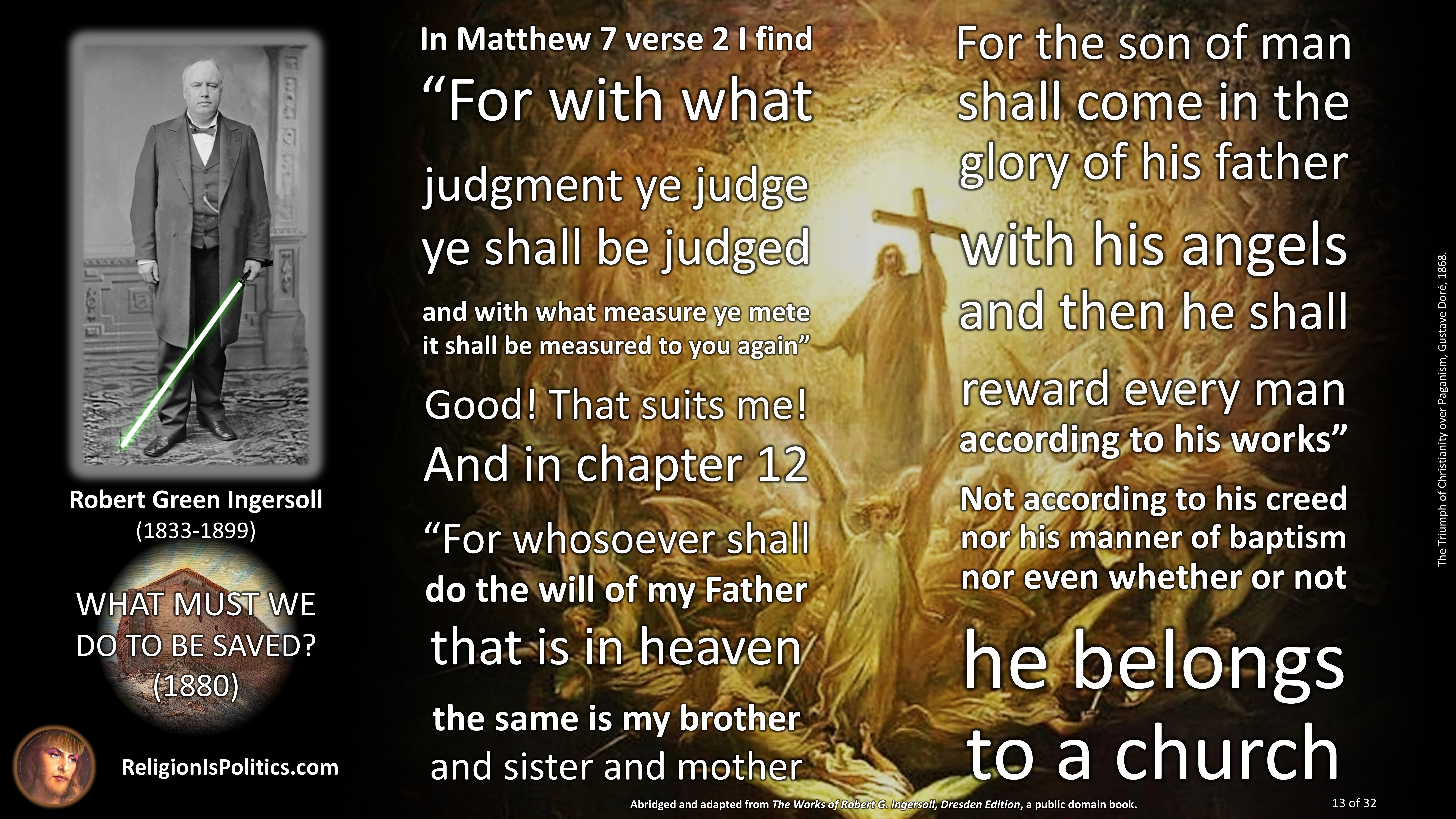
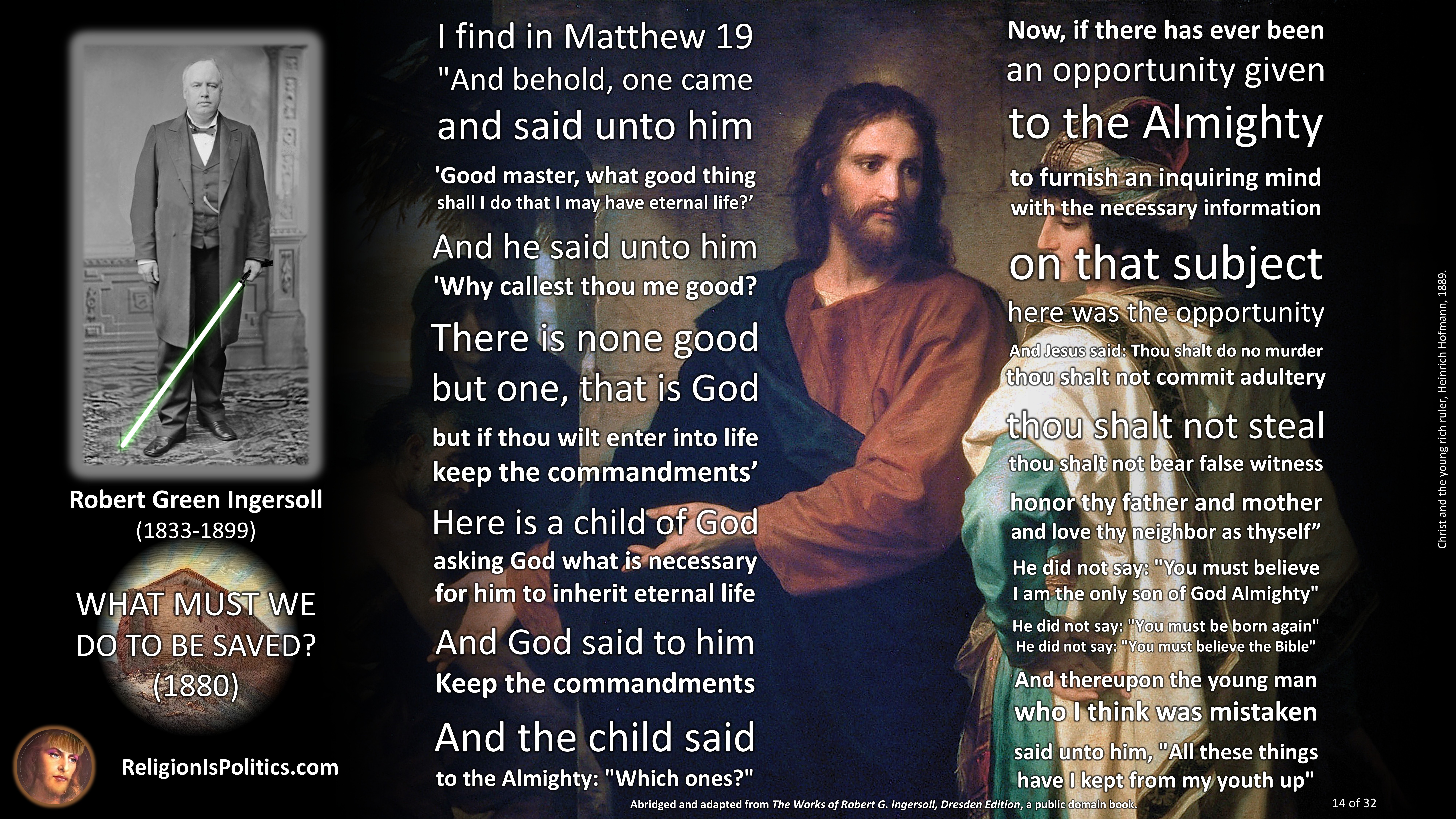
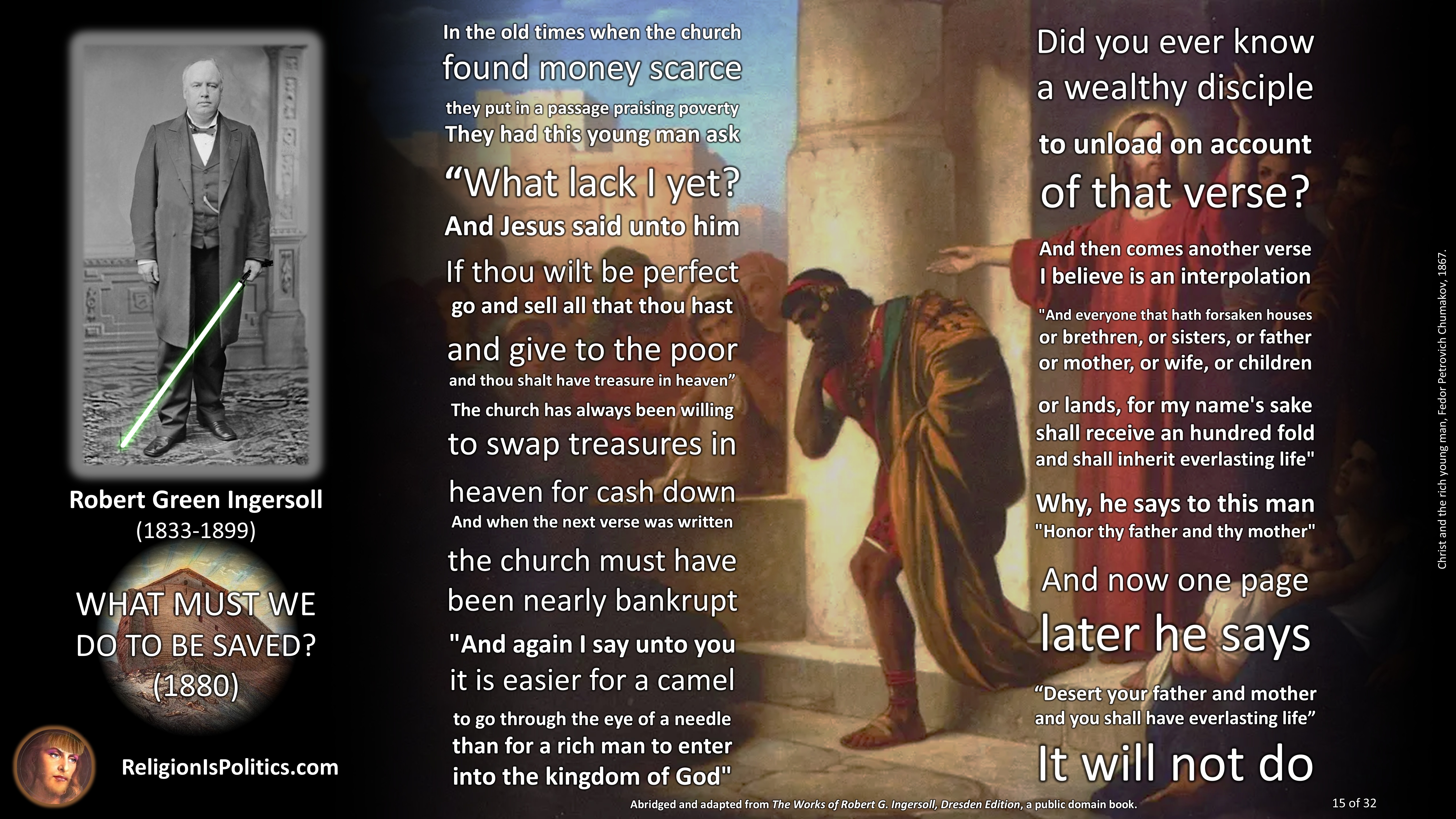

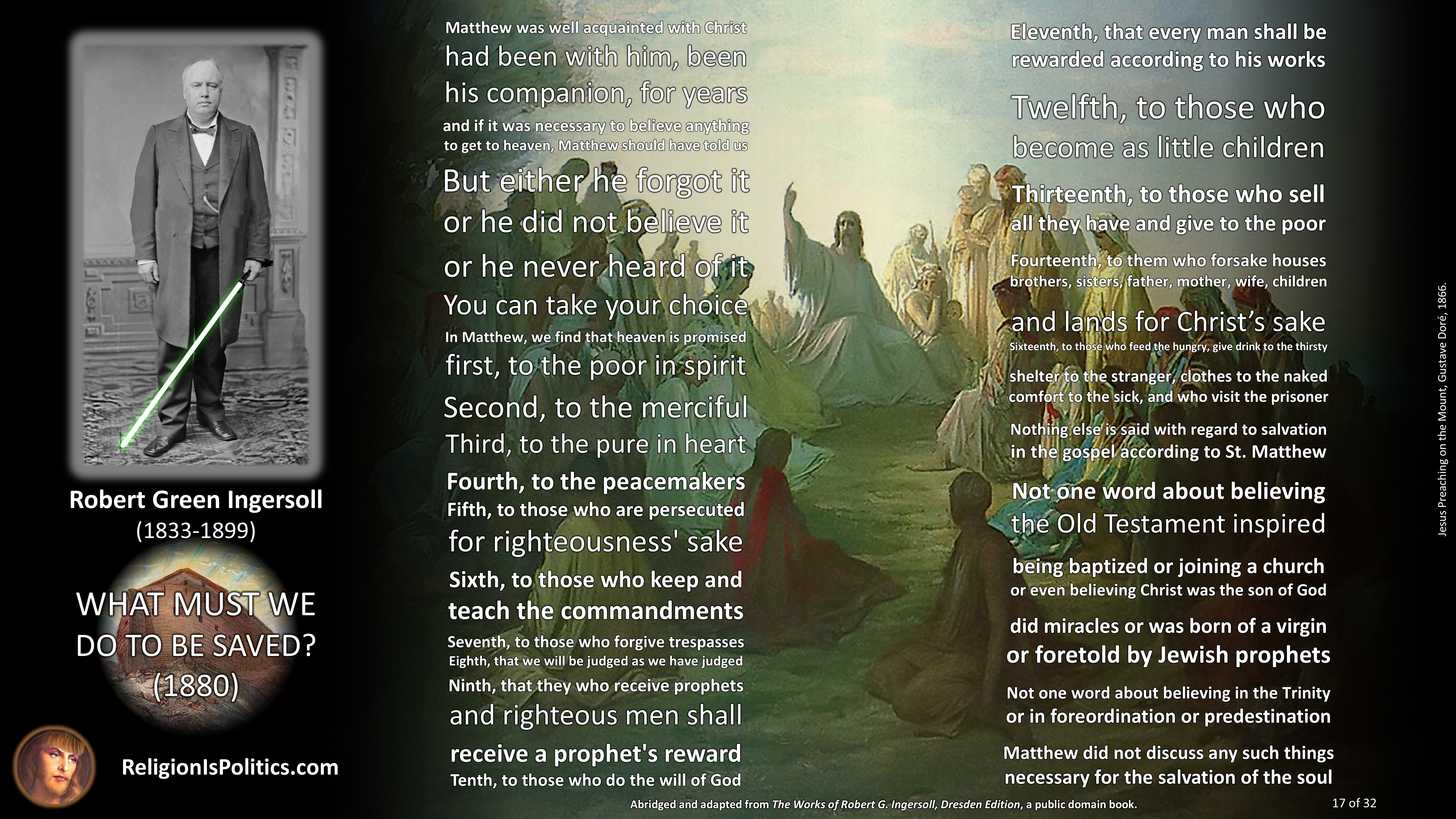
Matthew was written to update Mark for a changing market. They added Jesus’ genealogy and crafted a birth narrative like other demigods had.
Scholars disagree on whether Mark was the first version or whether the first was lost.
Obviously if there was another gospel written that wasn’t included in the Bible then it must have been written by Satan.
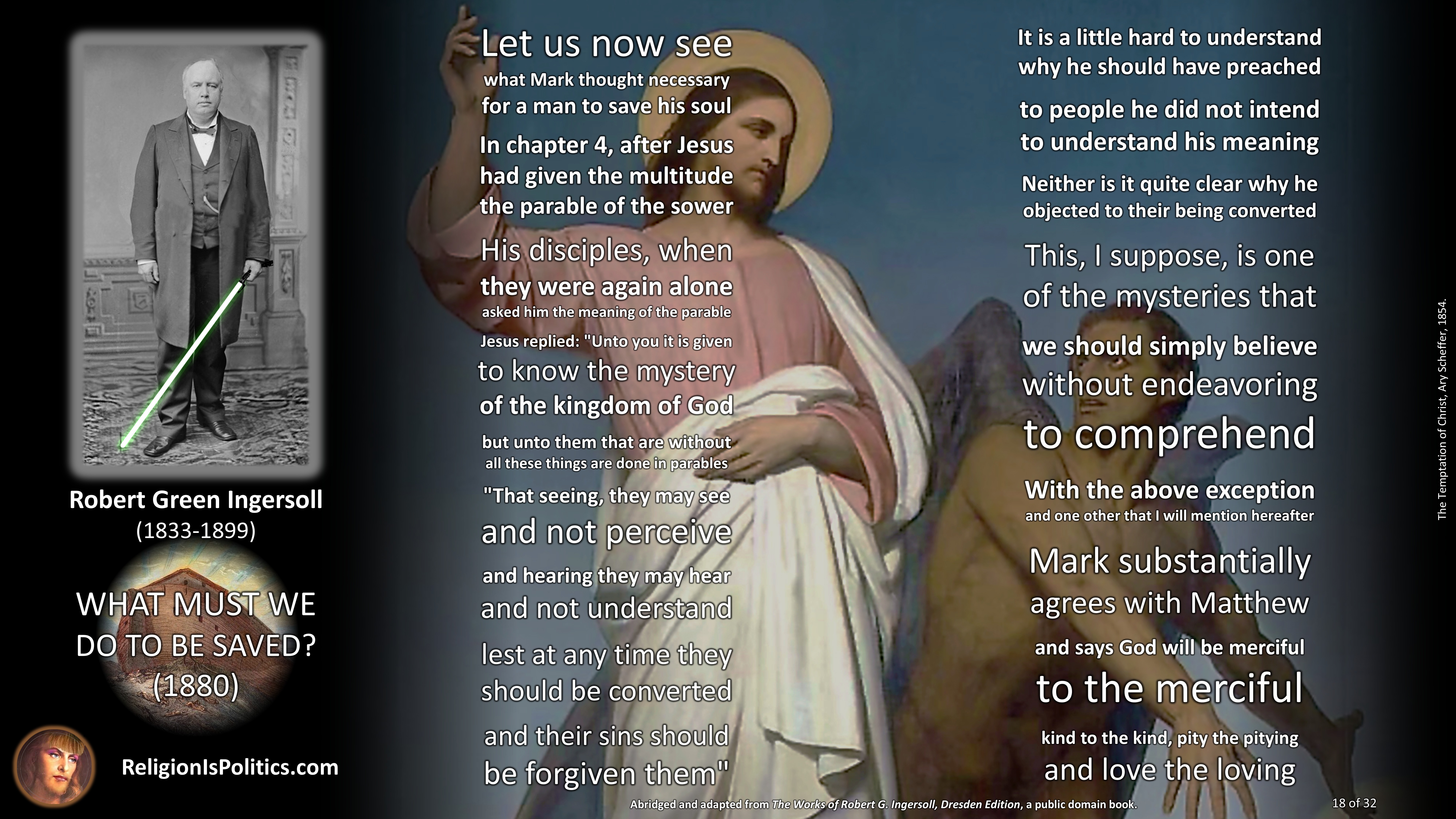
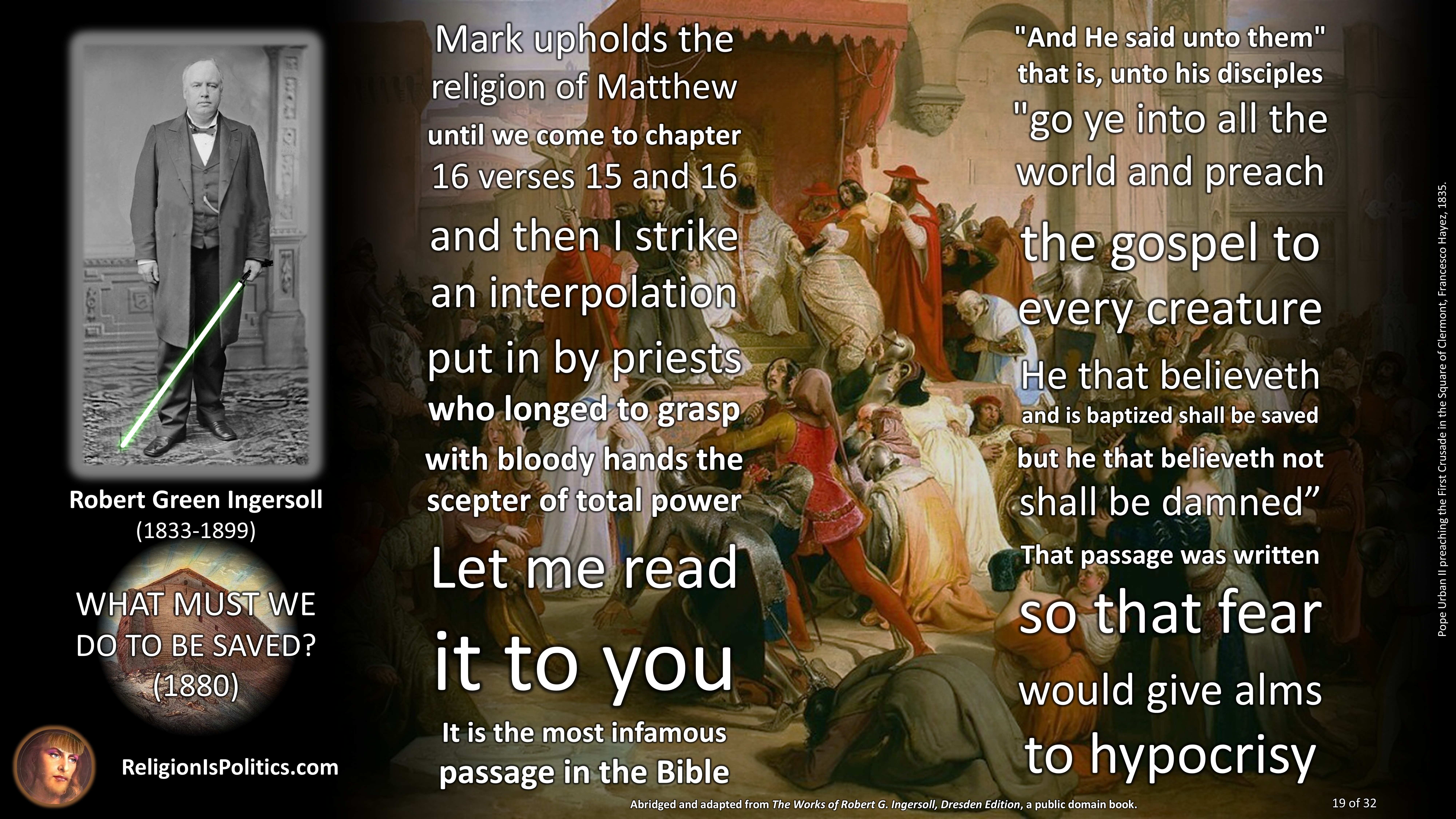

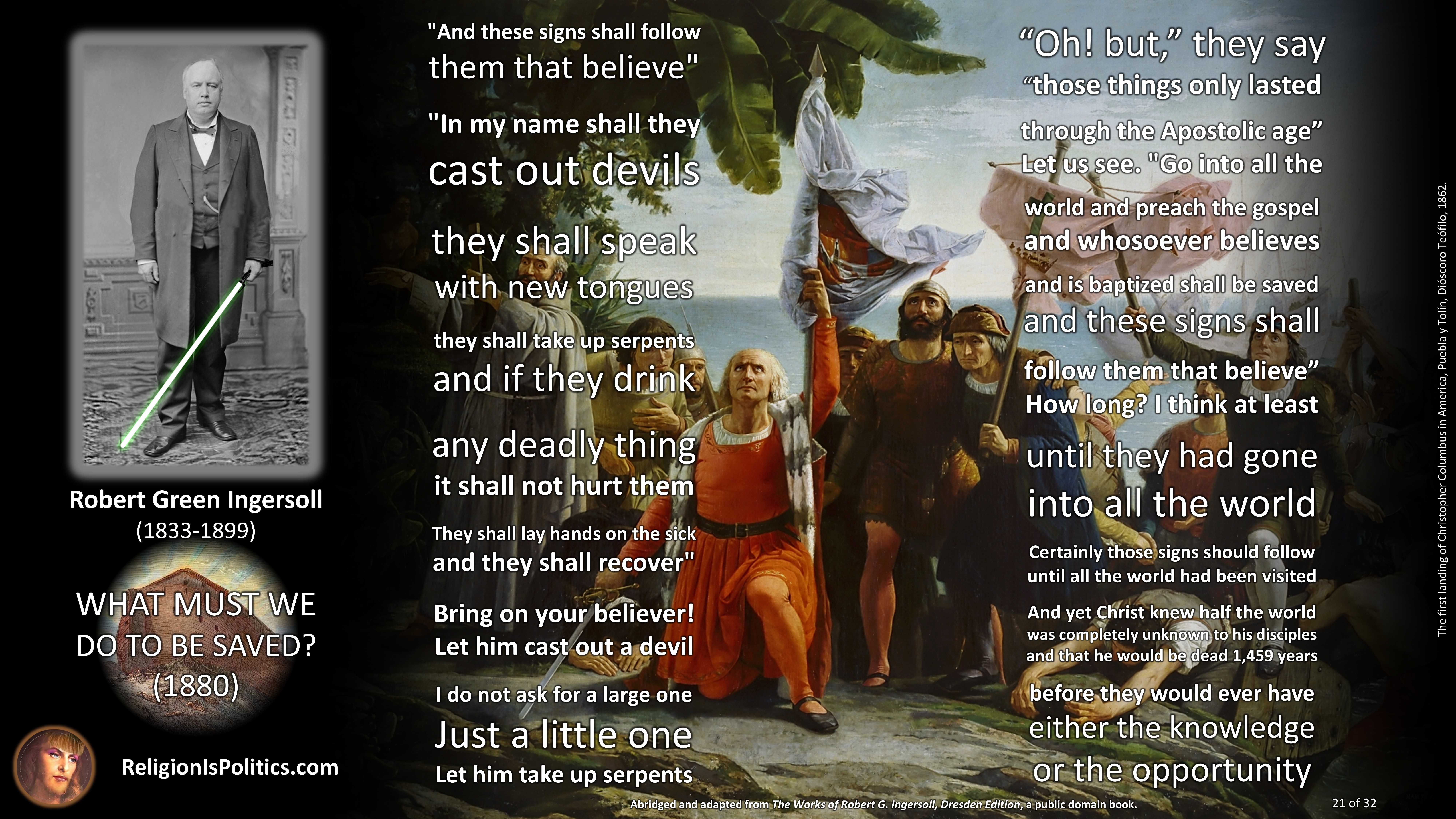
Mark was also updated directly as the market evolved. A longer ending was added to make the resurrection explicit rather than implicit; believers were promised eternal youth and unbelievers were threatened with a fate worse than death.
If the original writer had such notions at all, they were mere afterthoughts. But maybe the original audience didn’t want to hear about them.
When Luke wrote a genealogy for Jesus, he wrote it in the opposite direction, he used a wildly different number of generations and except for Joseph almost all of the names are different.
For 2,000 years Christian apologists have claimed one of those genealogies is actually Mary’s, but in 2,000 years no one has been able to provide a satisfactory explanation why two divinely gifted writers each wrote a man’s name when one of them should have written a woman’s name instead. And I predict that it will take at least another 2,000 years for a satisfactory explanation to evolve.
By the time Matthew and Luke were written, Jesus’ brand was no longer simply about getting people to be nicer to one another. By then it was starting to be about frightening and cajoling people, into fidelity to one church or another, and into believing the same things as everyone else there.
In other words, personal loyalty was getting to be more important than personal honesty, and as far as churches are concerned it has been ever since.
We can tell about these books just by their content that they were written over decades while the events they described were passing from memory into myth.
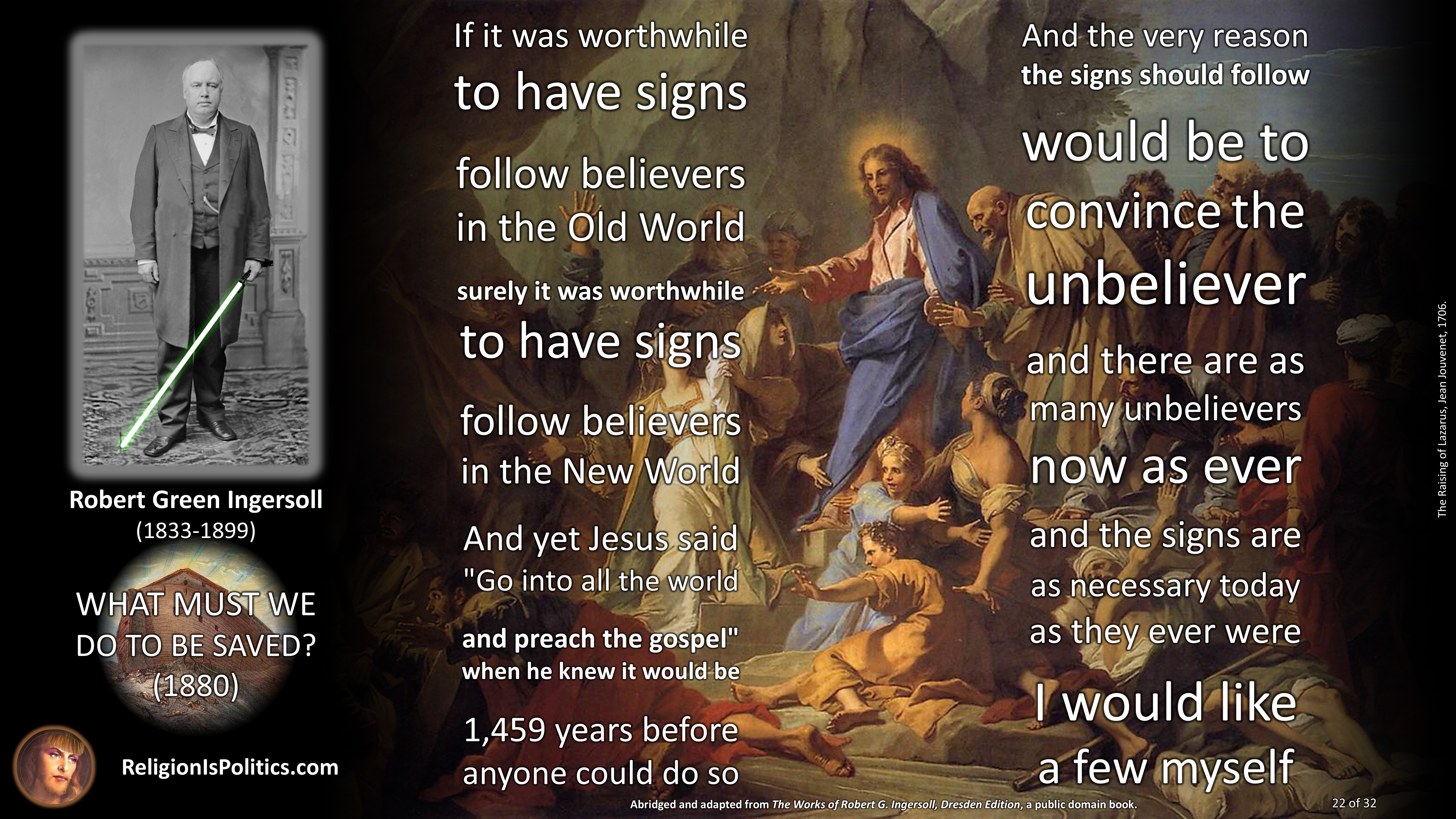
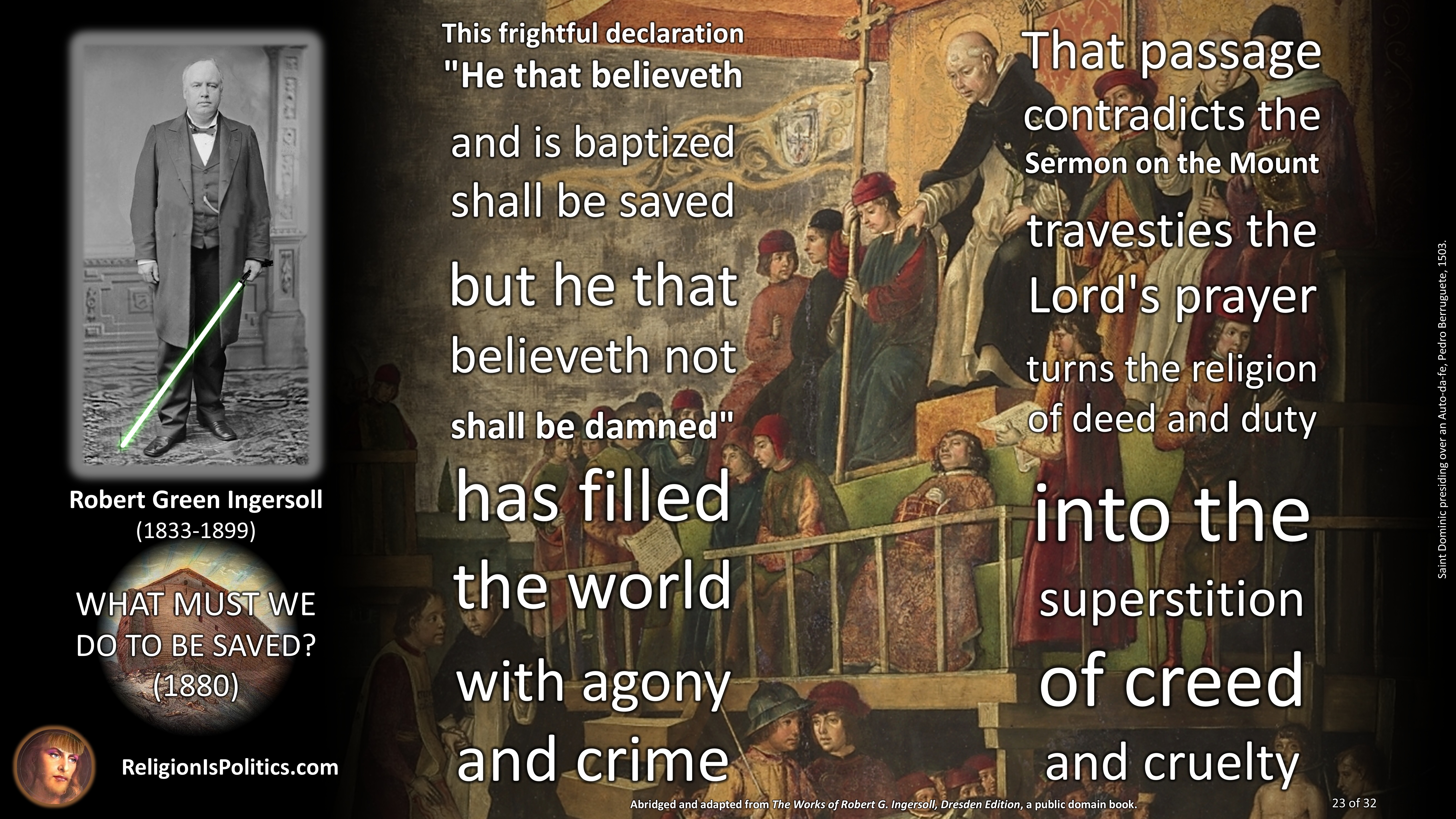
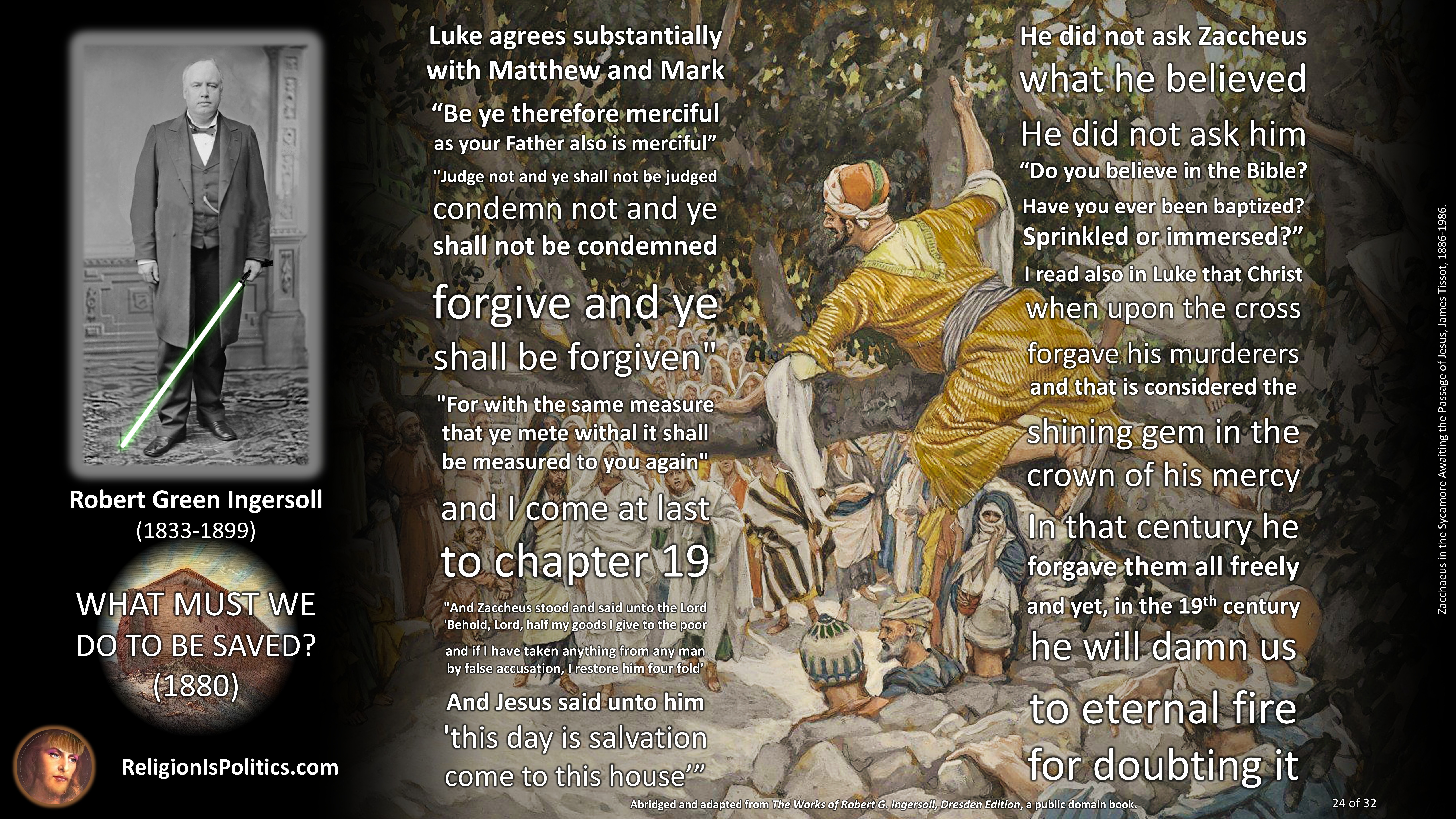
Matthew, Mark and Luke are filled with gems like ‘cut off the hand that offends you,’ ‘do not resist an evildoer,’ and ‘whoever is angry is a murderer.’
From these books we mostly remember the good and forget the bad, especially if we think the bad was added later.
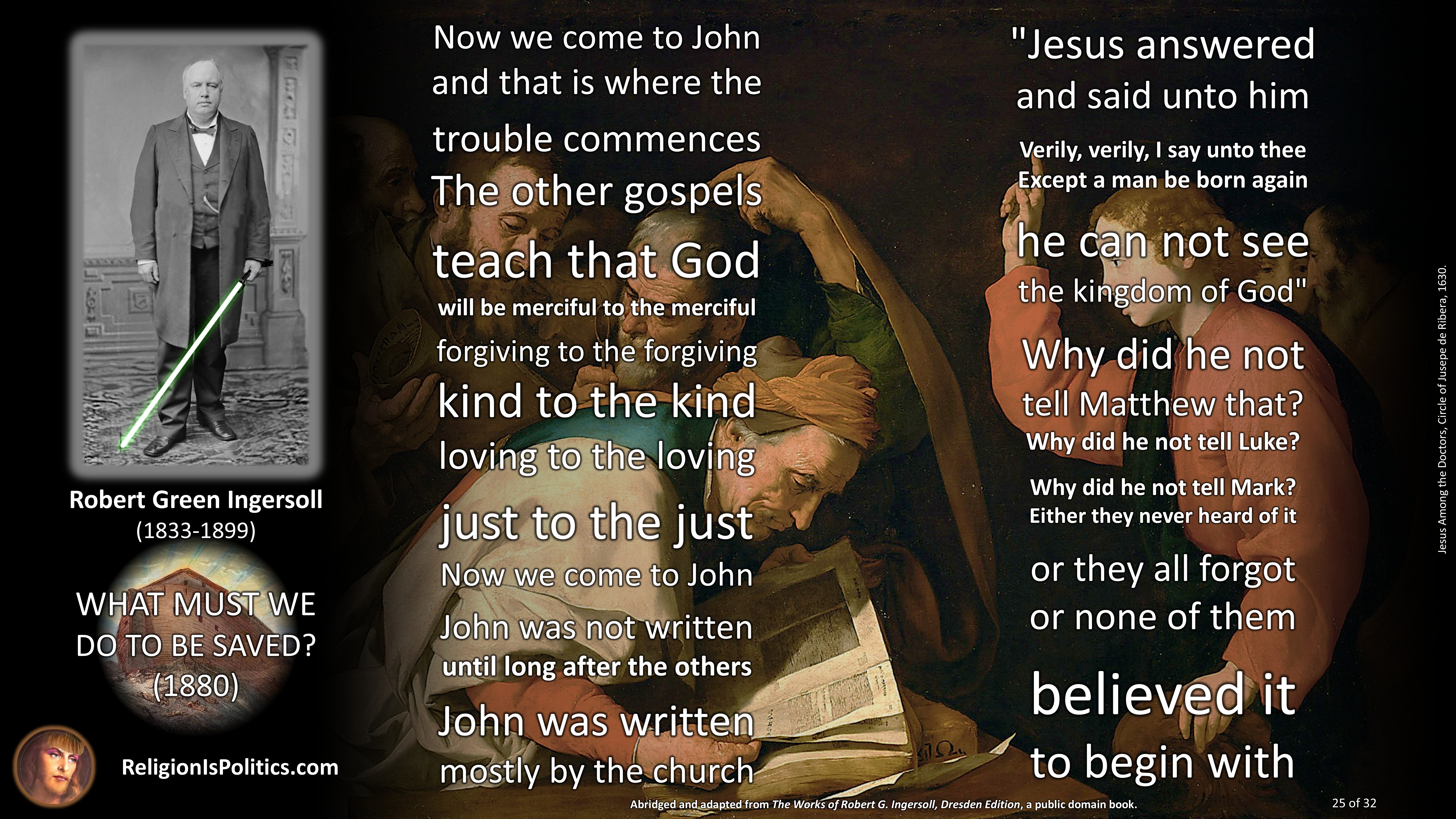
Matthew, Mark and Luke give us a picture of a God who shows mercy to the merciful even if he’s still merciless to the rest.
And if only Paul’s disciples had valued liberty and justice for all, they might have had less violence in their legacy.
But they rejected the first version of the Matrix because it wasn’t cruel enough. They wanted something they could believe in. Or, rather, they wanted to be part of something just by believing.
By the time John was written, both the product and the audience of Jesus had been completely transformed by the legacy of Paul. Ever since, the Christian gospel has been less about character and more about personality, less about morality and more about loyalty, less about delivering solutions and more about closing the sale.
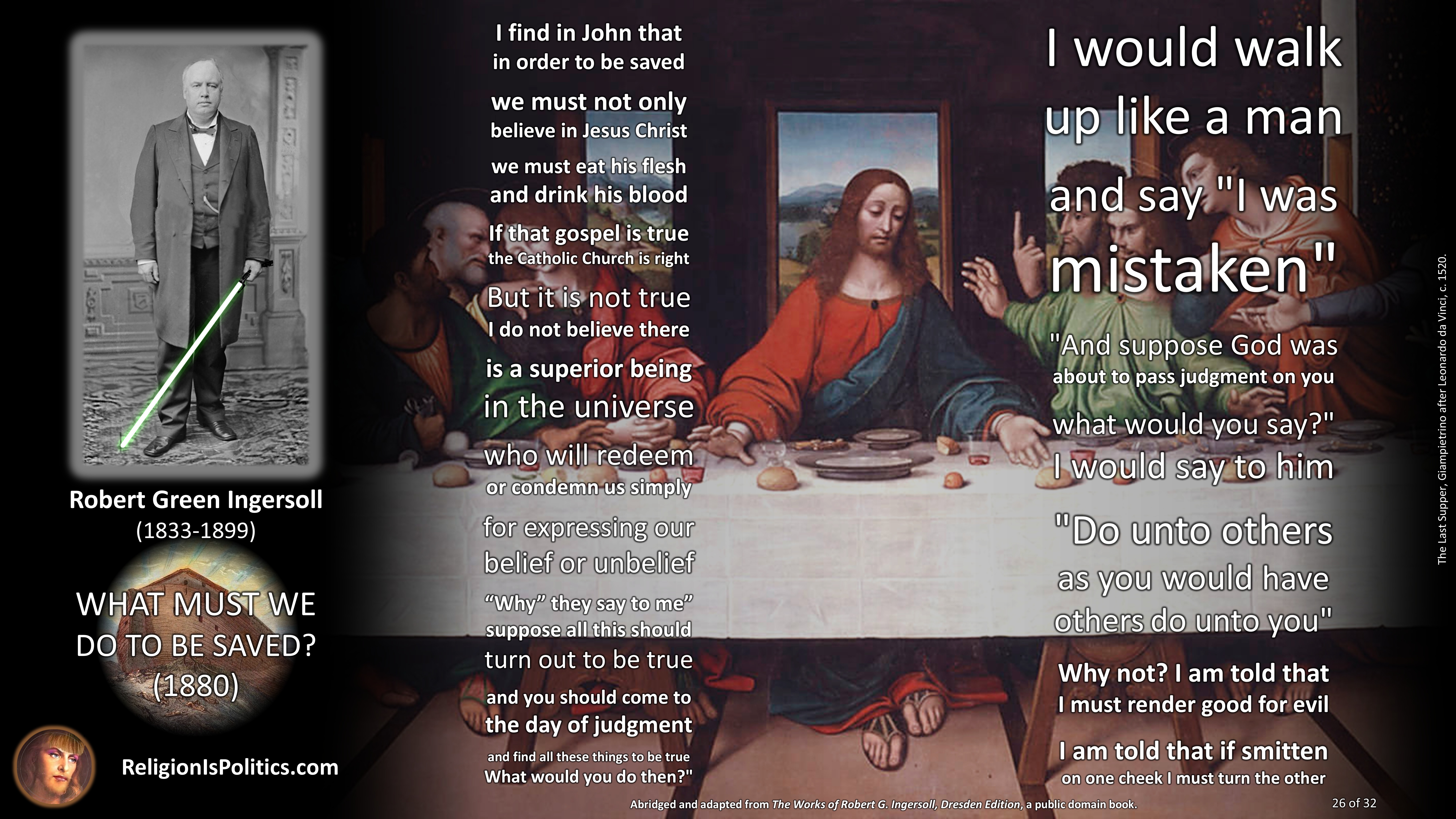
After Paul’s death his disciples wrote narratives to explain what had just happened and they collected the ones they liked best.
In Paul’s epistles he makes no reference to any gospels, nor to their authors. But he refers frequently to rival apostles with whom he disagrees.
Paul had no gospels. They were written by his followers after he was gone. They wrote dozens of versions and settled ultimately on just four. Not one. Not twelve, not all of them, just four.
And none of those gospels were histories.
They were not moral guides.
They were sales guides.
They were simply the four most popular sales guides with the faction that ultimately seized power.
Paul’s disciples tell us to this day that if we do not love our enemies then we will be the enemy of an almighty being who hates his enemies infinitely and forever.
They tell us we will deserve what we get. And they call this free will.
Our enemies can harm us and therefore we require protection from the freedom of their will.
Does an almighty being require protection? Does an almighty being provide protection?
Does an almighty being stop planes from crashing? Control the carbon dioxide in the atmosphere? Determine the strength of the greenhouse effect? Make dinosaurs just to kill them with an asteroid?
God, if she exists, cannot be harmed and requires no protection from us whatsoever. That shoe is entirely on the other foot.
Jesus’ instructions about loving enemies and submitting to evildoers were not put in to please an almighty being.
They were put in to make sure the huddled masses rendered to Caesar what was Caesar’s and to God what was God’s
They were put in to keep poor people paying tithes and to keep them from attracting unwanted attention from the police.
In a sane country, it would be deplorable to spread medical misinformation.
But in a culture that entertains unrealistic fantasies of eternal youth and endless revenge, medical misinformation is just a proven business model.
If there is another life after death, we should not hope to live happily ever after while other people are miserable.
An eternity trapped in one big, abusive family?
What kind of life would that be?
Do we want the last to be first and the first to be last forever?
If there is another life after this one, either we will know our past or we will not.
If we do not know our past, then we will be different people.
Only if we know our past will we have any choice about our future.
Only by acting on the truth can we be set free.

What must we do to be saved?
We must put away childish things.
We must stop lying to ourselves and to one another.
We must be kinder to one another and to ourselves.
We must stop believing what we know ain’t so.
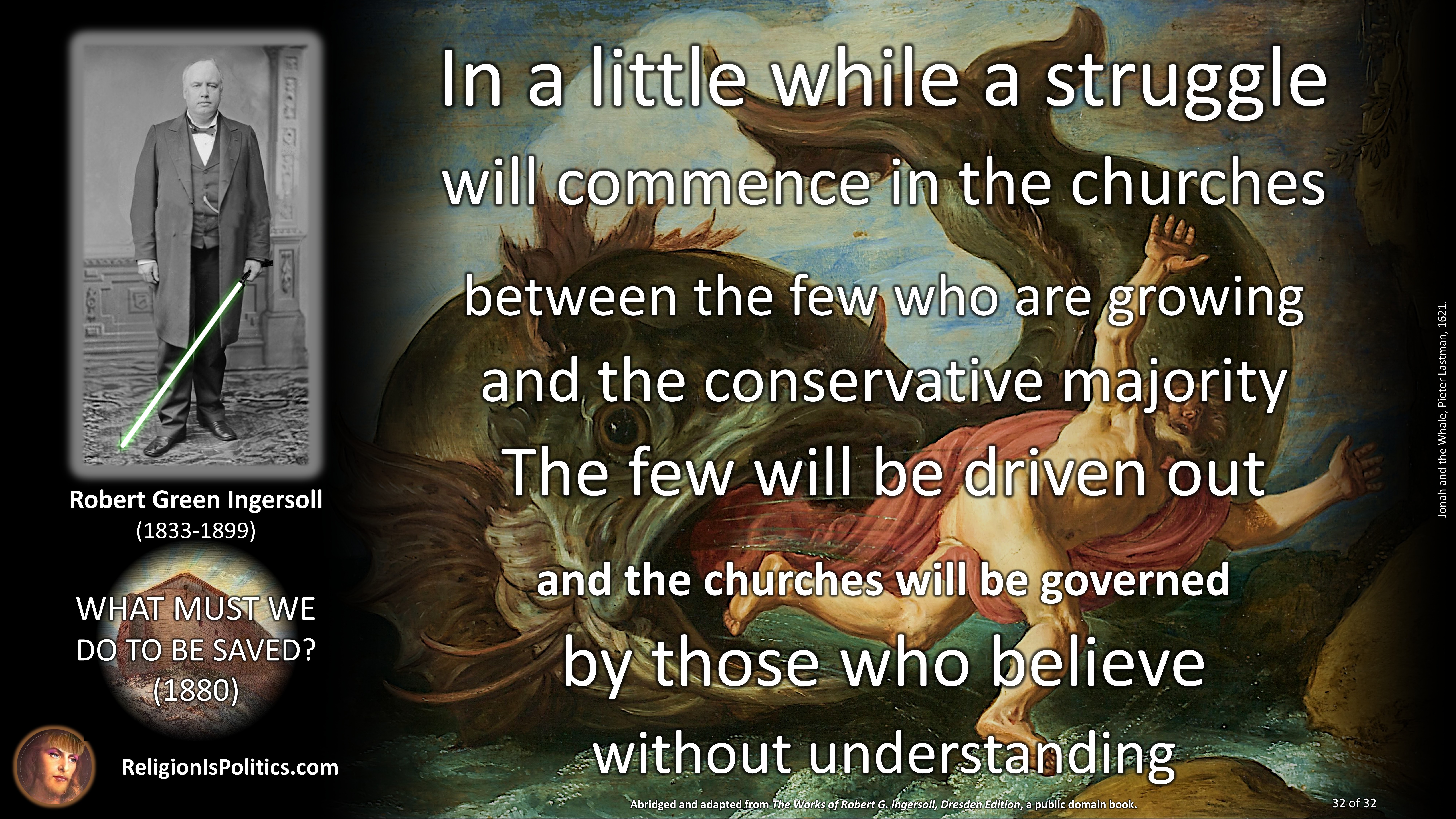
Background art
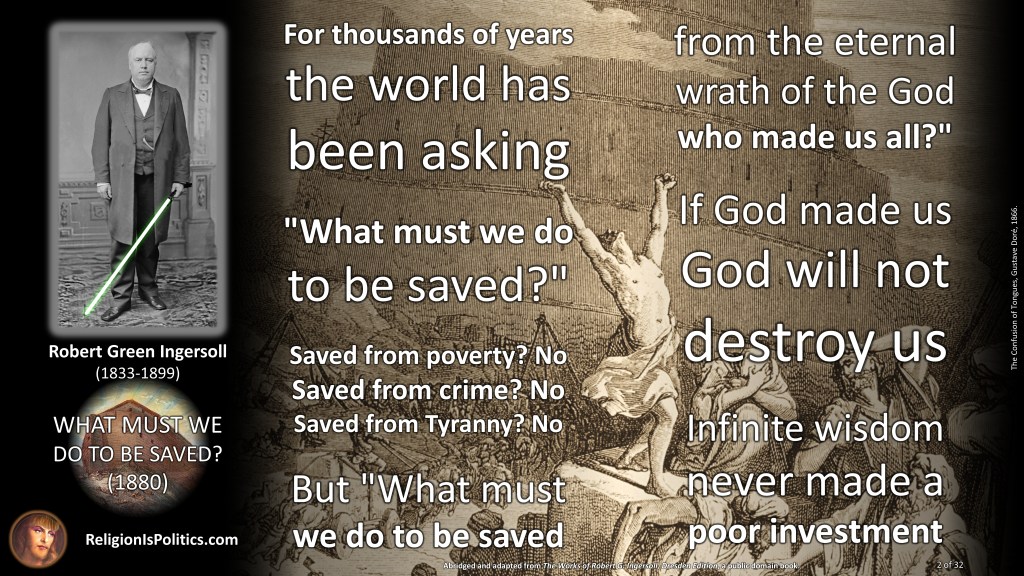
- Elijah in the Wilderness, Frederic Leighton, 1877.
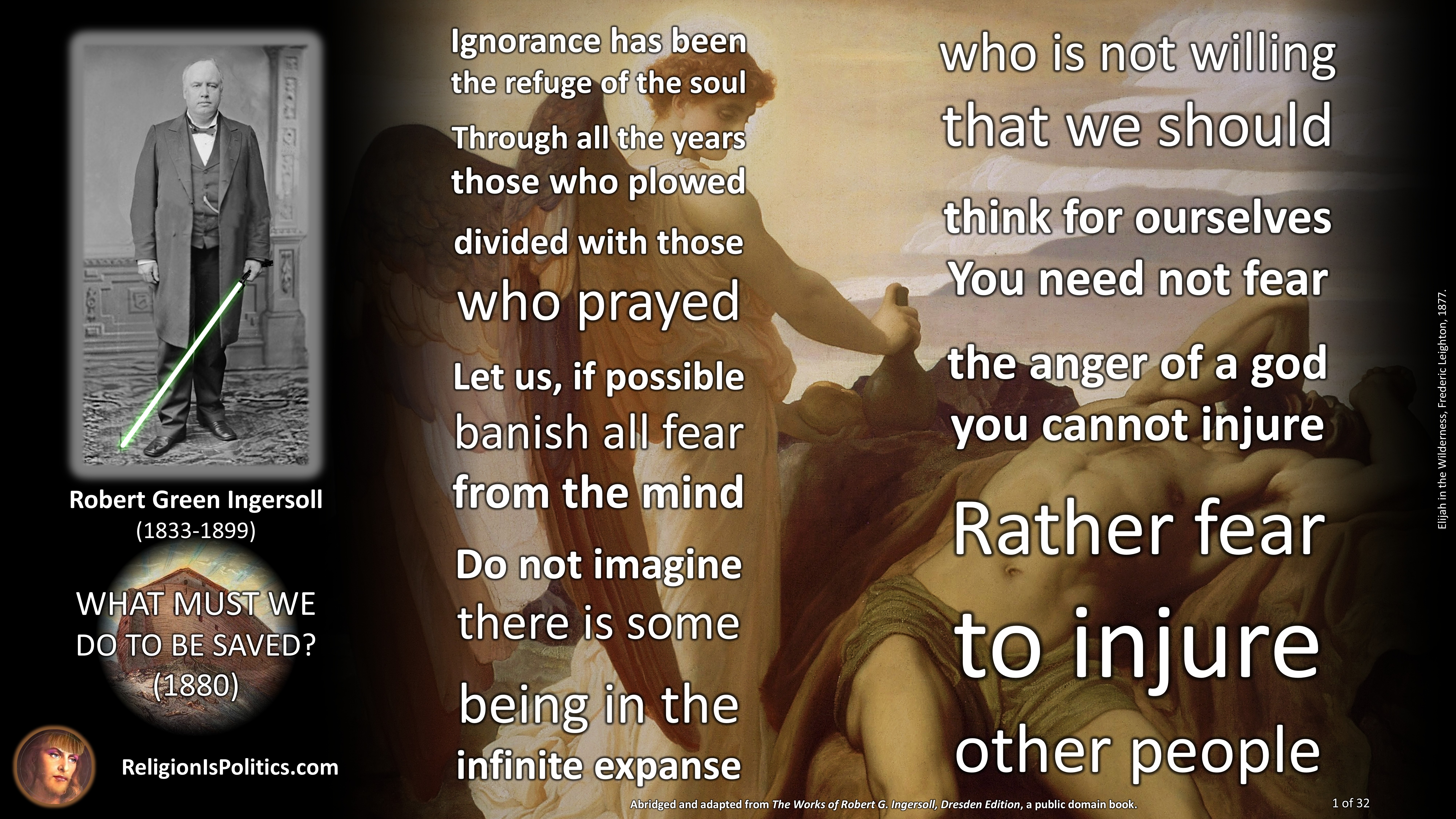
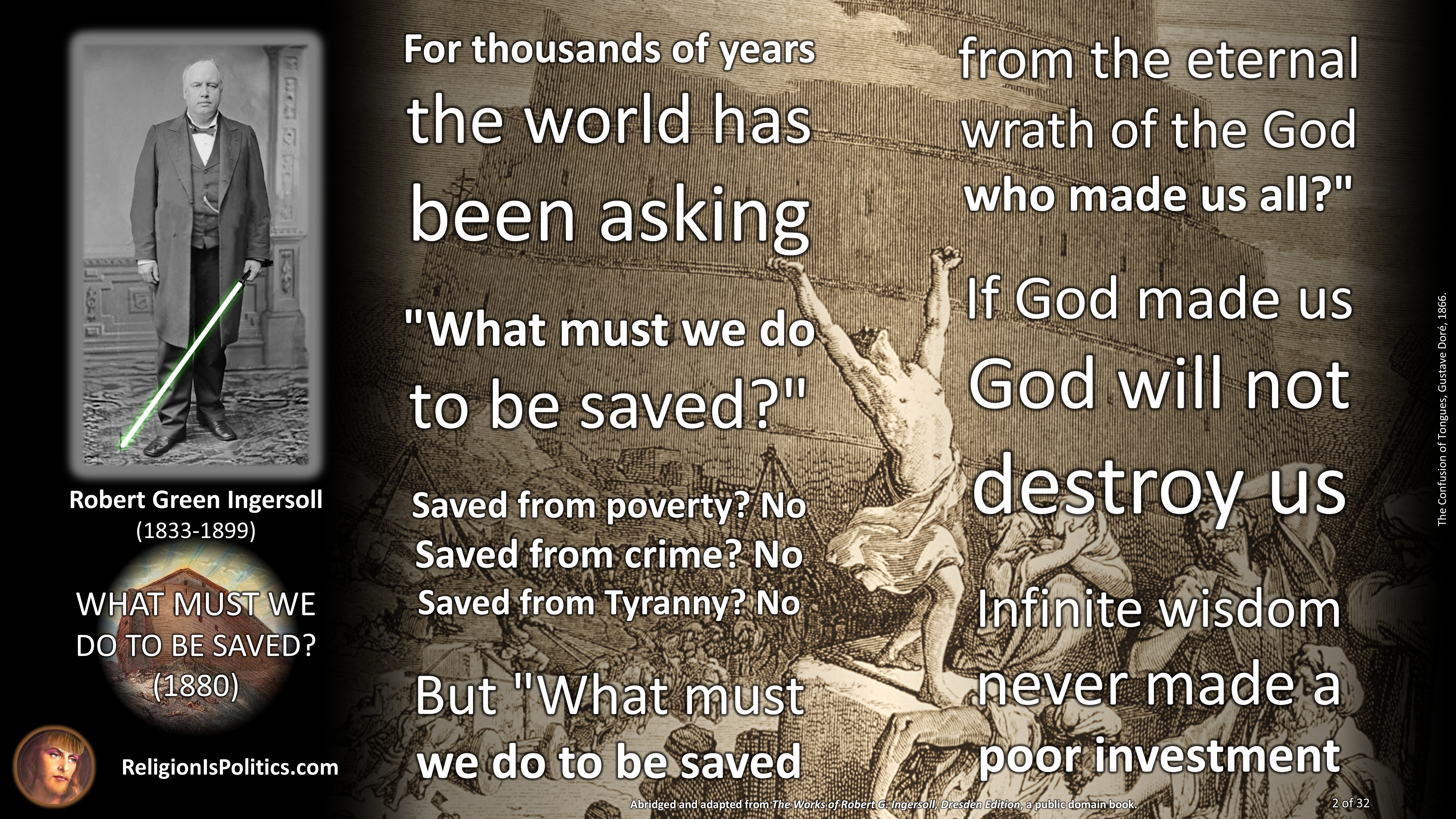
- The Confusion of Tongues, Gustave Doré, 1866.
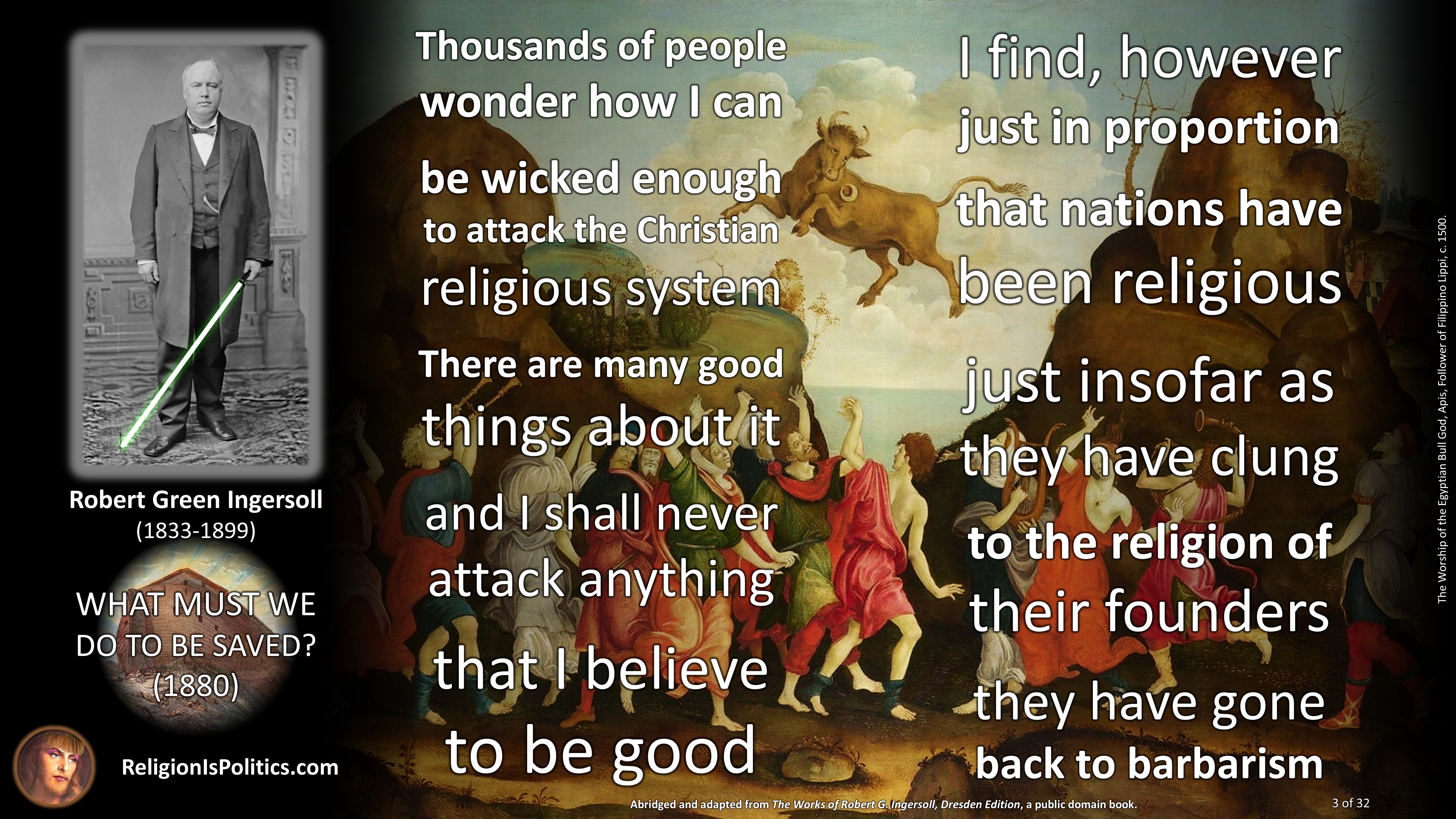
- The Worship of the Egyptian Bull God, Apis, Follower of Filippino Lippi, c. 1500.
- Saint Augustine, Philippe de Champaigne, 1650.
- Transfiguration of Jesus, Raphael, 1550.
- Transfiguration of Jesus, Raphael, 1550.
- The Resurrection of Lazarus, Leon Bonnat, 1857.
- The Last Judgment, John Martin, 1853.
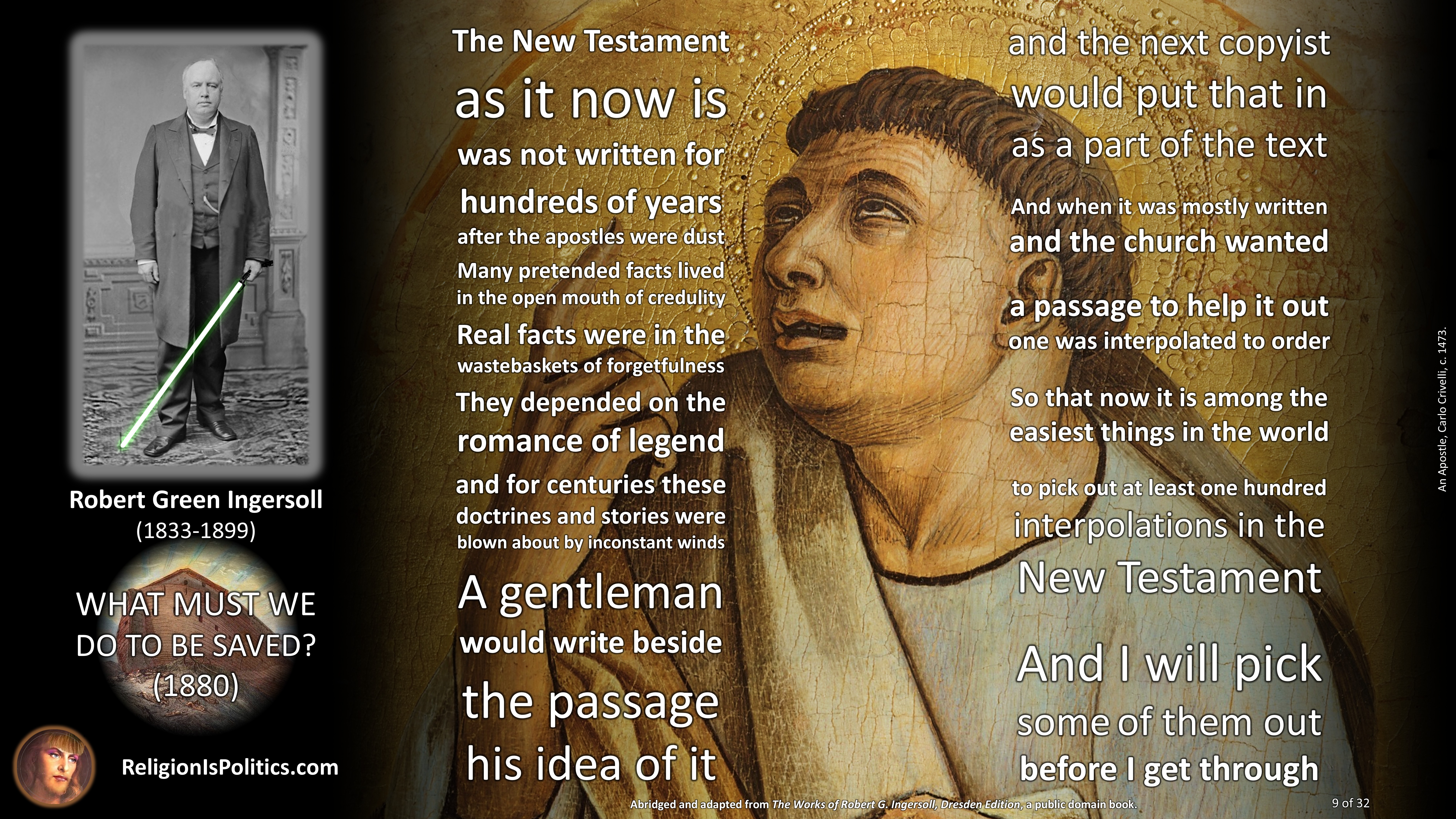
- An Apostle, Carlo Crivelli, c. 1473.
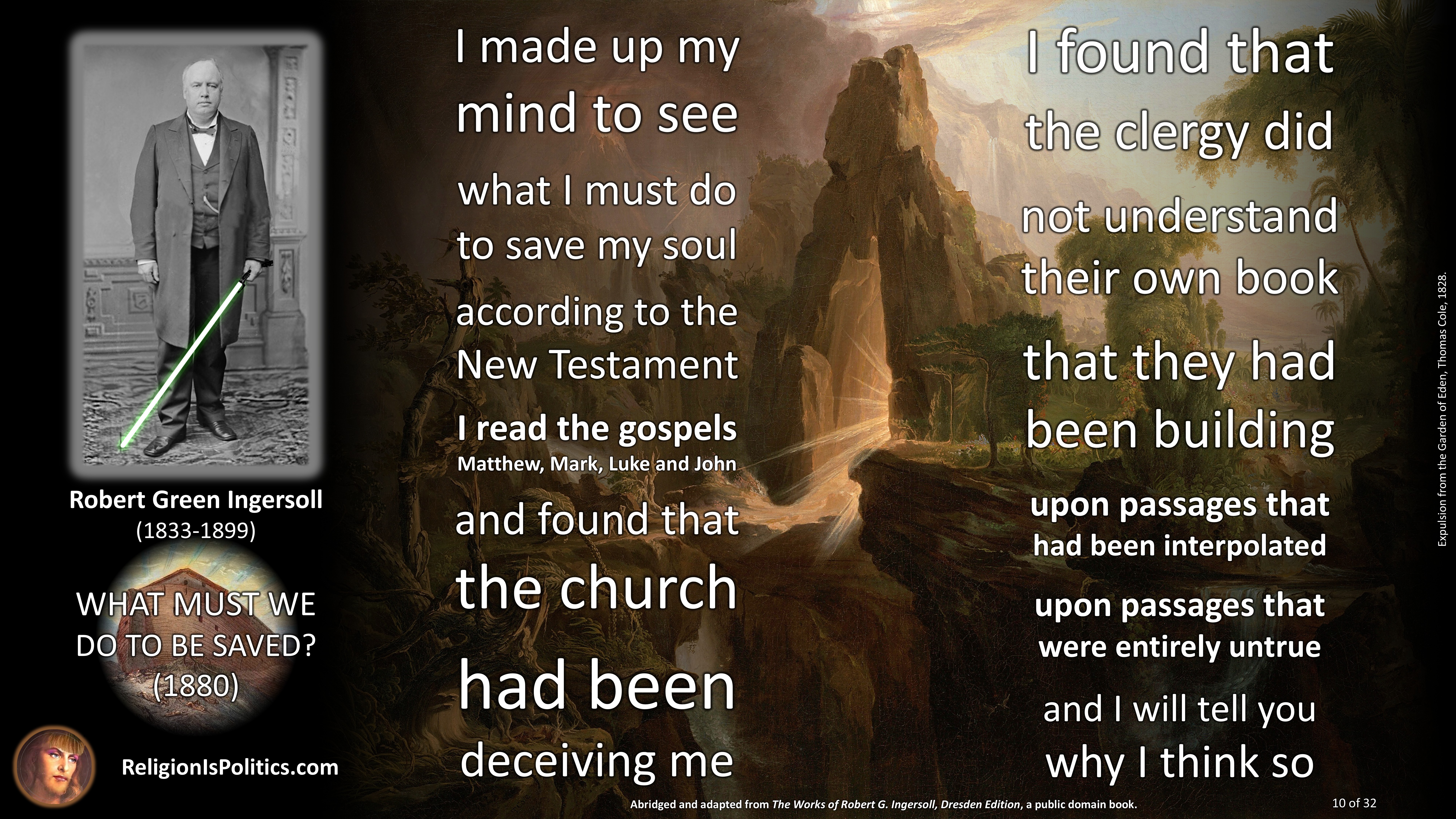
- Expulsion from the Garden of Eden, Thomas Cole, 1828.
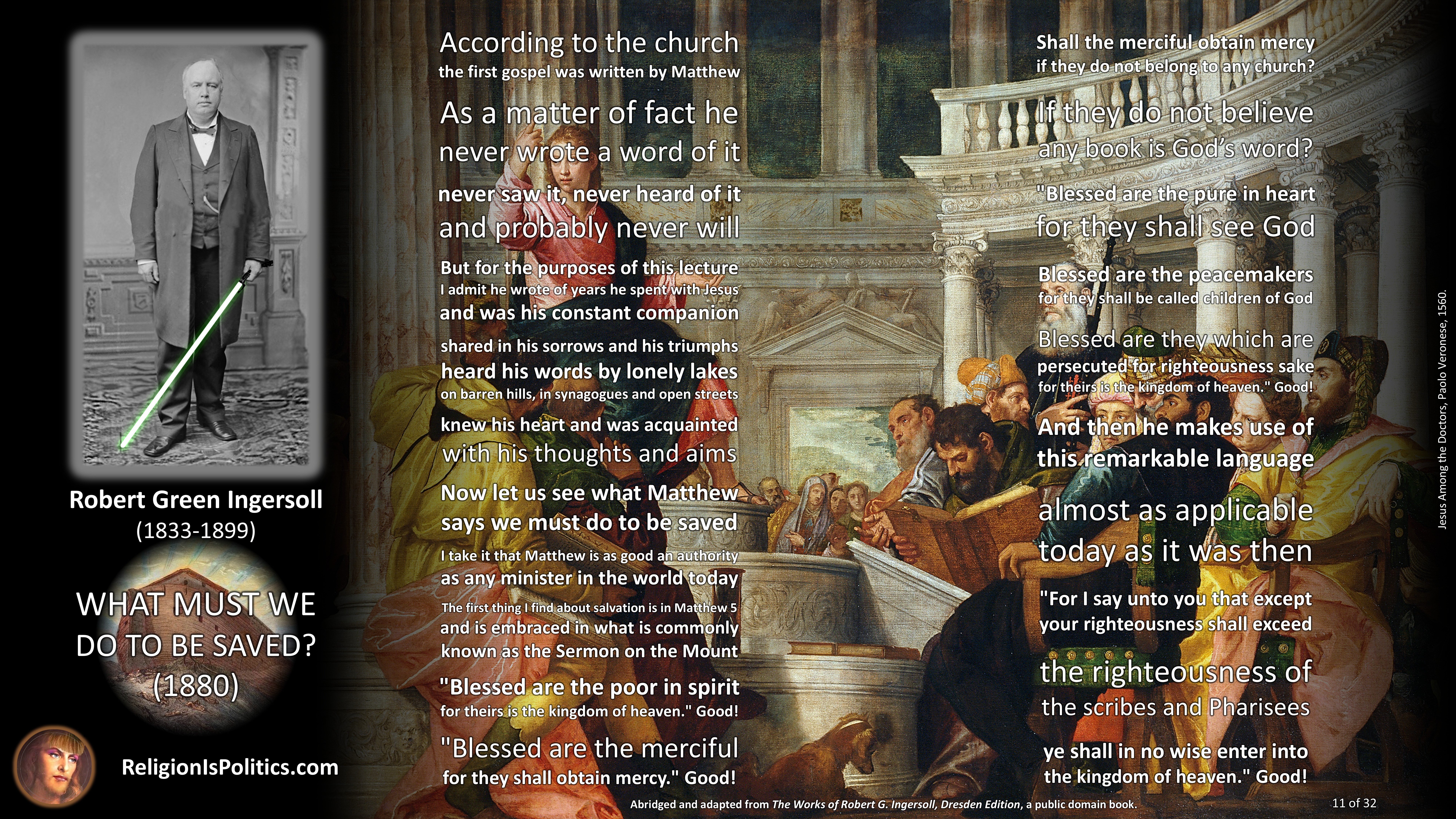
- Jesus Among the Doctors, Paolo Veronese, 1560.
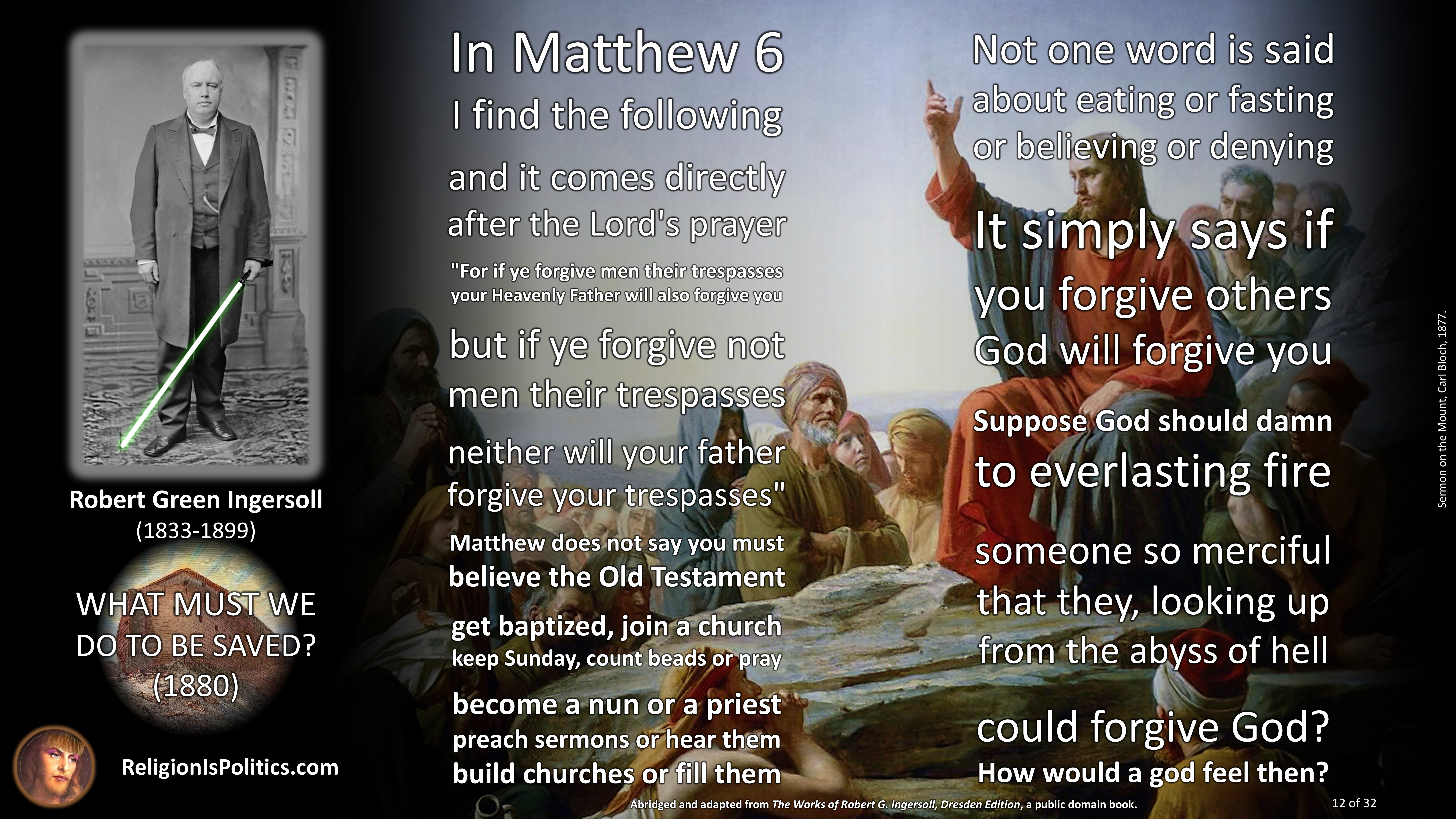
- Sermon on the Mount, Carl Bloch, 1877.
- The Triumph of Christianity over Paganism, Gustave Doré, 1868.
- Christ and the young rich ruler, Heinrich Hofmann, 1889.
- Christ and the rich young man, Fedor Petrovich Chumakov, 1867.
- Christ in Gethsemane, Heinrich Hofmann, 1866.
- Jesus Preaching on the Mount, Gustave Doré, 1866.
- The Temptation of Christ, Ary Scheffer, 1854.
- Pope Urban II preaching the First Crusade in the Square of Clermont, Francesco Hayez, 1835.
- Jesus Ascending to Heaven, John Singleton Copeley, 1775.
- The first landing of Christopher Columbus in America, Puebla y Tolín, Dióscoro Teófilo, 1862.
- The Raising of Lazarus, Jean Jouvenet, 1706.
- Saint Dominic presiding over an Auto-da-fe, Pedro Berruguete, 1503.
- Zacchaeus in the Sycamore Awaiting the Passage of Jesus, James Tissot, 1886-1986.
- Jesus Among the Doctors, Circle of Jusepe de Ribera, 1630.
- The Last Supper, Giampietrino after Leonardo da Vinci, c. 1520.
- The Deluge, J. M. W. Turner, 1805.
- The Garden of Earthly Delights, Hieronymus Bosch, 1500.
- The Triumph of Death, Pieter Brueghel, 1562.
- The Ascension of Christ, Salvador Dali, 1958.
- Prometheus Bound, Thomas Cole, 1847.
- Jonah and the Whale, Pieter Lastman, 1621.

