Robert Green Ingersoll’s Great Infidels is a passionate defense of intellectual freedom, and the contributions of secularism and freethought to human progress.
As the son of a minister, Ingersoll heard thousands of sermons in his life, and heard many times all the same slanders against typically the same five infidels. Without minds like theirs we’d still be under medieval theocracy.
If all you know is what you were told in church, then you’re not going to know how often people in church are lying to you. And if the people who were lying to you in church get their way, the sign of the cross will cast a shadow of theocracy across the world once more.
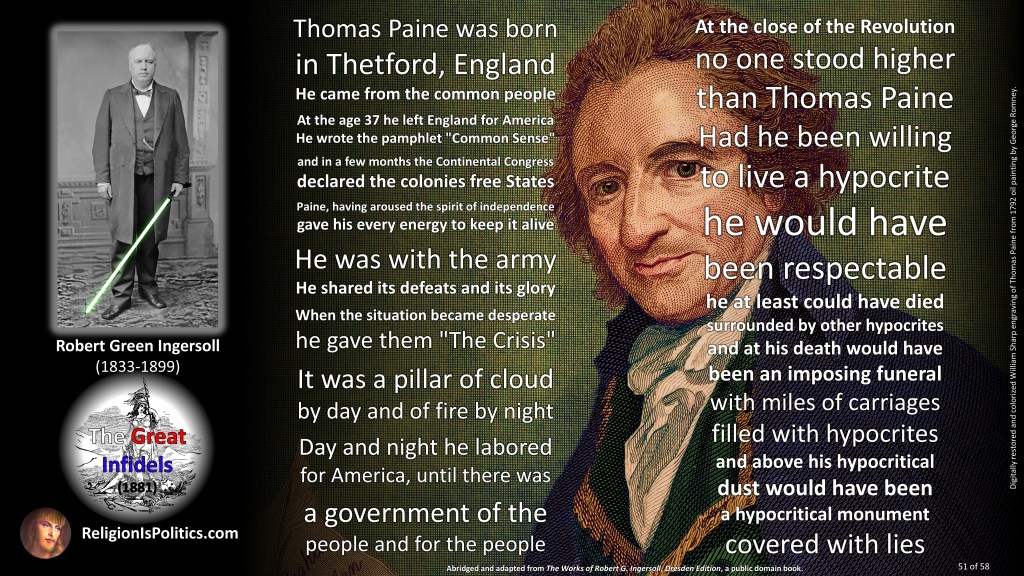
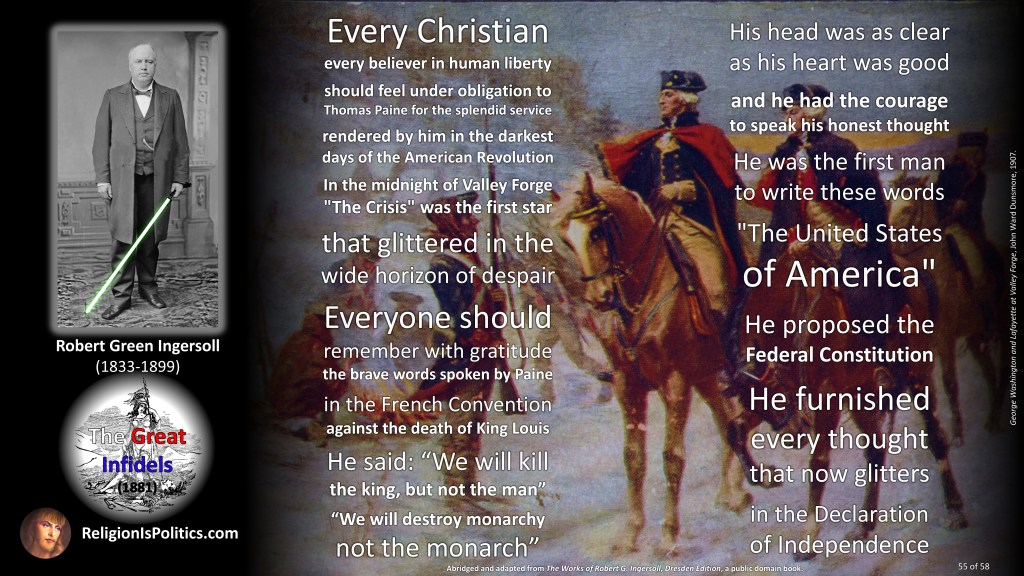
Practically every good idea in the history of the United States was the legacy of Thomas Paine: from the Declaration of Independence, to the amendments of the constitution, to public education, universal health care and social security.
Every century, the forces of money and power in the US do their worst to undo Paine’s legacy. And nevertheless every century so far has been a triumph of Thomas Paine.
Let us compare him with George Washington, keeper of slaves.
If we are honest, we will see the believer was blinded by bigotry. And we will see the infidel was right all along.
In The Great Infidels, Ingersoll did his best to set the record straight, and I bring his best to you.






Background art:
- NASA: Solar Dynamics Observatory.
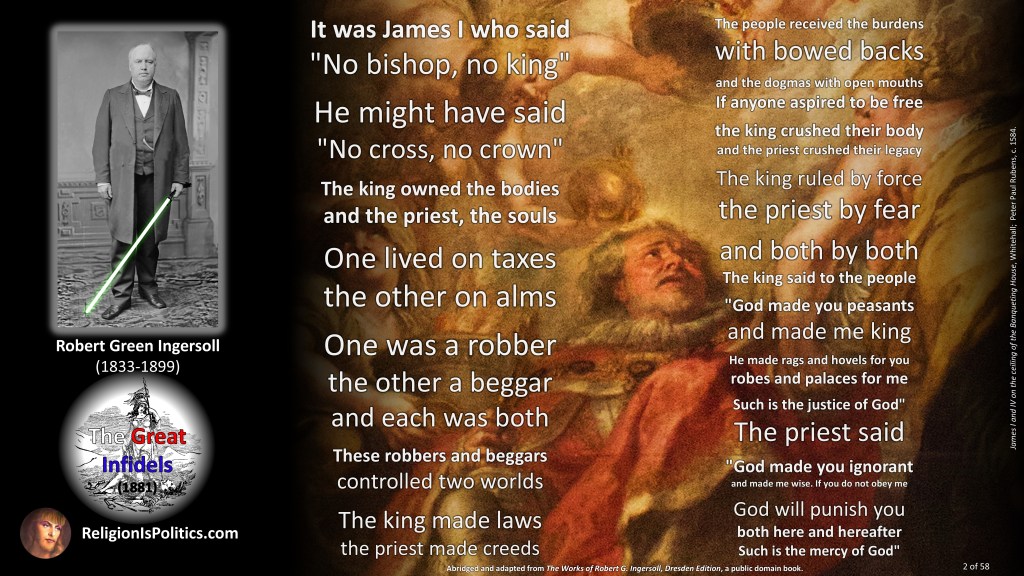
- James I and IV on the ceiling of the Banqueting House, Whitehall; Peter Paul Rubens, c. 1634.
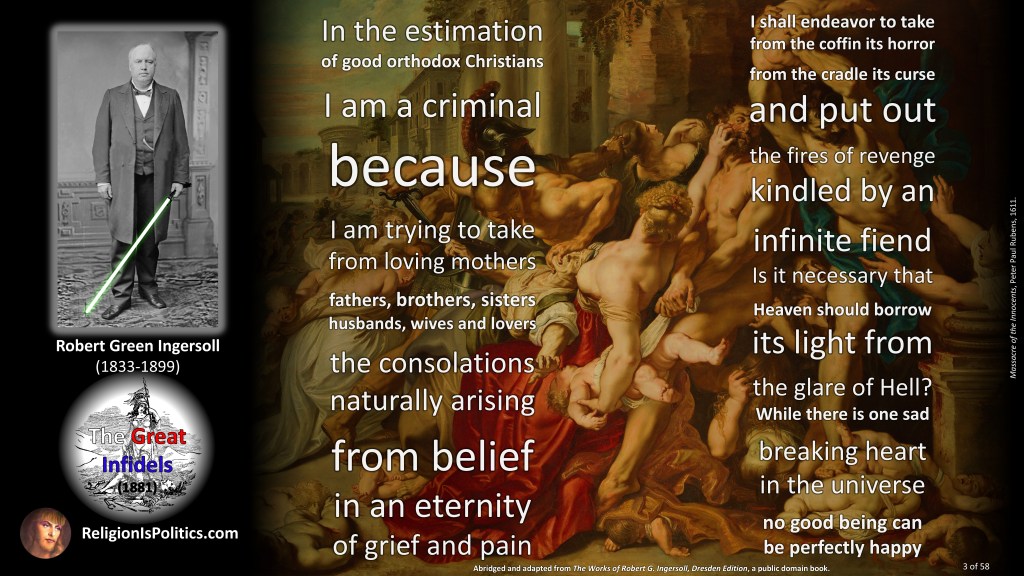
- Massacre of the Innocents, Peter Paul Rubens, 1611.
- And Smote Job with Sore Boils from the Sole of His Foot to the Crown of His Head, William Blake 1821
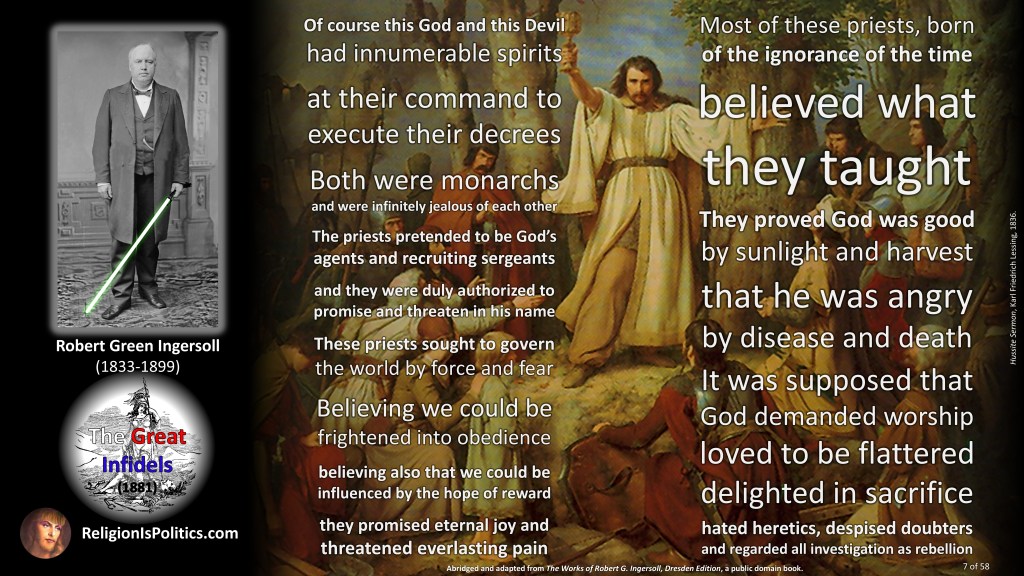
- Hussite Sermon, Karl Friedrich Lessing, 1836.
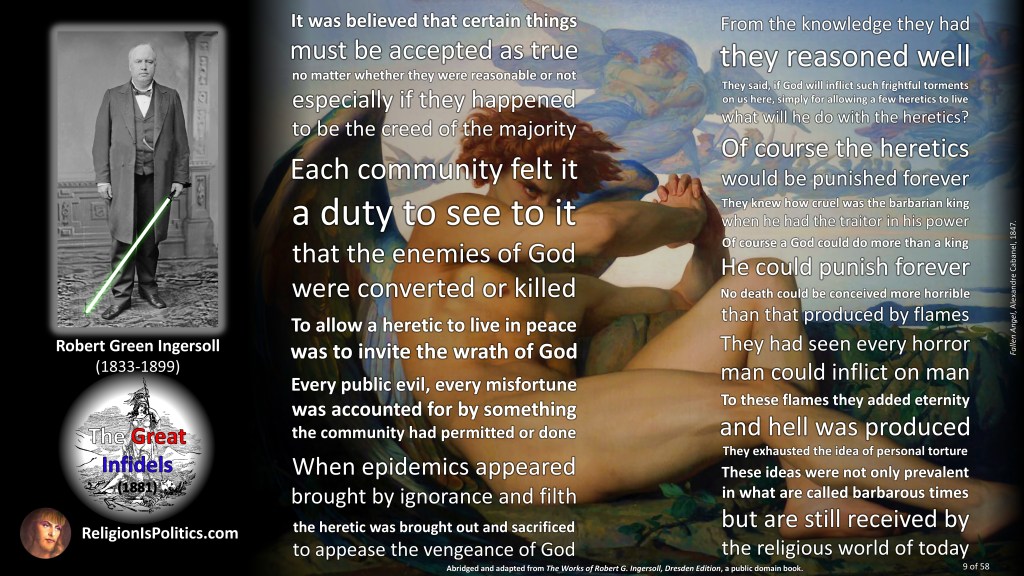
- Fallen Angel, Alexandre Cabanel, 1847.
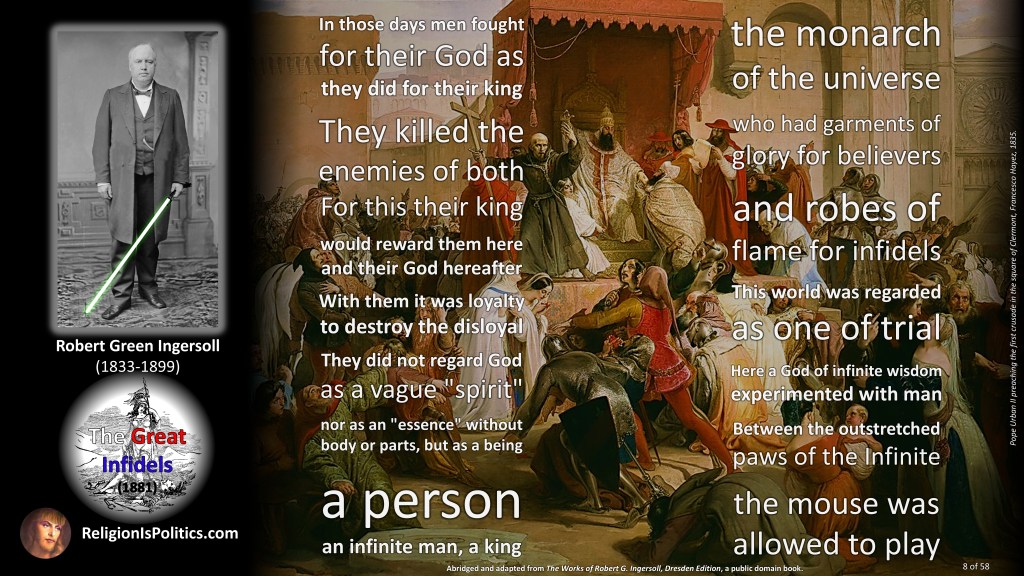
- Pope Urban II preaching the first crusade in the square of Clermont, Francesco Hayez, 1835.
- Saint Augustine of Hippo receiving the Most Sacred Heart of Jesus, Philippe de Champaigne, c. 1645-1650.
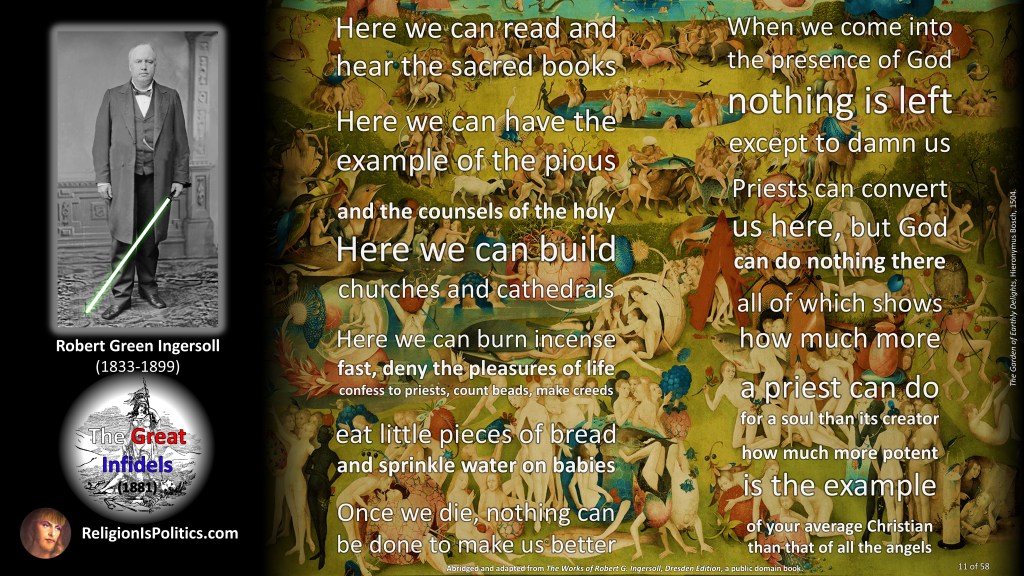
- The Garden of Earthly Delights, Hieronymus Bosch, 1504.
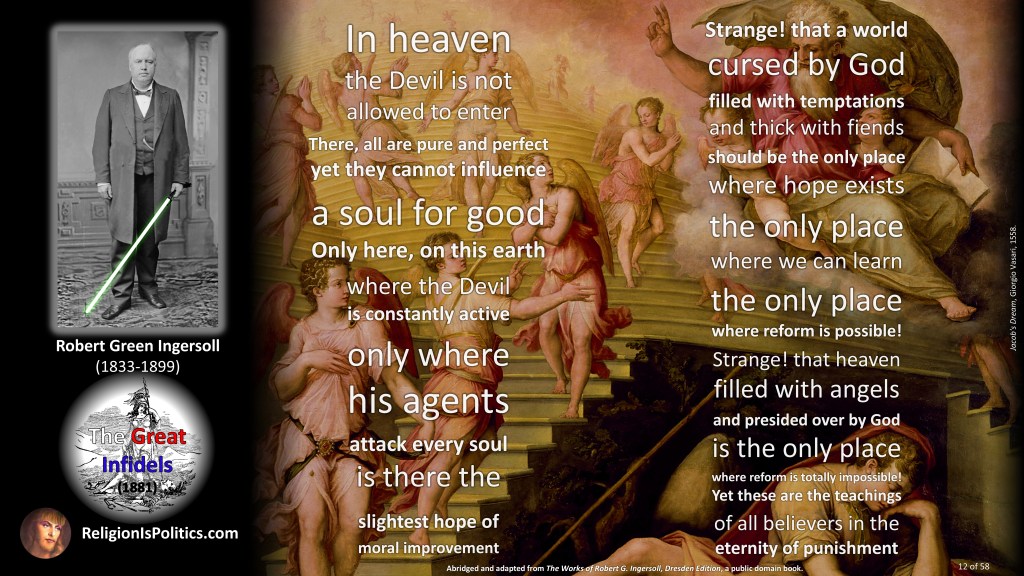
- Jacob’s Dream, Giorgio Vasari, 1558.
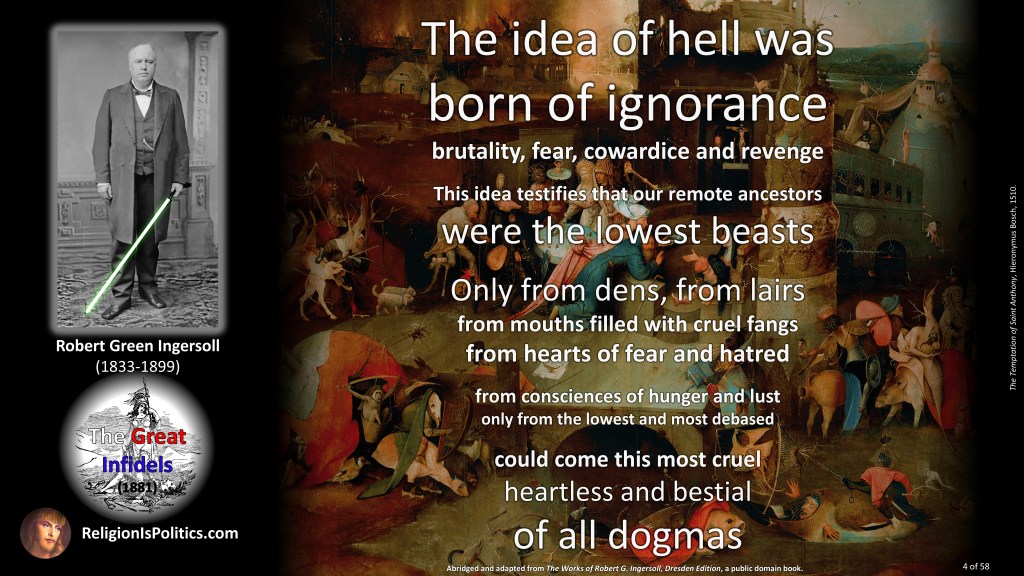
- The Temptation of Saint Anthony, Hieronymus Bosch, 1510.
- An Apostle, Carlo Crivelli, 1473.
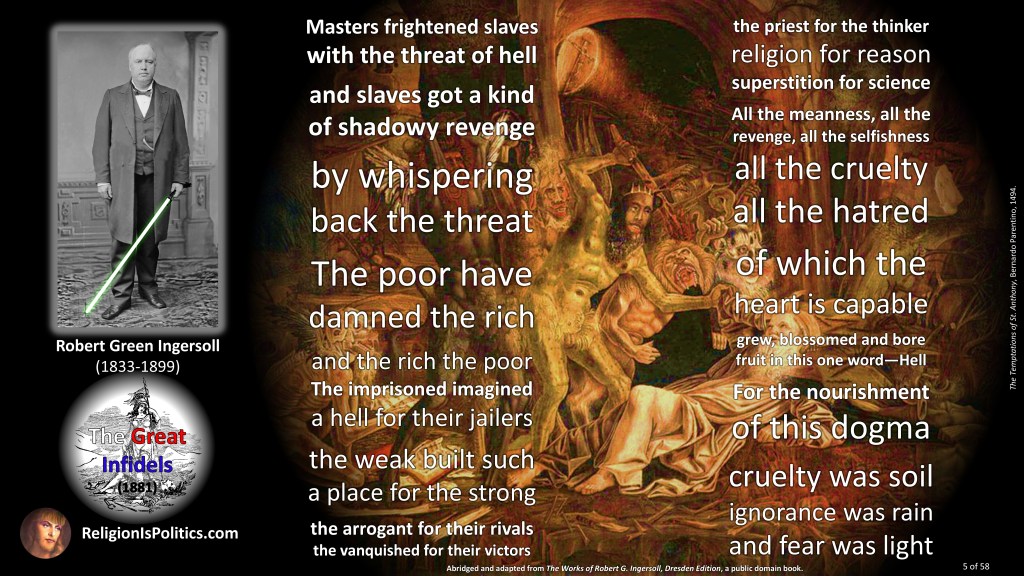
- The Temptations of St. Anthony, Bernardo Parentino, 1494.
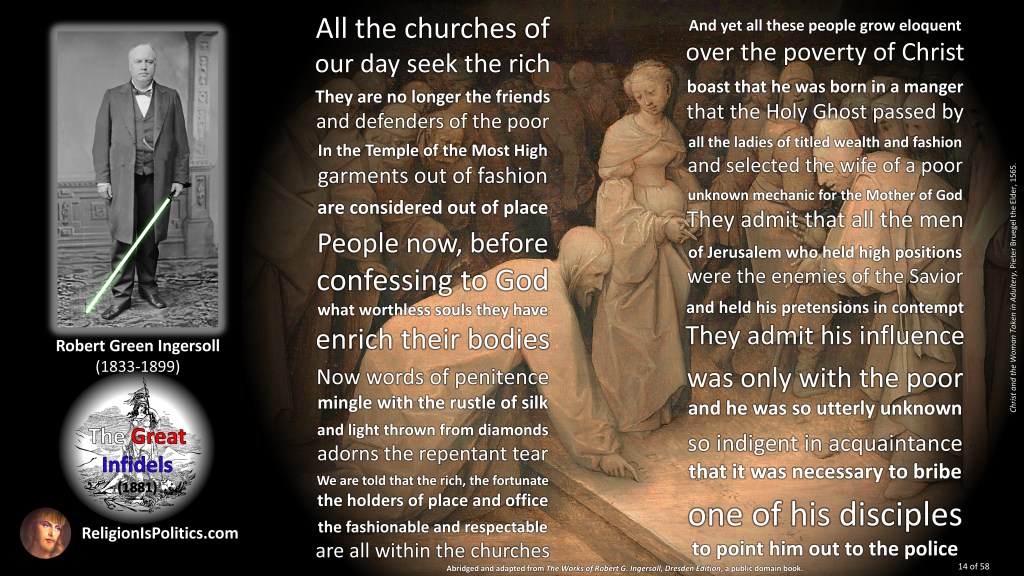
- Christ and the Woman Taken in Adultery, Pieter Bruegel the Elder, 1565.
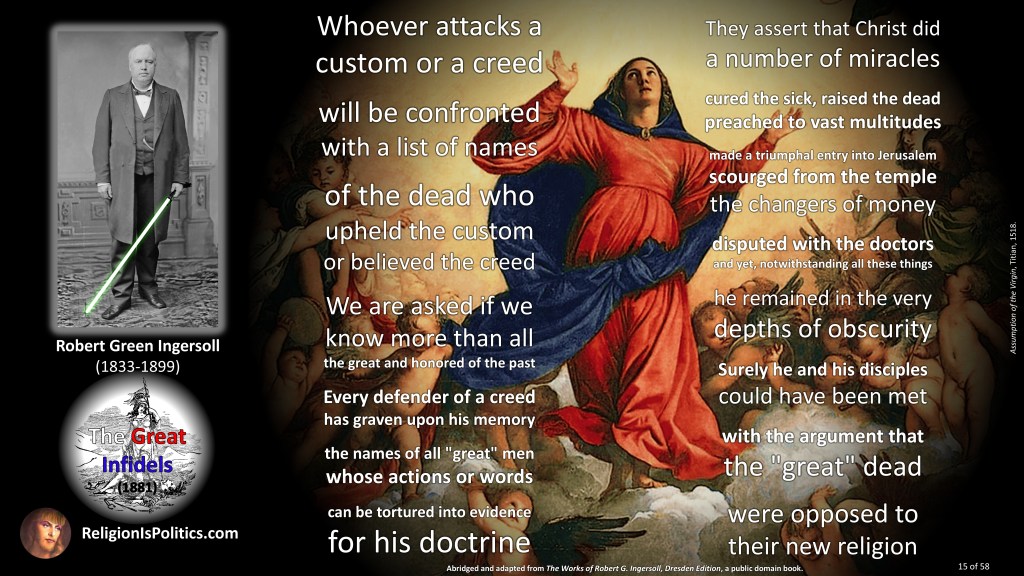
- Assumption of the Virgin, Titian, 1518.
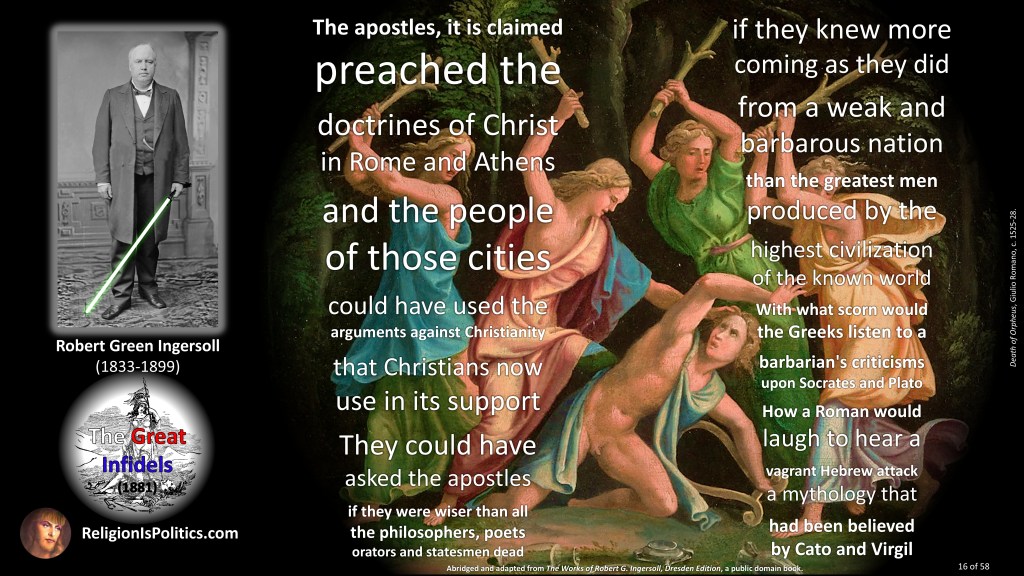
- Death of Orpheus, Giulio Romano, c. 1525-28.
- Solar Eclipse, United States Air Force Air Education and Training Command.
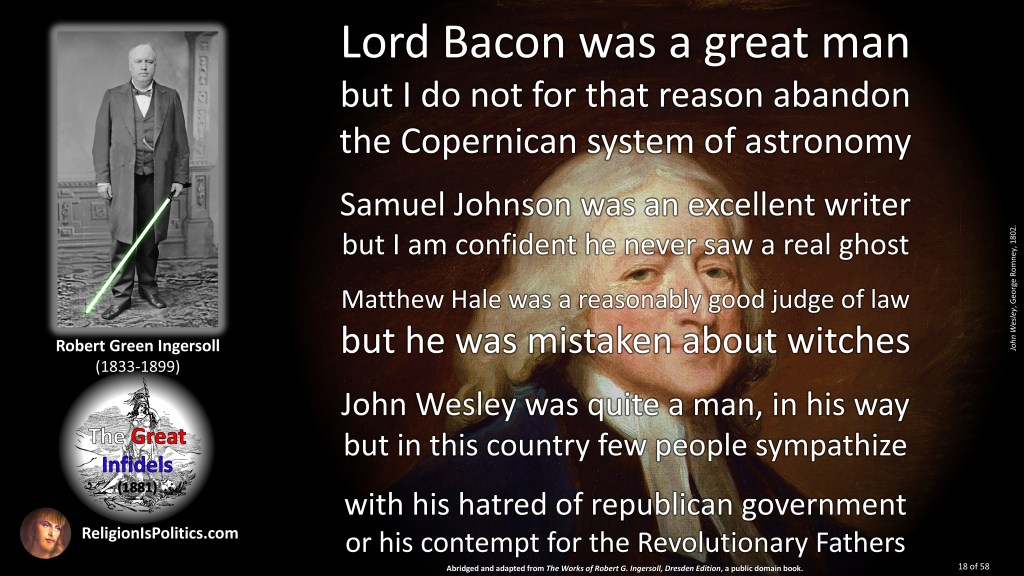
- John Wesley, George Romney, 1802.
- The Death of Napoleon, Charles de Steuben, 1821.
- George Whitefield Preaching Outdoors, John Collet, c. 1766.
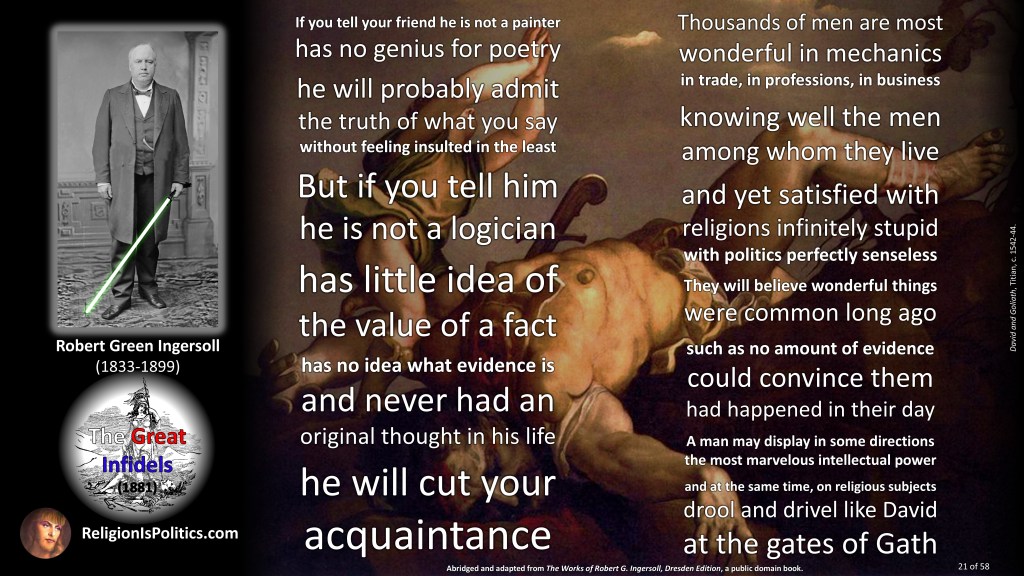
- David and Goliath, Titian, c. 1542-44.
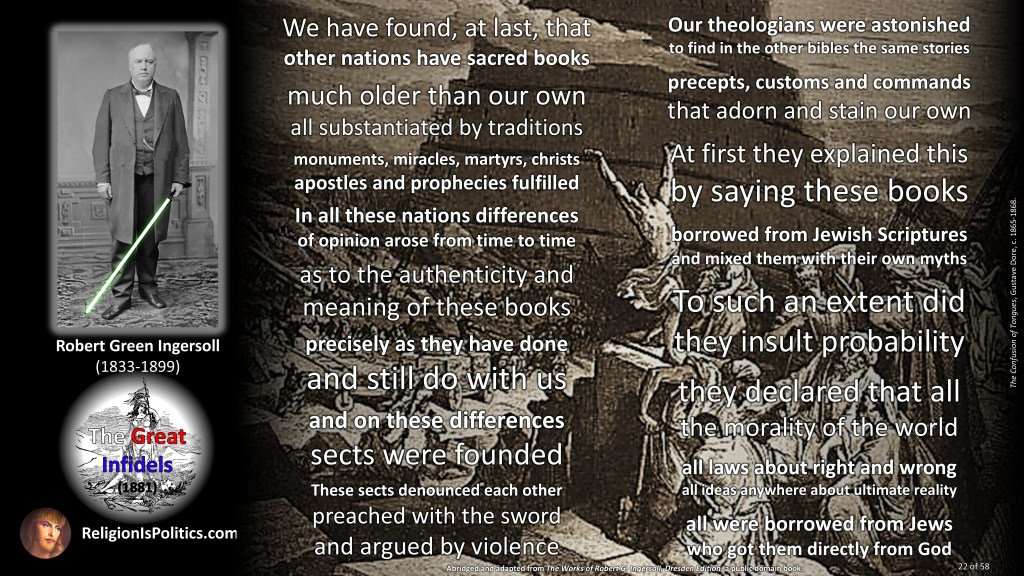
- The Confusion of Tongues, Gustave Dore, c. 1865-1868.
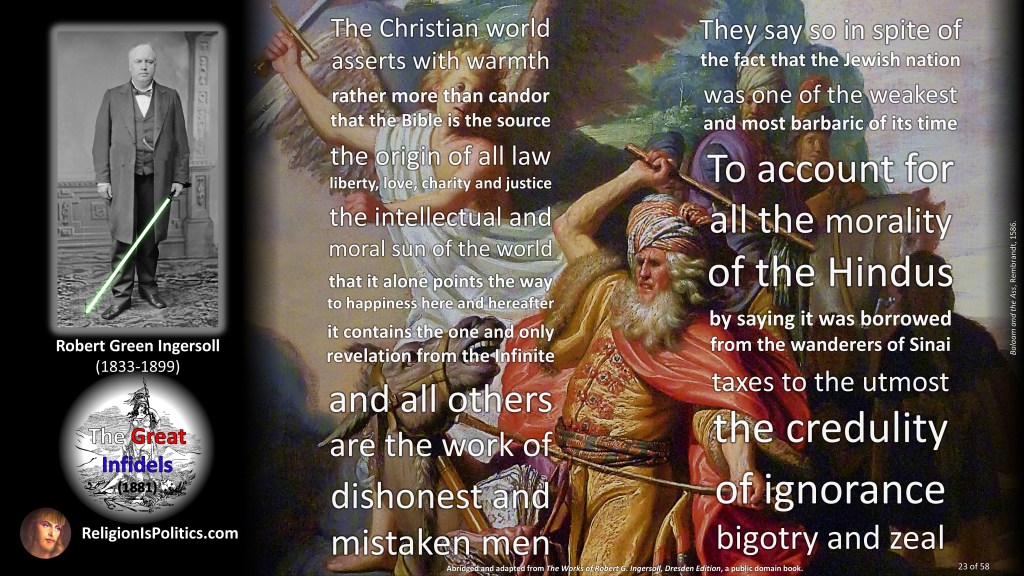
- Balaam and the Ass, Rembrandt, 1626.
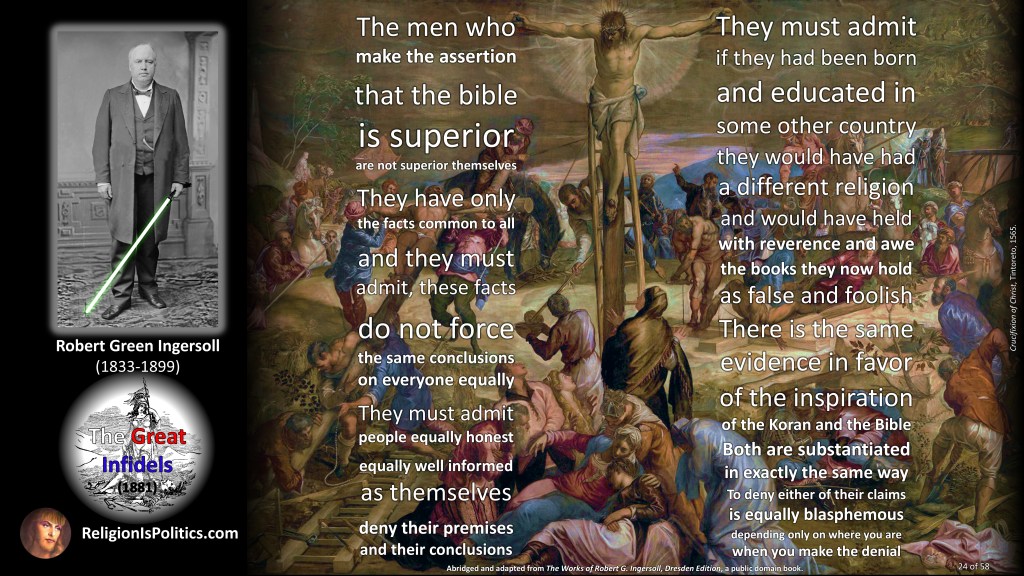
- Crucifixion of Christ, Tintoreto, 1565.
- Joseph Smith daguerrotype, colorized after Dan Larsen by TheOverExcitedDragon at reddit.com/r/exmormon, 2022.
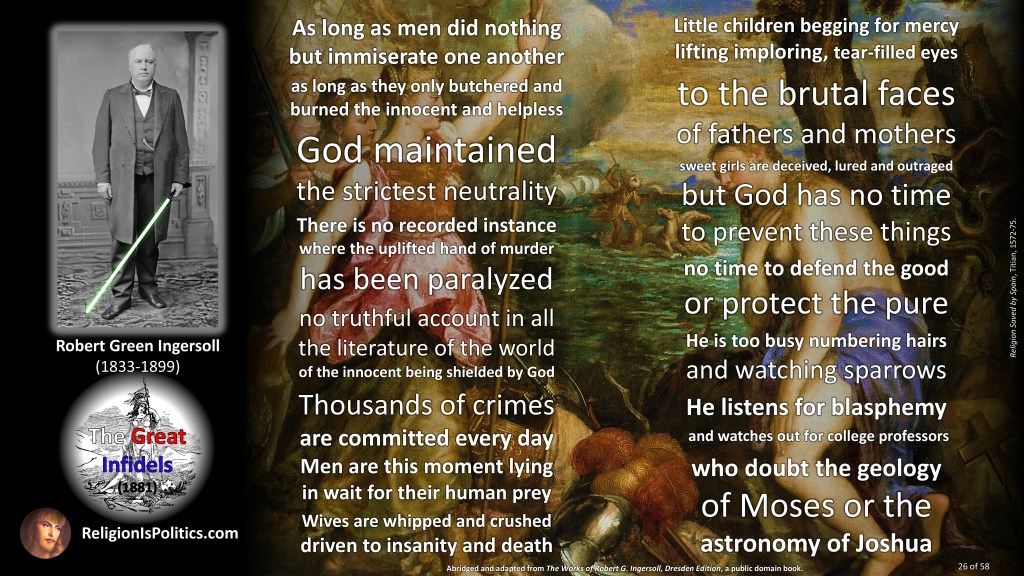
- Religion Saved by Spain, Titian, 1572-75.
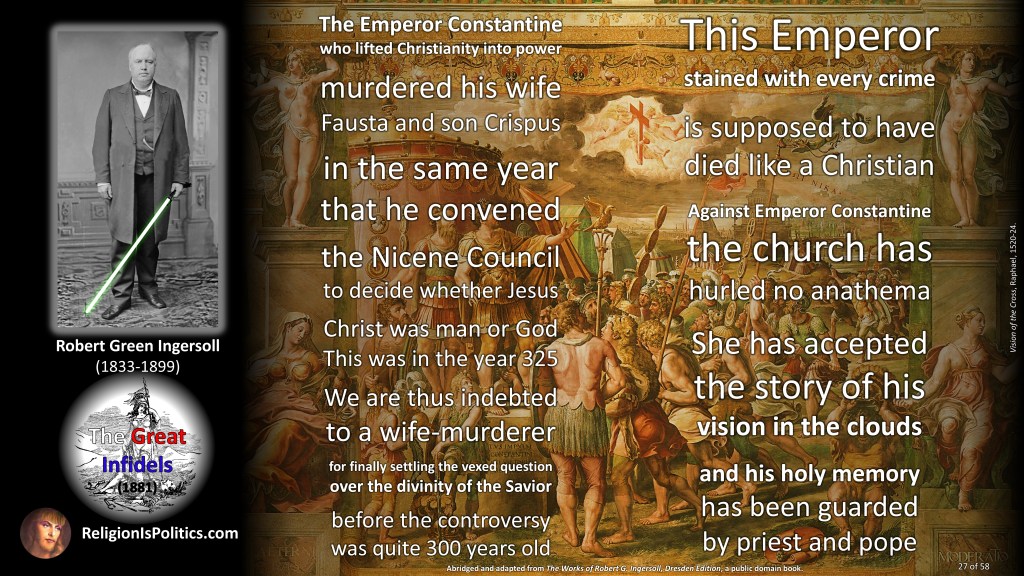
- Vision of the Cross, Raphael, 1520-24.
- Christ Carrying the Cross, Titian, 1565.
- David and Saul, Ernst Josephson, 1878.
- Auto de Fe en la plaza Mayor de Madrid, Francisco Rizi, 1683.
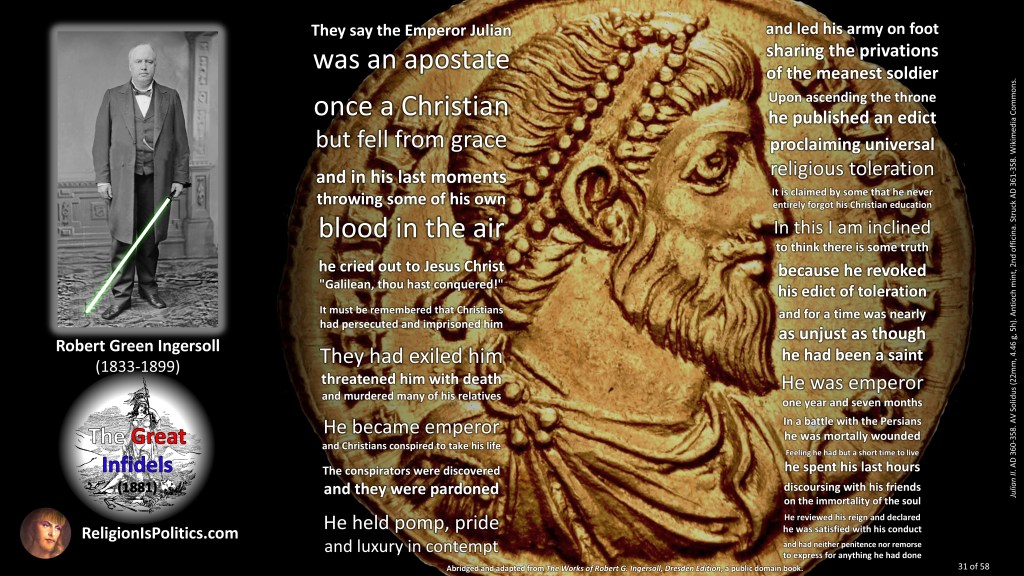
- Julian II. AD 360-363. AV Solidus (22mm, 4.46 g, 5h). Antioch mint, 2nd officina. Struck AD 361-363. Wikimedia Commons.
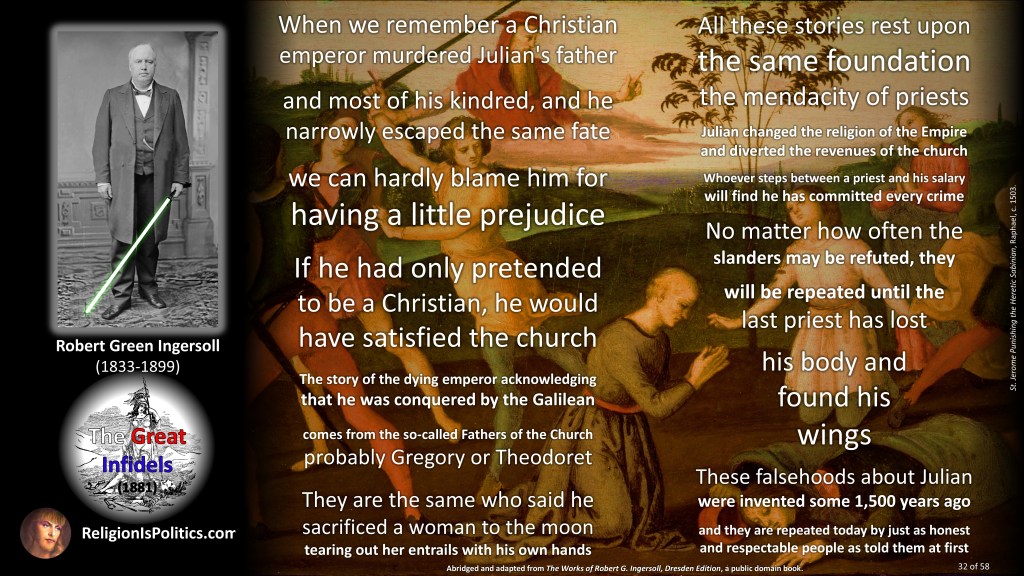
- St. Jerome Punishing the Heretic Sabinian, Raphael, c. 1503.
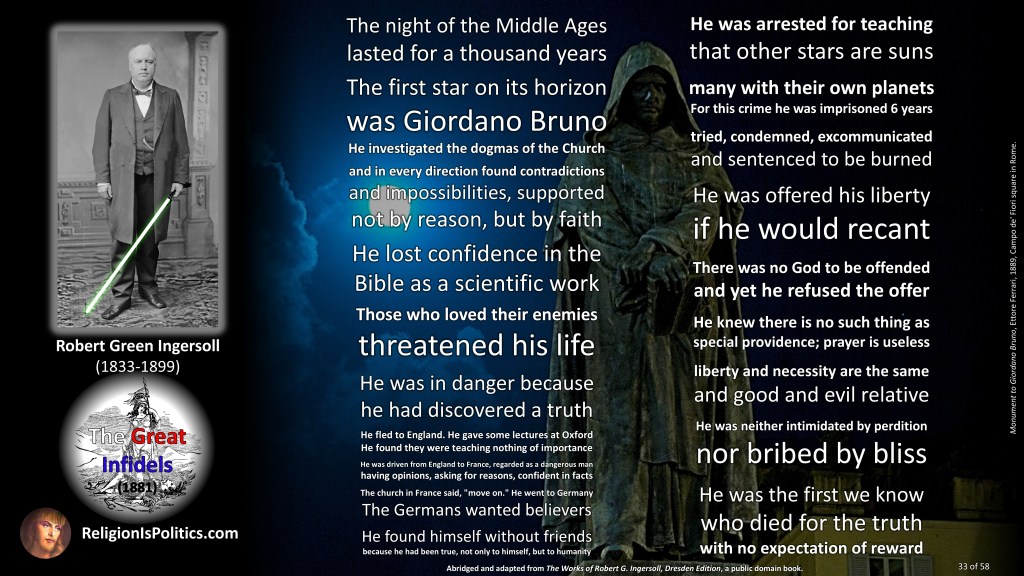
- Monument to Giordano Bruno, Ettore Ferrari, 1889, Campo de’ Fiori square in Rome.
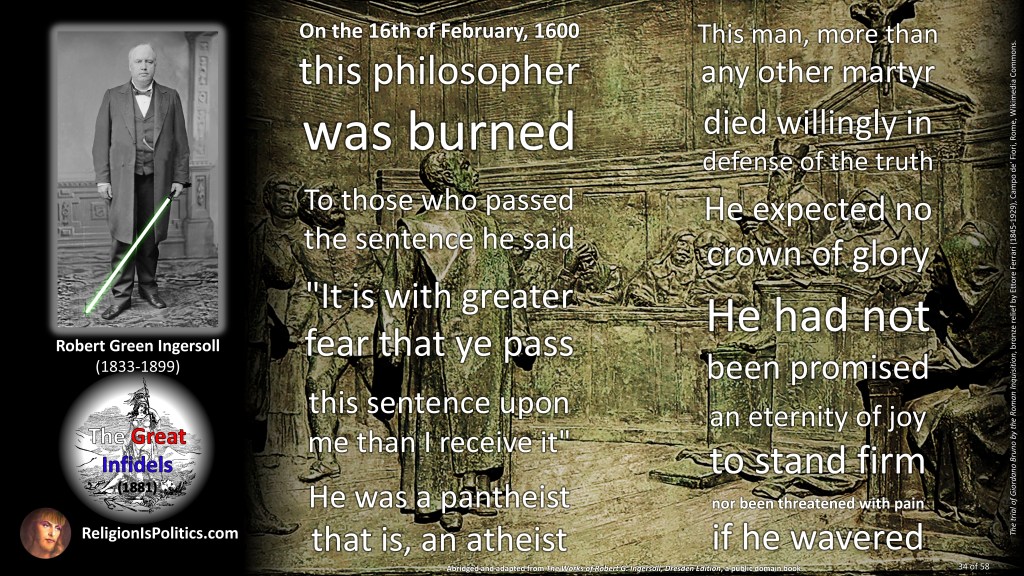
- The trial of Giordano Bruno by the Roman Inquisition, bronze relief by Ettore Ferrari (1845-1929), Campo de’ Fiori, Rome, Wikimedia Commons.
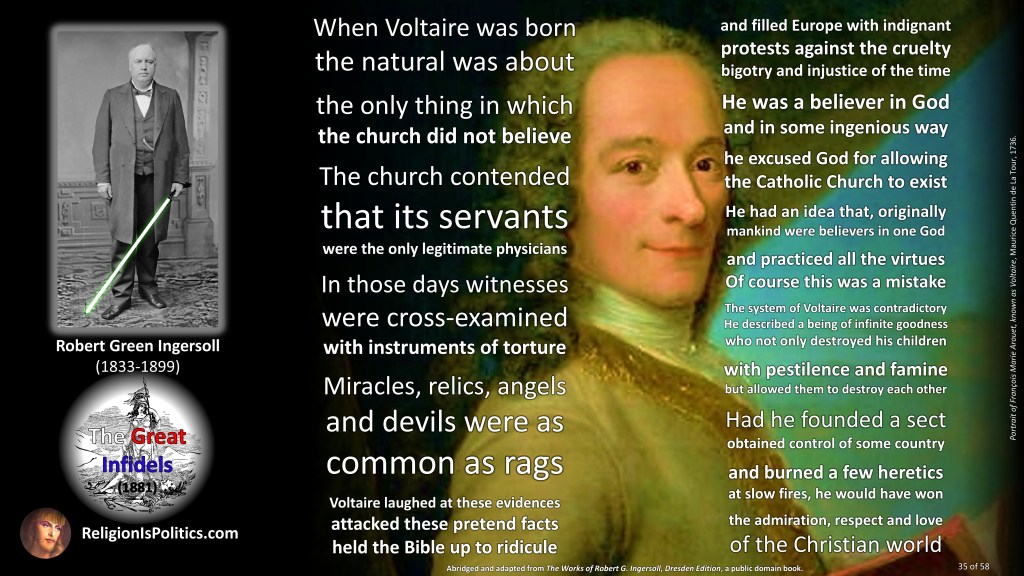
- Portrait of François Marie Arouet, known as Voltaire, Maurice Quentin de La Tour, 1736.
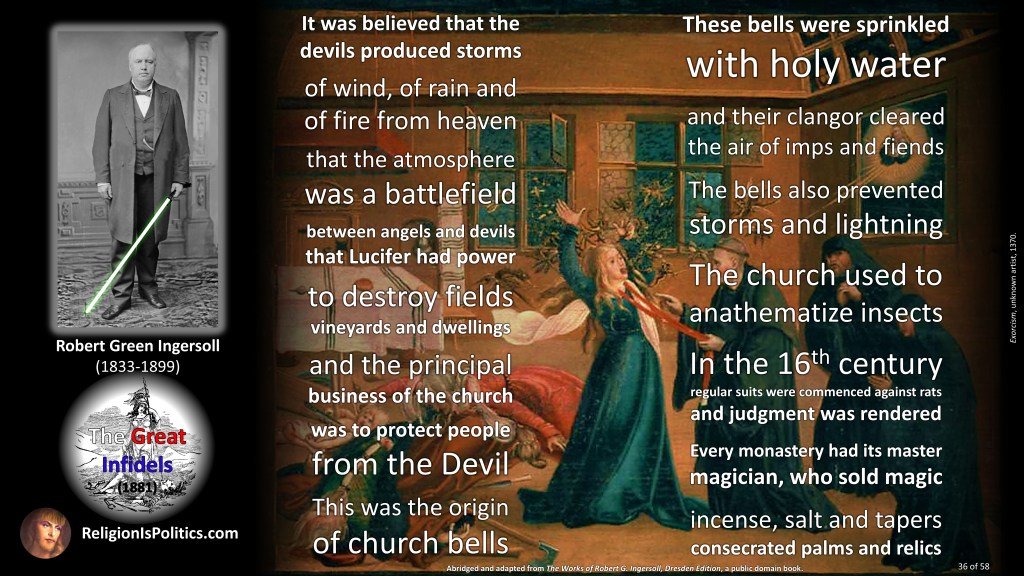
- Exorcism, unknown artist, 1370.
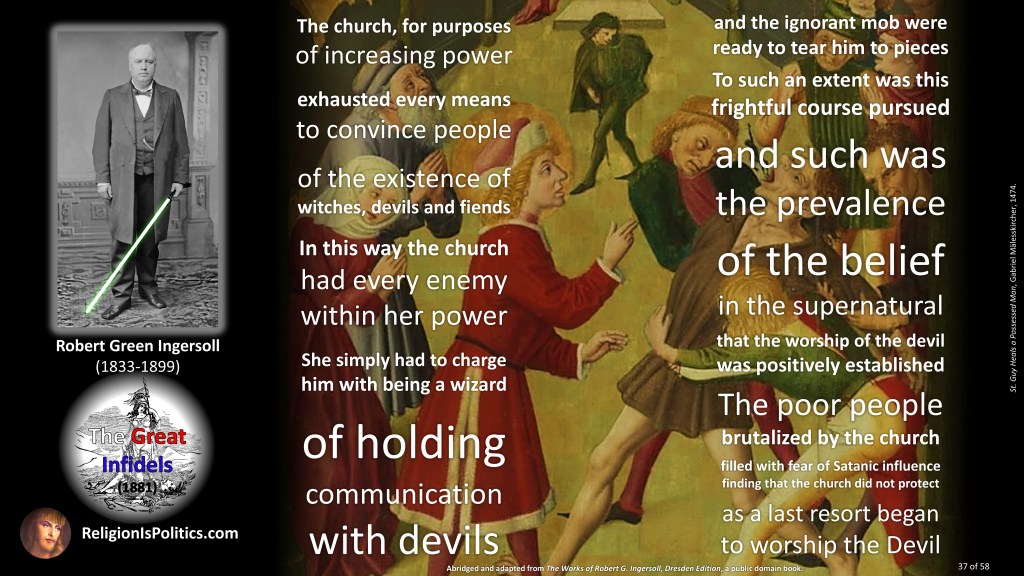
- St. Guy Heals a Possessed Man, Gabriel Mälesskircher, 1474.
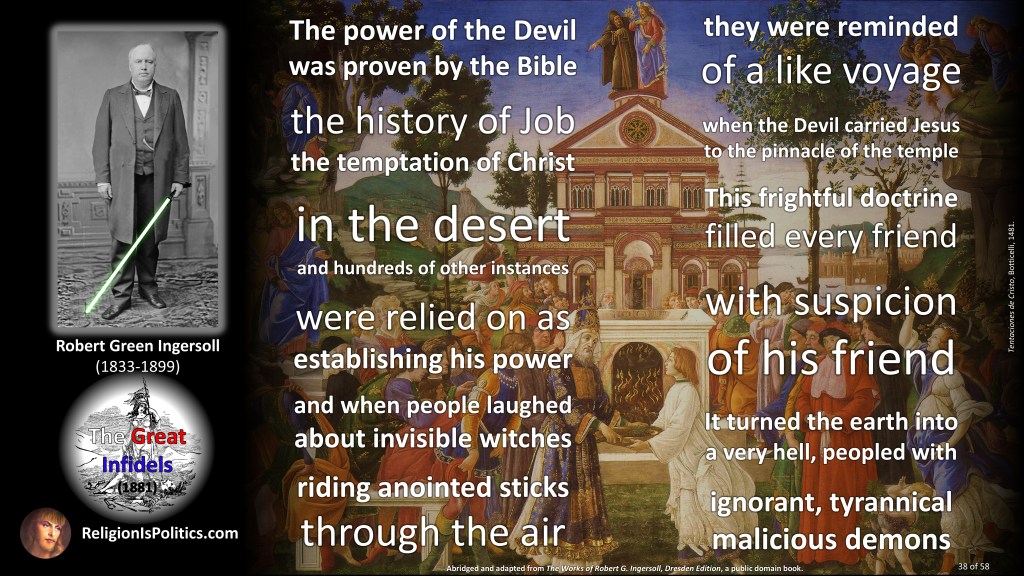
- Tentaciones de Cristo, Botticelli, 1481.
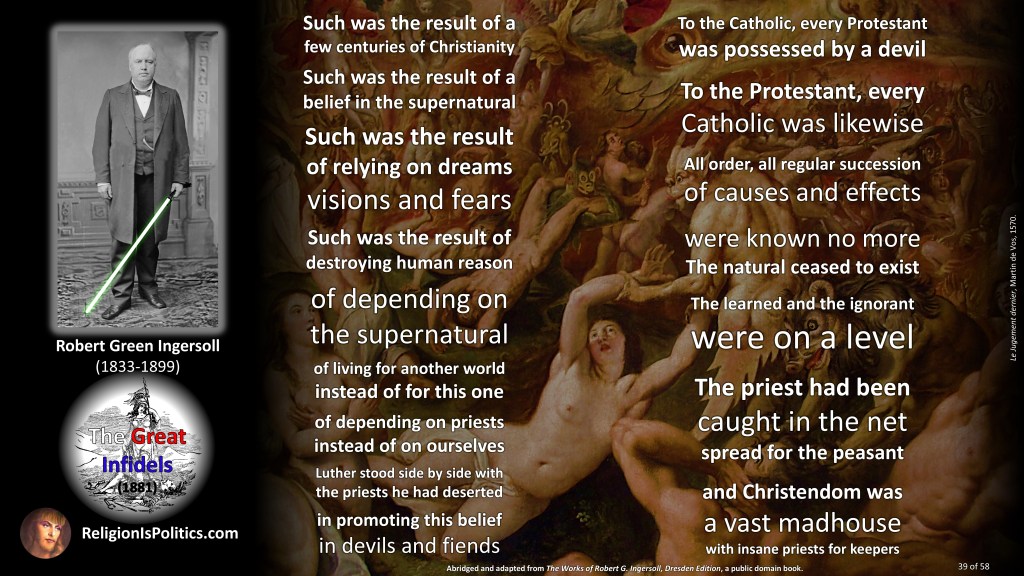
- Le Jugement dernier, Martin de Vos, 1570.
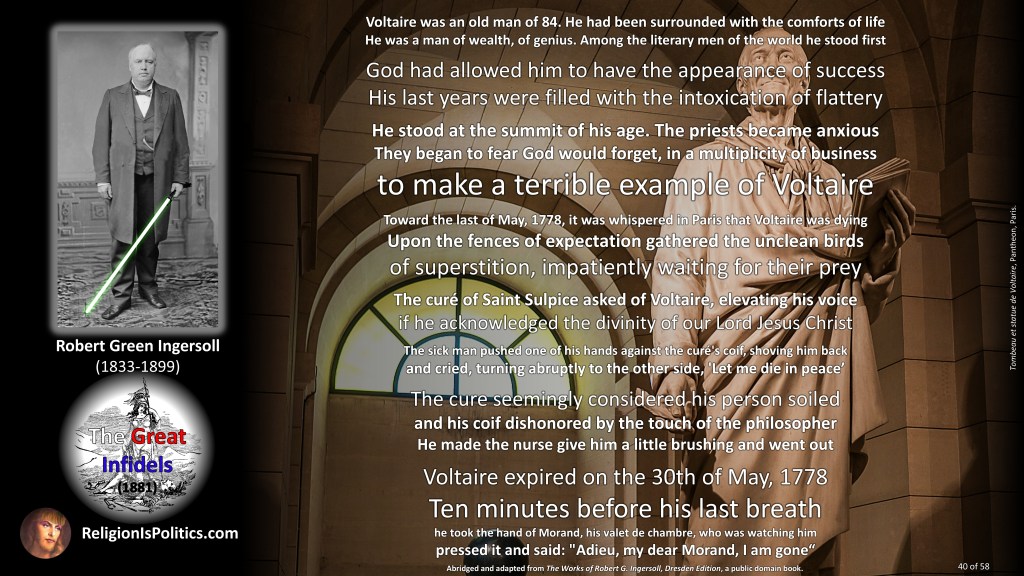
- Tombeau et statue de Voltaire, Pantheon, Paris.
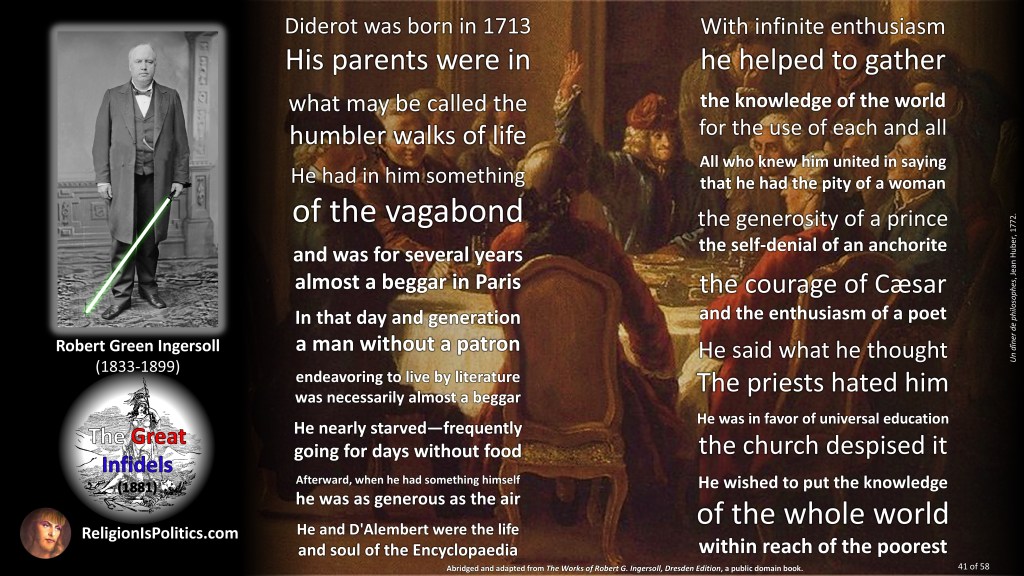
- Un dîner de philosophes, Jean Huber, 1772.
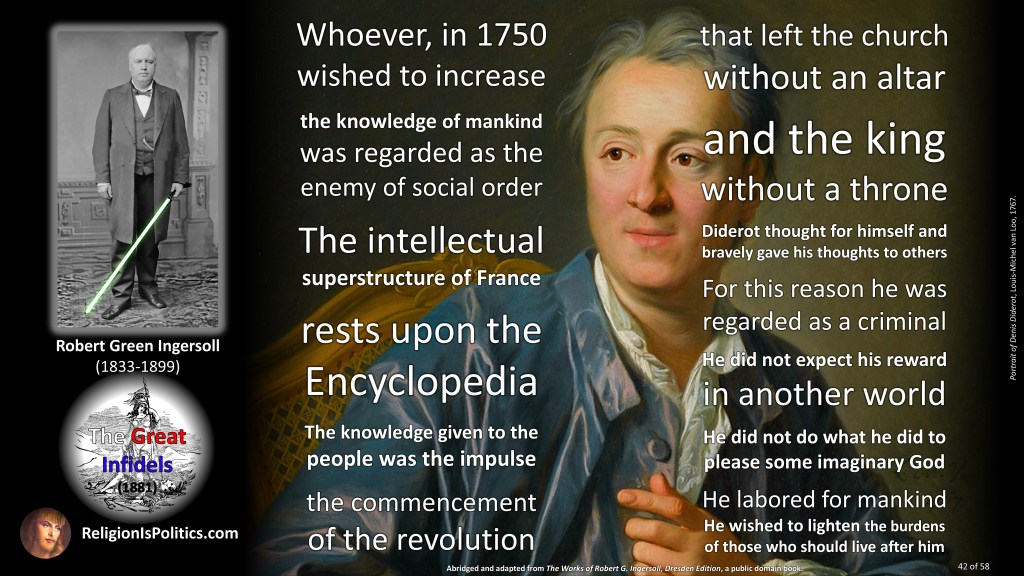
- Portrait of Denis Diderot, Louis-Michel van Loo, 1767.
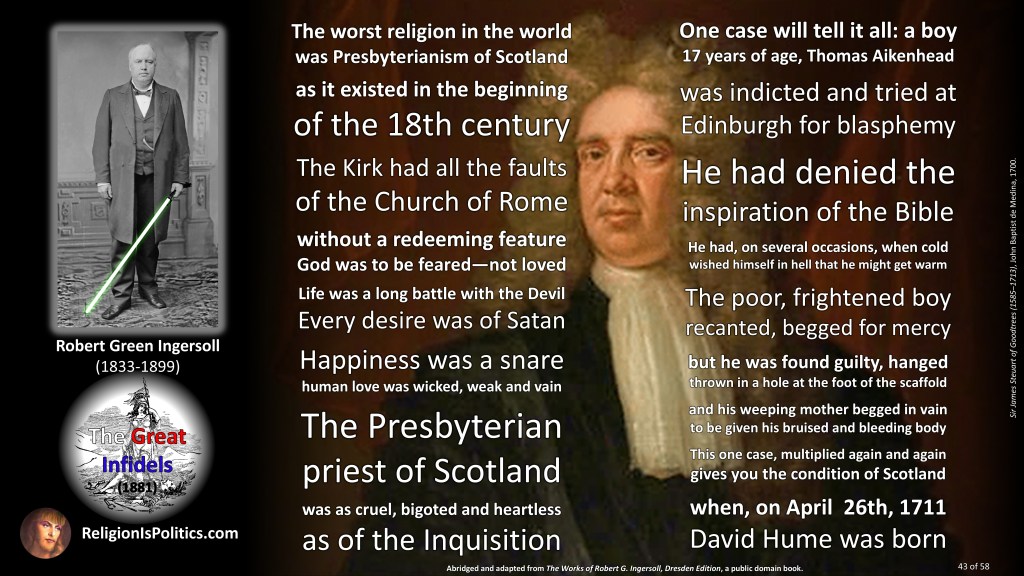
- Sir James Steuart of Goodtrees (1635–1713), John Baptist de Medina, 1700.
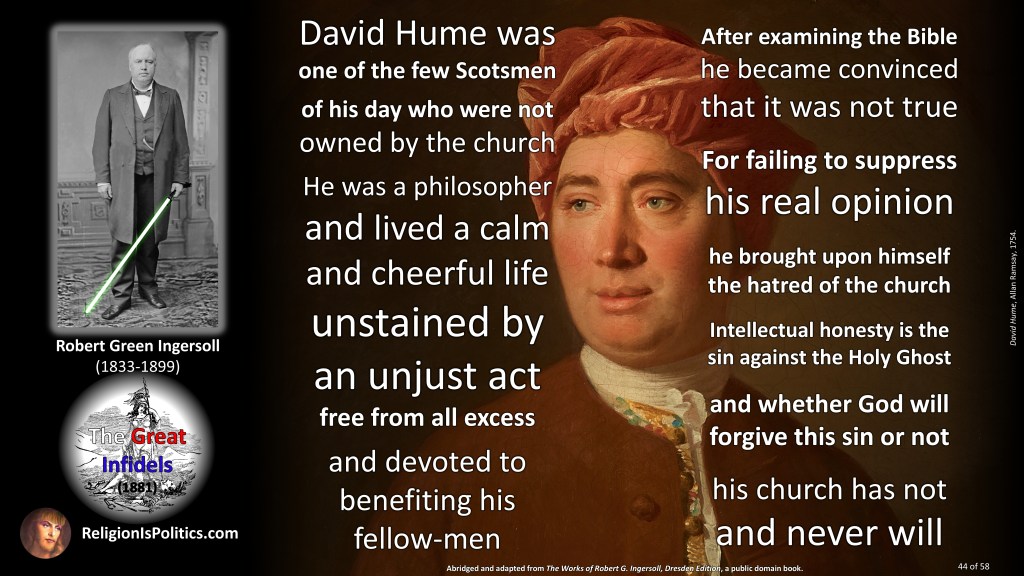
- David Hume, Allan Ramsay, 1754.
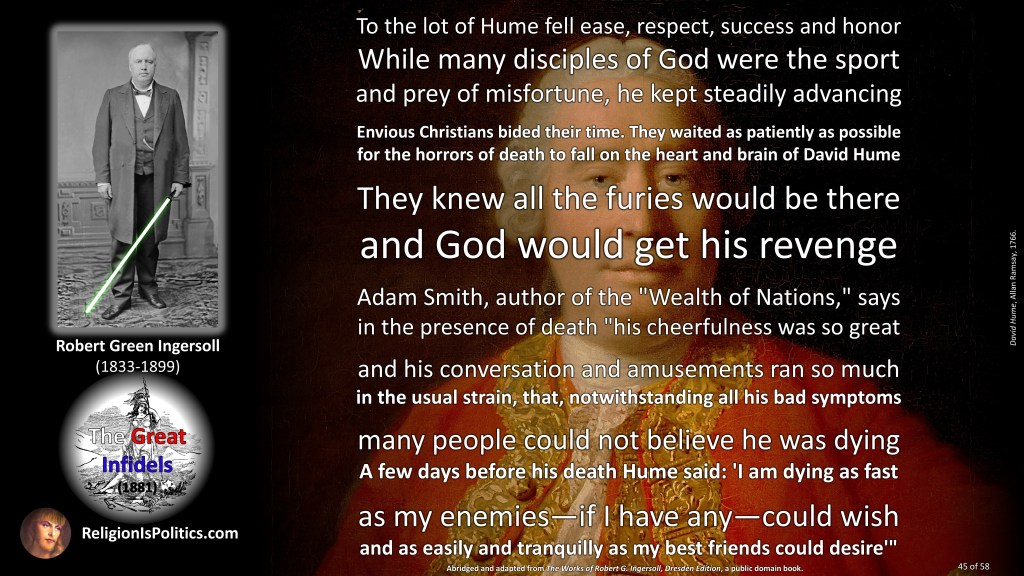
- David Hume, Allan Ramsay, 1766.
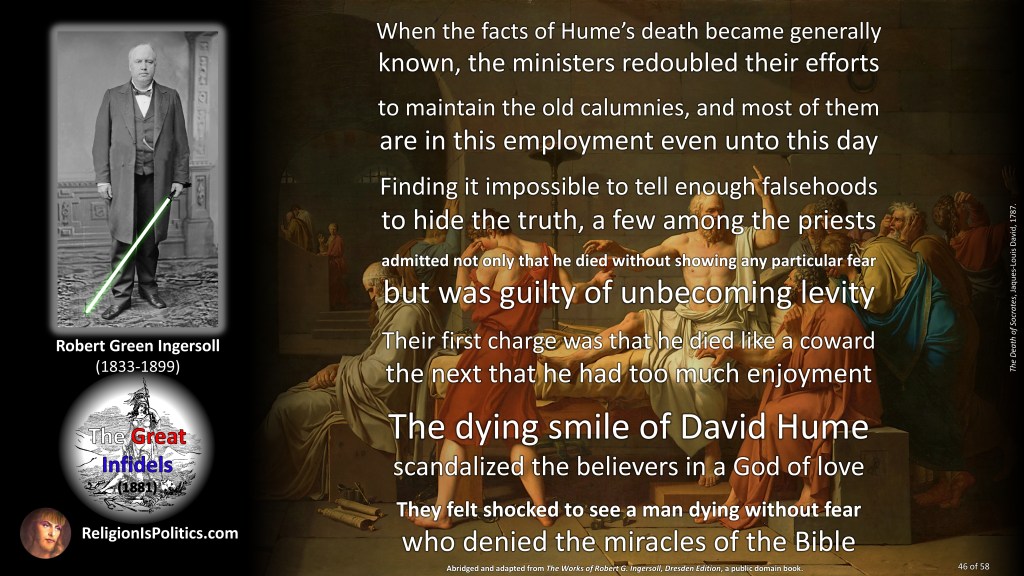
- The Death of Socrates, Jaques-Louis David, 1787.
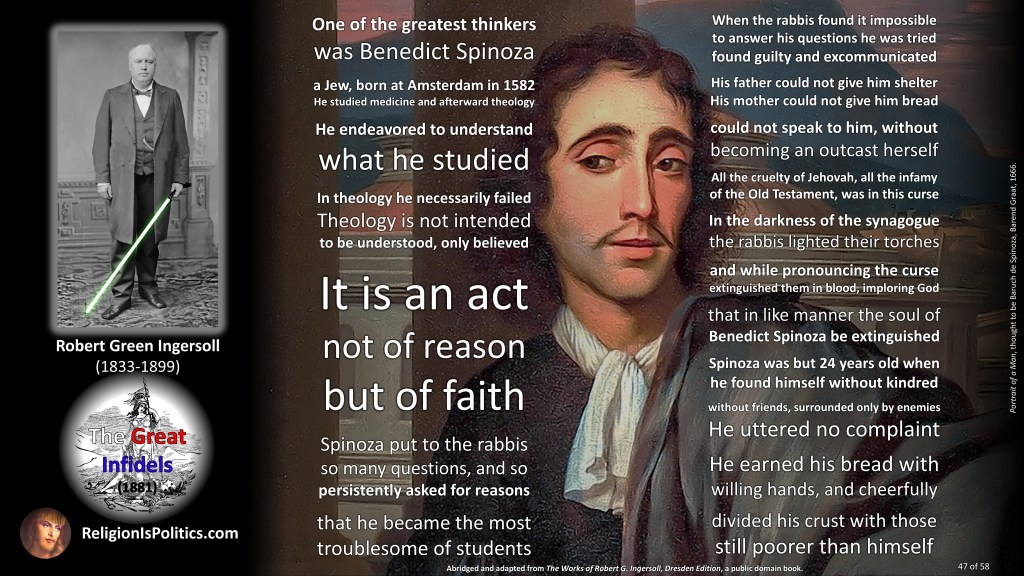
- Portrait of a Man, thought to be Baruch de Spinoza, Barend Graat, 1666.
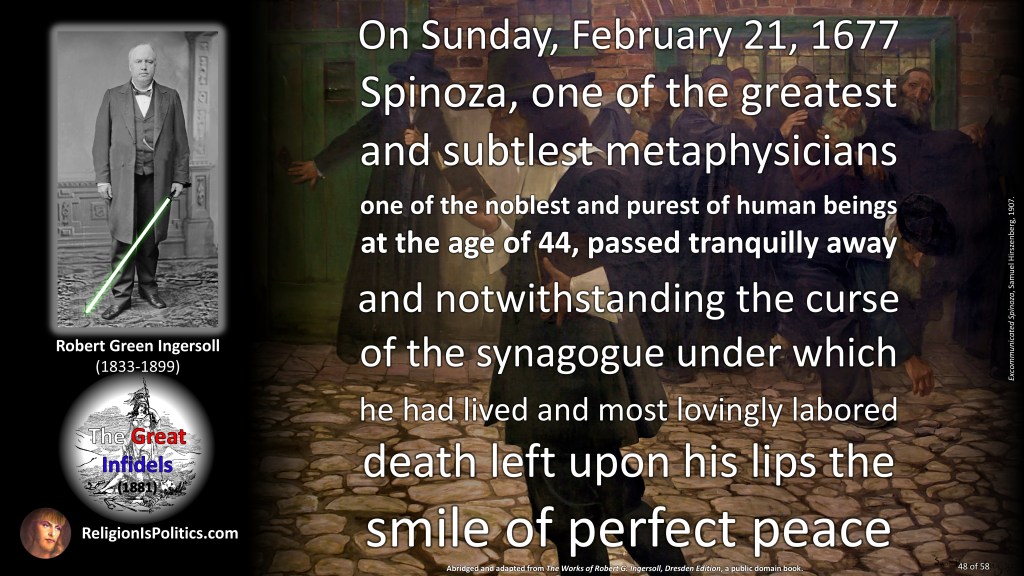
- Excommunicated Spinoza, Samuel Hirszenberg, 1907.
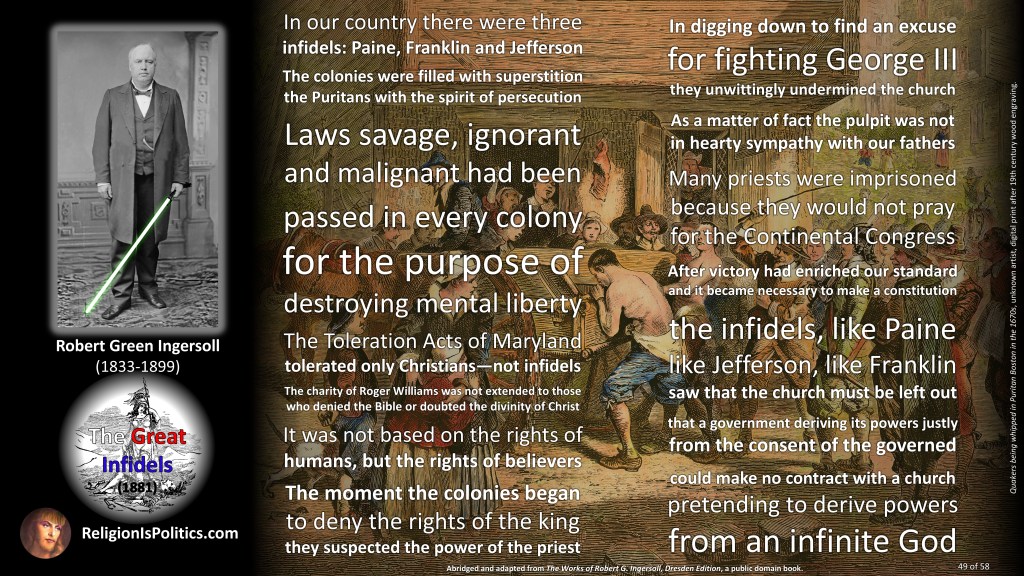
- Quakers being whipped in Puritan Boston in the 1670s, unknown artist, digital print after 19th century wood engraving.
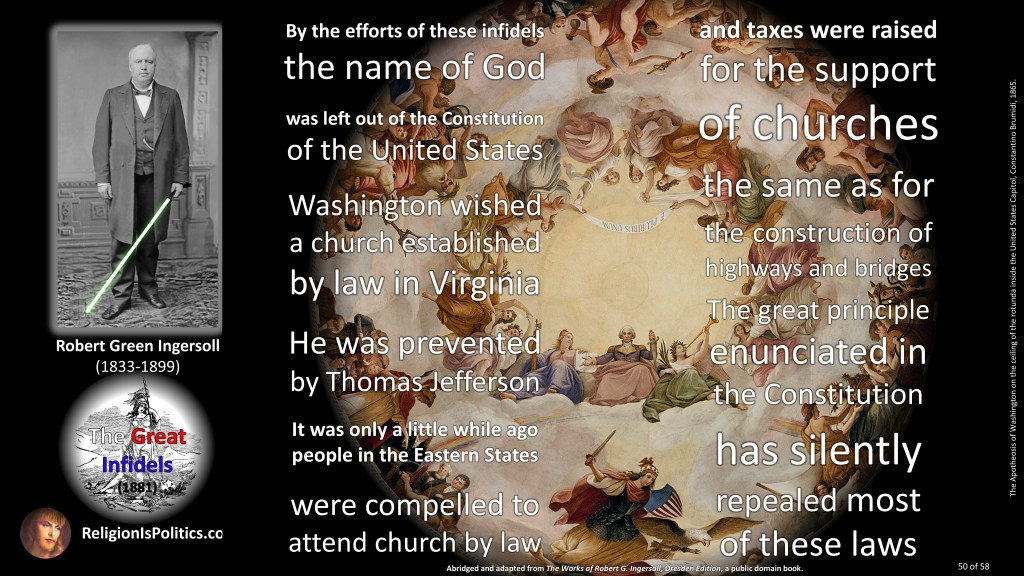
- The Apotheosis of Washington on the ceiling of the rotunda inside the United States Capitol, Constantino Brumidi, 1865.
- Digitally restored and colorized William Sharp engraving of Thomas Paine from 1792 oil painting by George Romney.
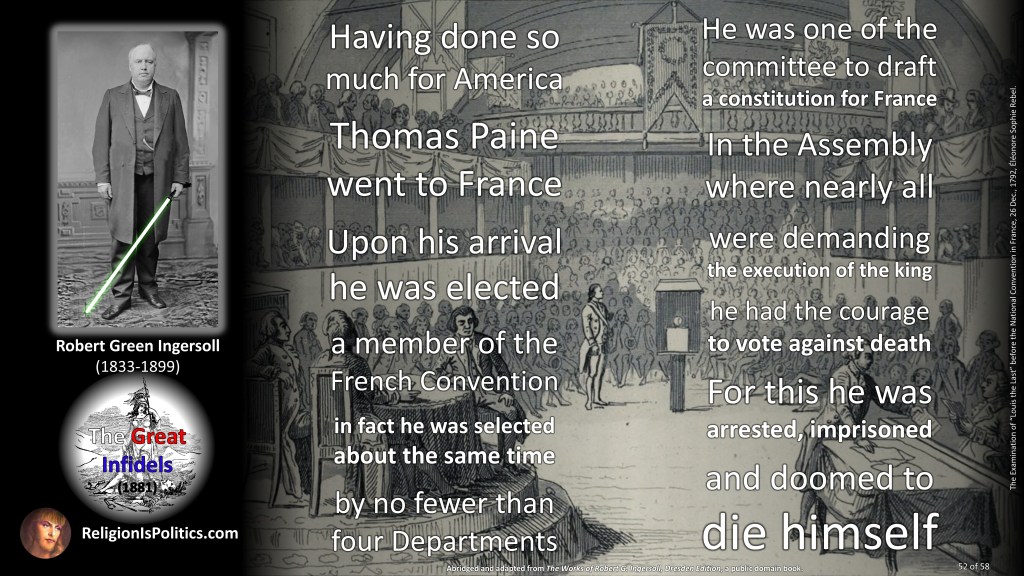
- The Examination of “Louis the Last” before the National Convention in France, 26 Dec., 1792, Éléonore Sophie Rebel.
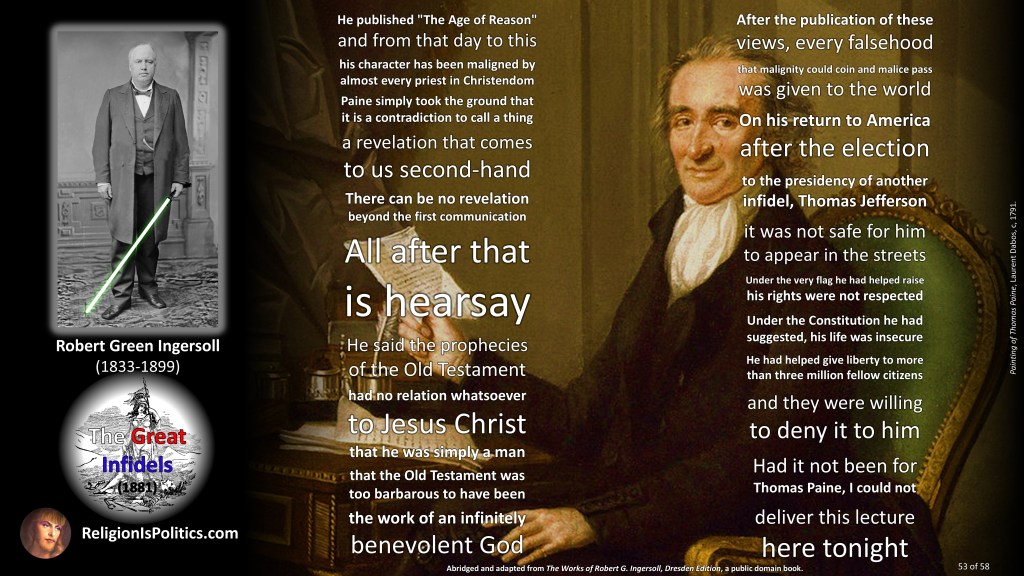
- Painting of Thomas Paine, Laurent Dabos, c, 1791.
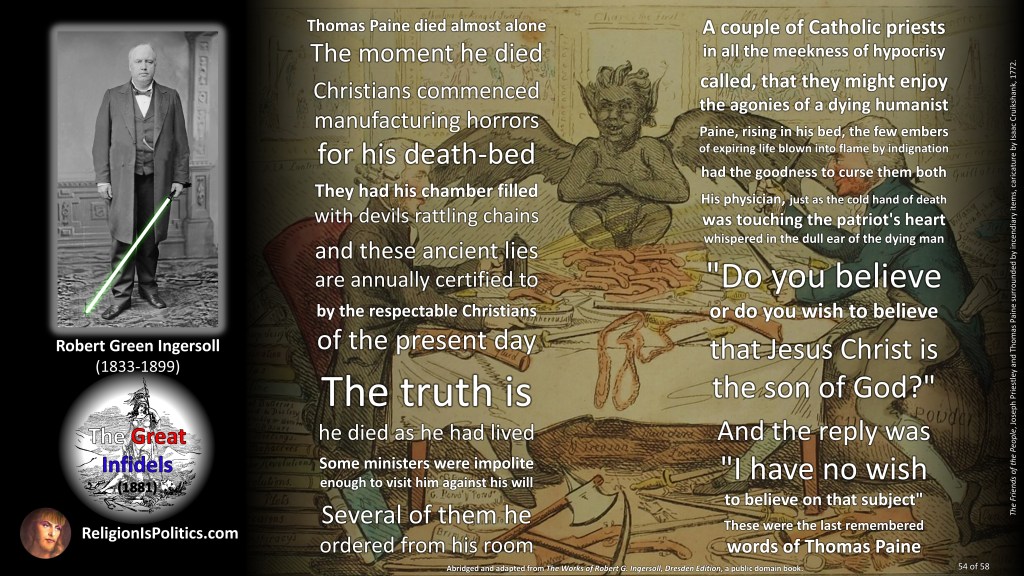
- The Friends of the People, Joseph Priestley and Thomas Paine surrounded by incendiary items, caricature by Isaac Cruikshank, 1772.
- George Washington and Lafayette at Valley Forge, John Ward Dunsmore, 1907.
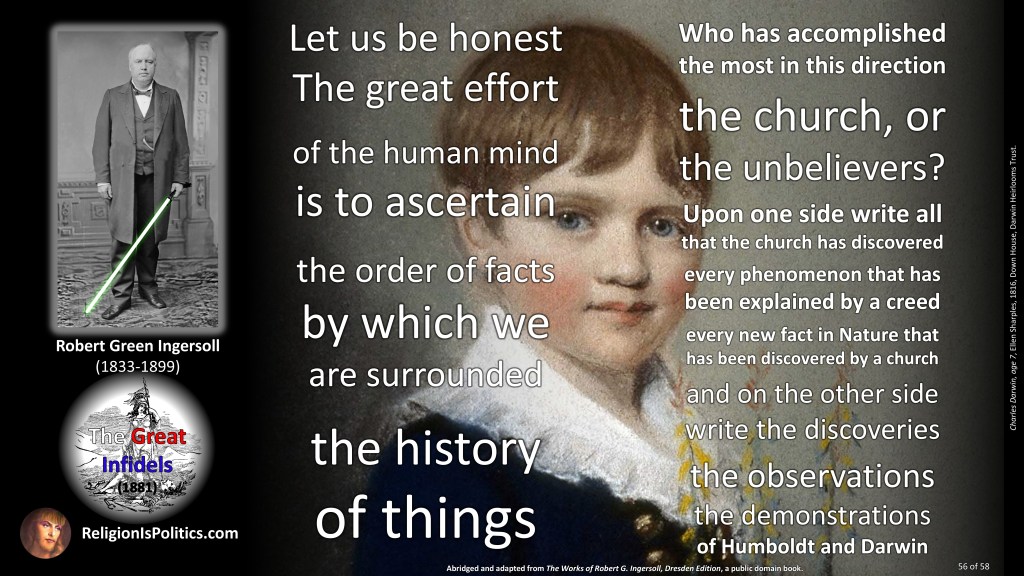
- Charles Darwin, age 7, Ellen Sharples, 1816, Down House, Darwin Heirlooms Trust.
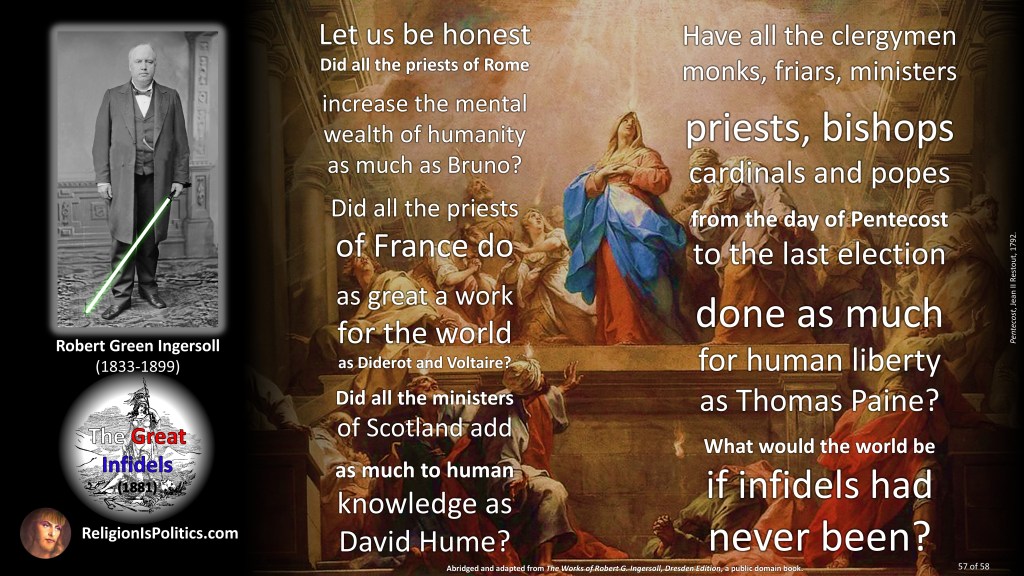
- Pentecost, Jean II Restout, 1792.
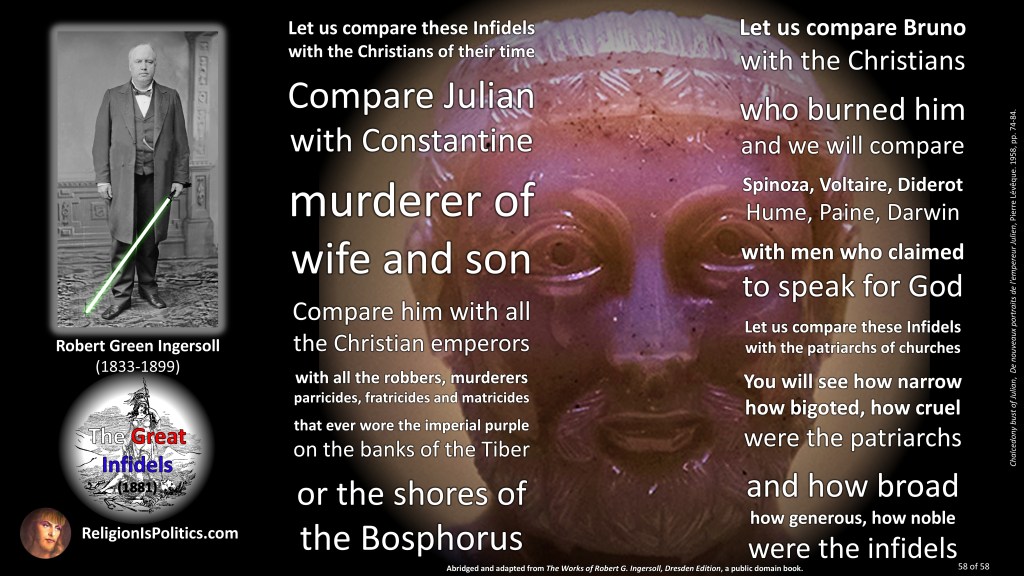
- Chalcedony bust of Julian, De nouveaux portraits de l’empereur Julien, Pierre Lévêque. 1963, pp. 74-84.
 Religion is politics about the unknown