Should divorce be legal at all? This was the actual debate in the United States in the 1880s-90s.
Many conservative Christians, including some who raised me, believe to this day that divorce should be more or less illegal.
Some think it will make their country great again. Some think it for their own selfish reasons.
I don’t argue with them. I tell them they lost this debate more than 100 years ago.
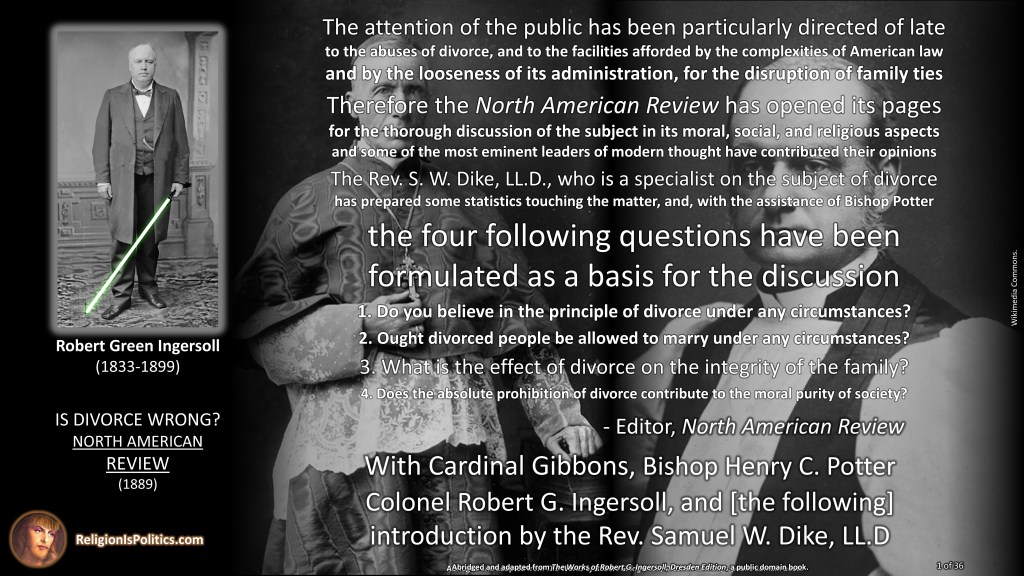
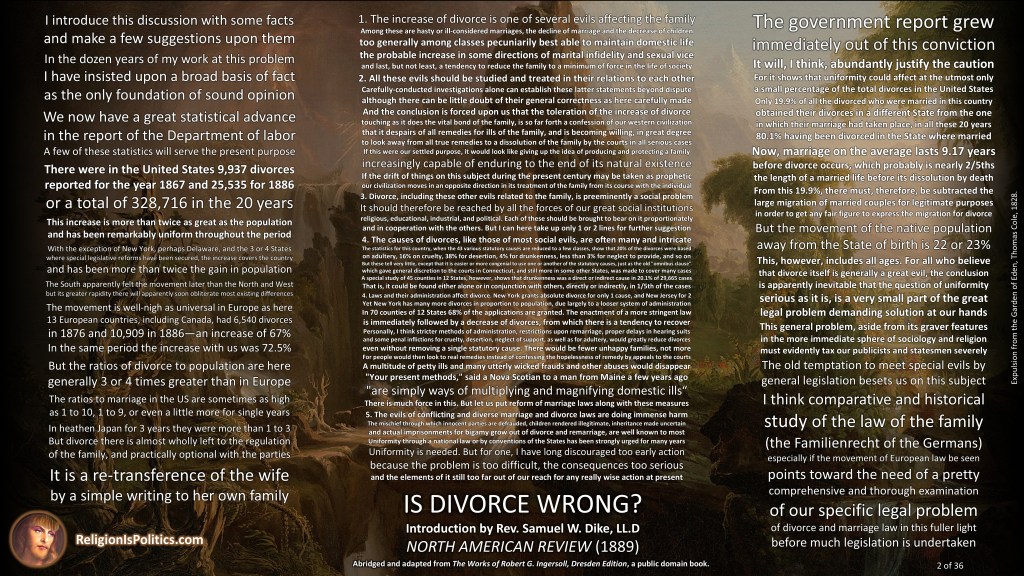
I refer them to this debate between Robert Green Ingersoll and several clergymen in the pages of the North American Review from December through February, 1889-90.
Even before women had a vote, they had lost this debate. And here you can read all about it.
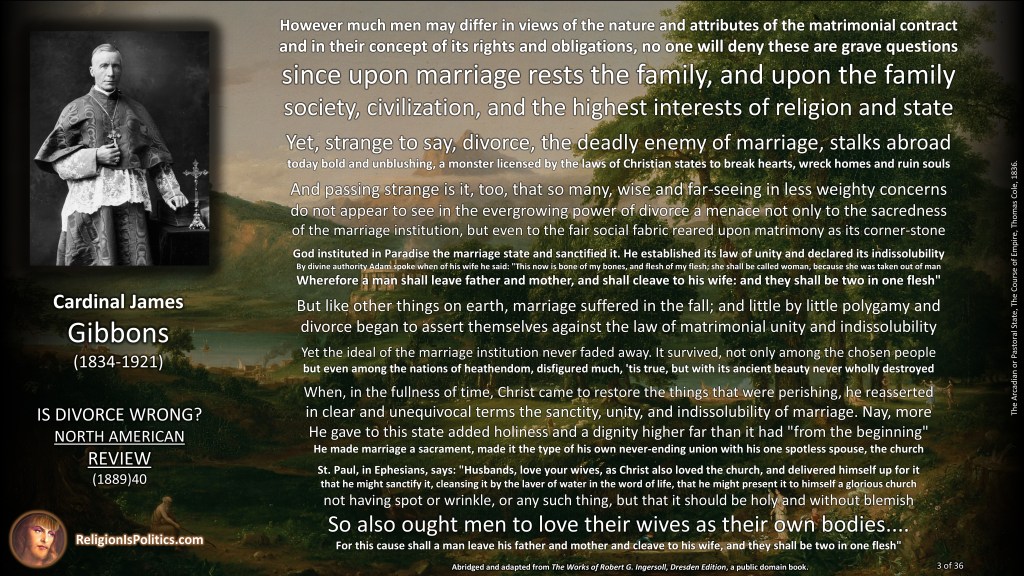
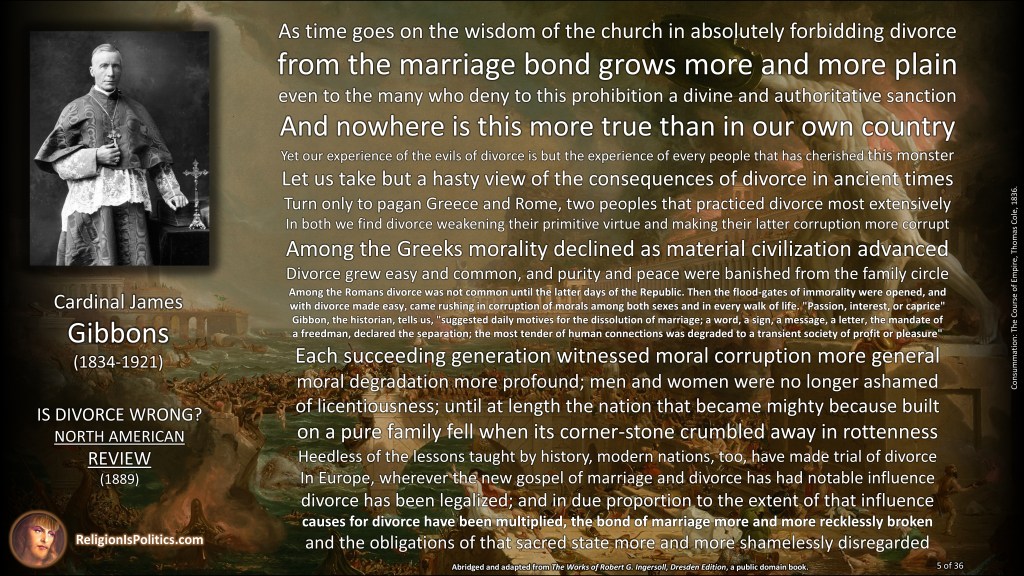
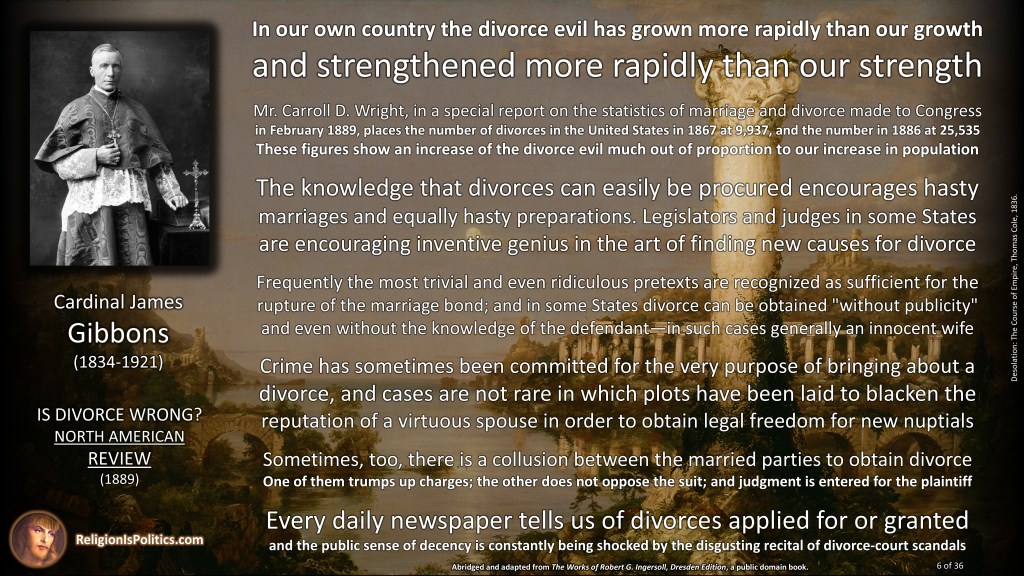
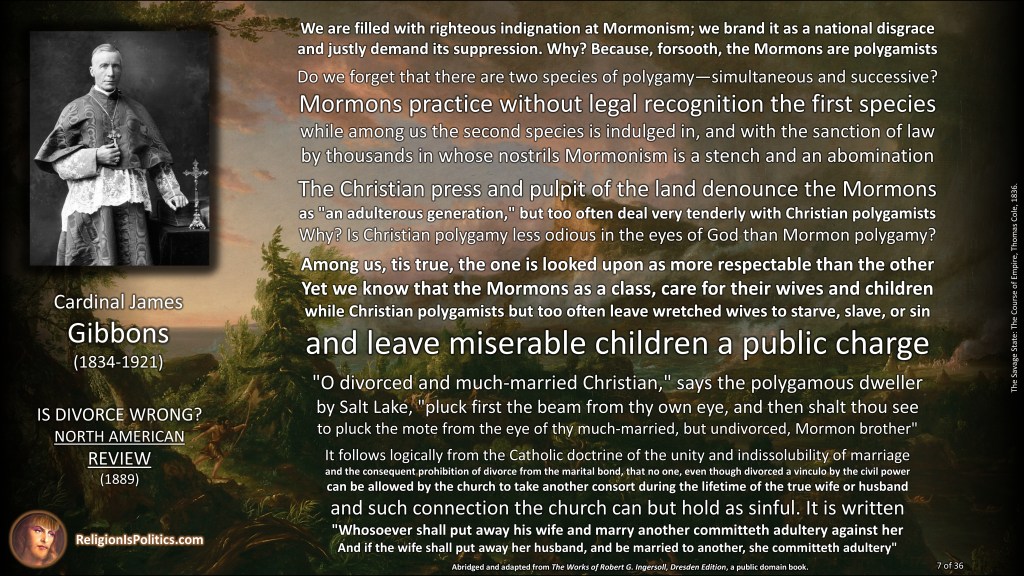
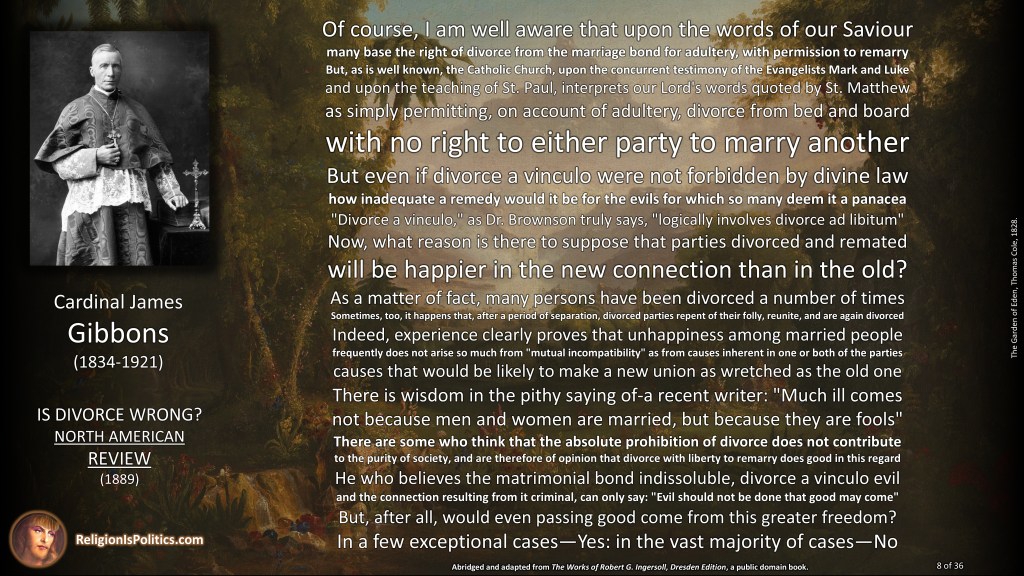
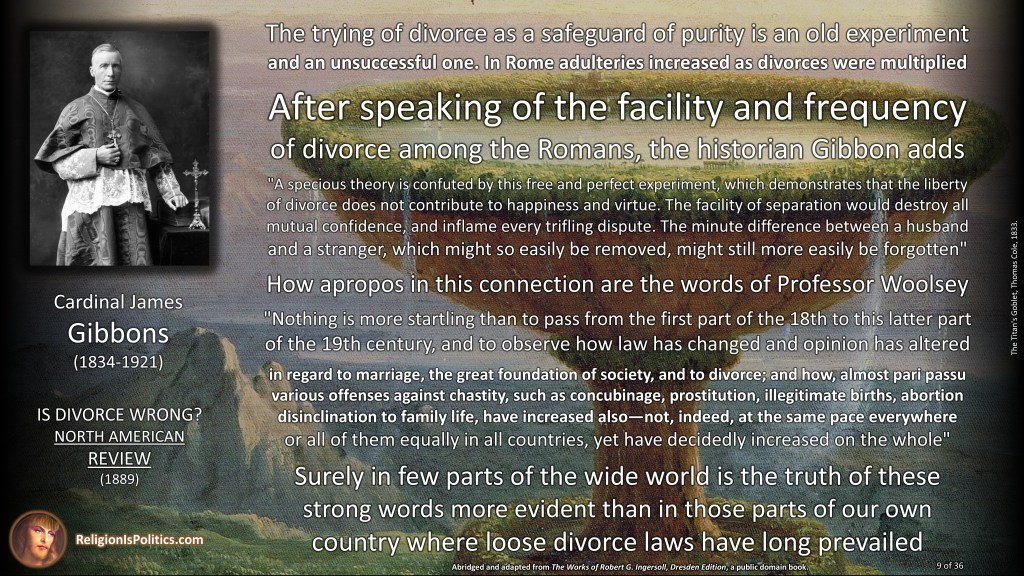
After the introduction, the debate began with the essay of Roman Catholic Cardinal James Gibbons. I found him an excellent writer by the standards of the time. I give him credit for making almost the strongest case he could have, but in his dogmatism he let slip some embarrassing admissions that later apologists learned to avoid.
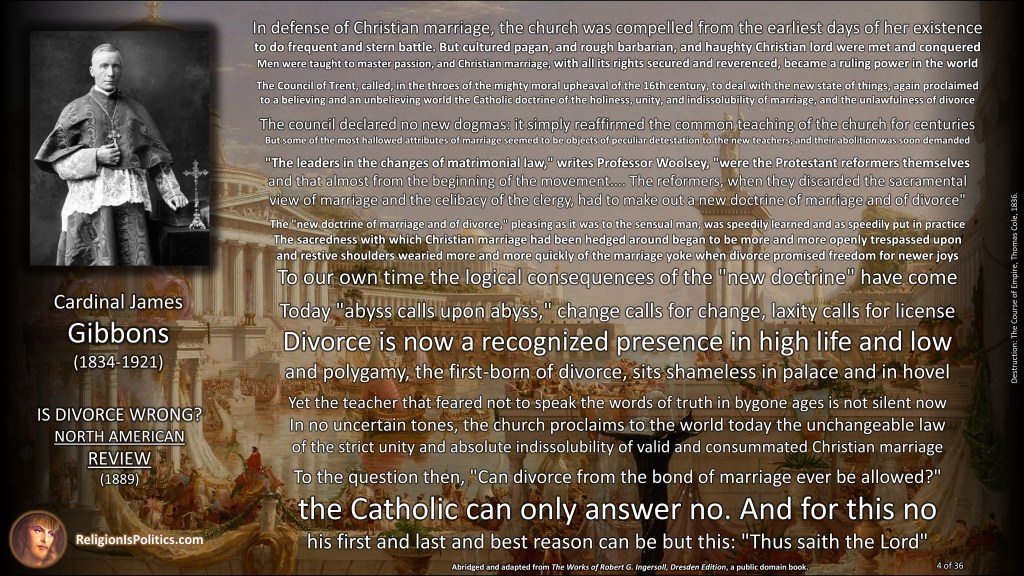
Christians did not bring monogamy to pagan Rome. They found it there.
Romans despised polygamy. Early Christians despised sex. They thought it was a temptation dragging them to hell. And they expected to be raised to heaven within their very lifetimes. But as they had to come to terms with death, so also they had to come to terms with sex, as lifetime after lifetime passed without Jesus’ return.
This created an evolving identity crisis. All kinds of beliefs proliferated to explain it. The beliefs that survived were the ones adapted to the family values of the Roman Empire.
Rome was a steep, rigid patriarchy, but at least there were female priesthoods and wide public access to divorce. When Christians took over, they replaced priestesses with nuns, made women handmaids, redefined divorce as a form of polygamy, made divorce illegal, and finally took credit for abolishing polygamy in Rome.
They still do. The clergy are not educators, they are salesmen. Women clergy are educators, because they have so much to teach from their uphill battle against sexism. Theology is the most sexist part of Christian society, and it has been ever since the divorce of Yahweh and Asherah.
The Cardinal blamed all the decline in the Western Empire after Rome converted to Christianity on the fact that not every citizen converted and the fact that people still got divorced.
He was absolutely scandalized that someone might be able to get out of a bad relationship as easily as into it. He could not bear the thought and he could not believe God could bear it either.
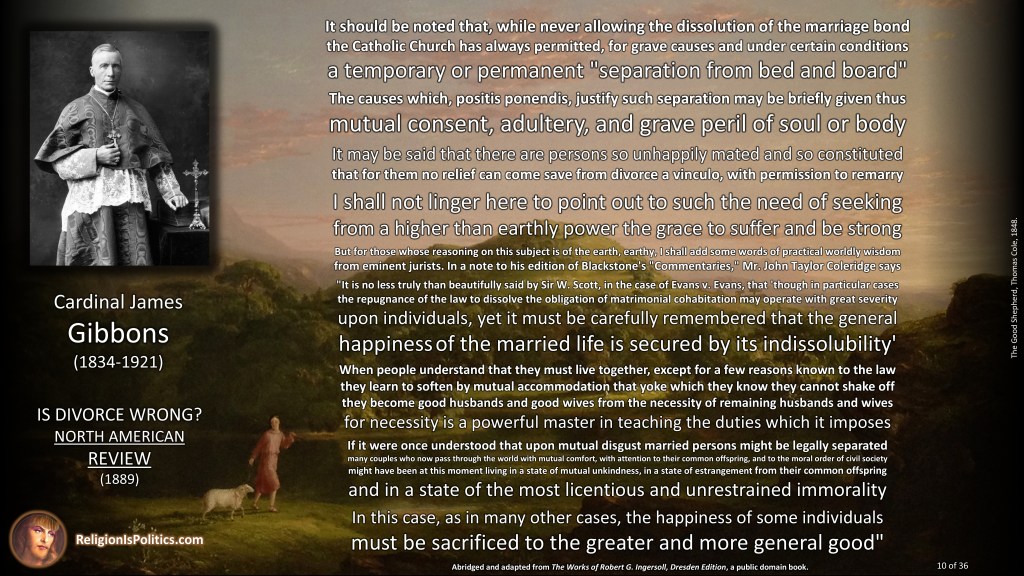
He emphasized that his church will always allow you to take a break from your abusive relationship, but you absolutely may not end it. Is his church not merciful?
The Cardinal claims that what holds couples together and makes happy couples happy is, in fact, the knowledge that unhappy couples are trapped together without any alternatives. This shows how much he really knows about happy relationships.
He should not have so readily admitted that people must be trapped to remain in Catholic marriages. This was a self-inflicted injury.
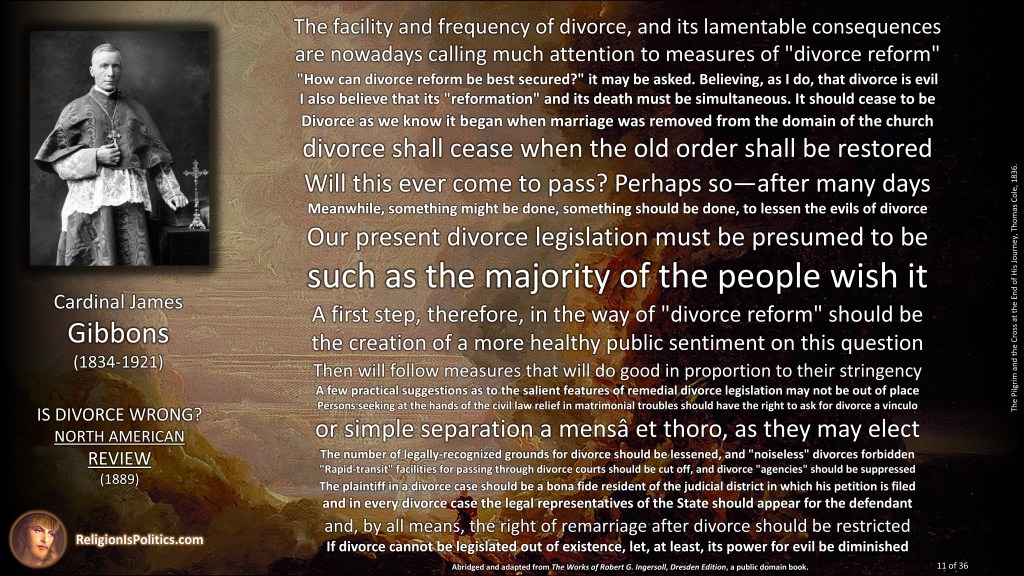
He candidly admitted he could never get the divorce laws he wants in a democracy, at least not without brainwashing the population first. And then he laid out basically the same playbook that the anti-abortion lobby are still using today.
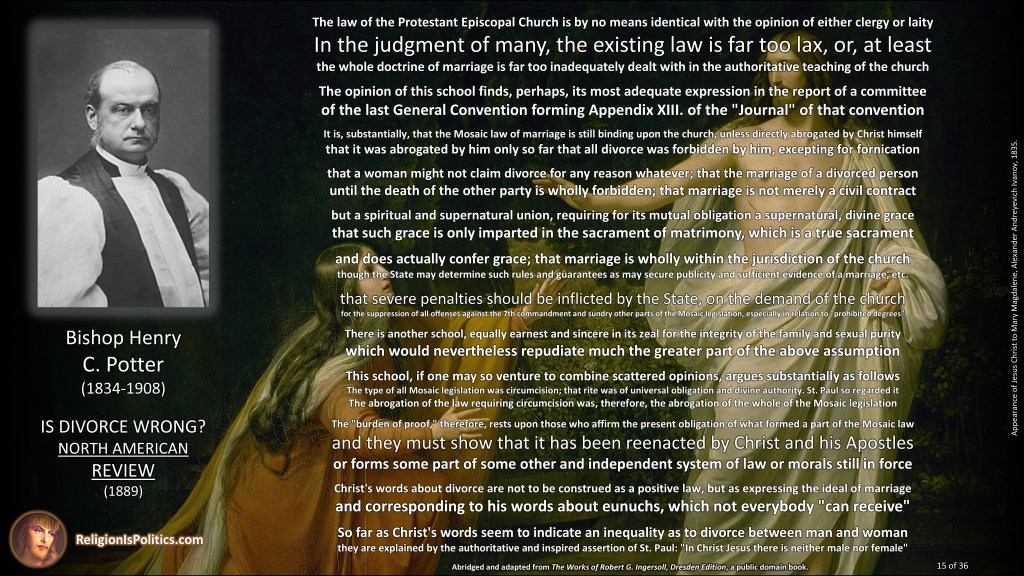
Bishop Henry Potter takes almost opposite views to the Cardinal’s. Remember his church’s only reason to exist was to provide an alternative to Rome, starting with a divorce.
He’s not going to tell us what he believes, only what other Anglicans believe, which is a lot of irreconcilable contradictions, and that they almost never get divorced.
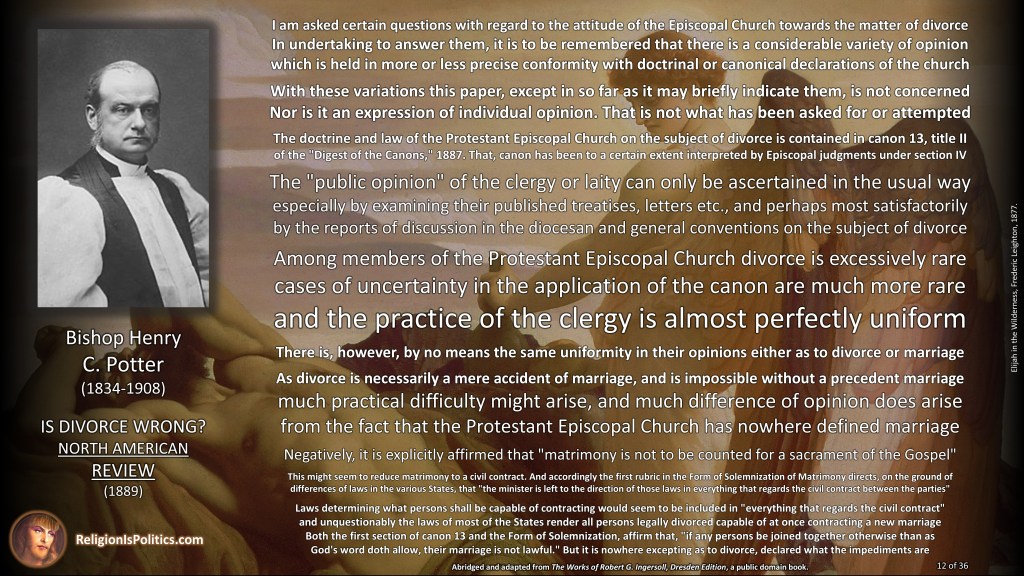
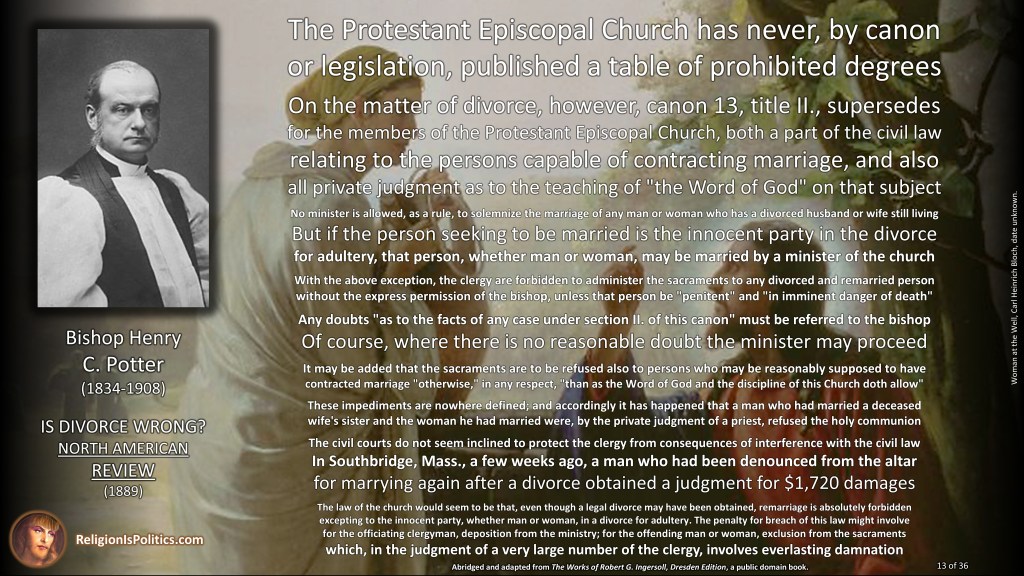
The Anglican Church’s appeal is that it has the same authoritarianism as the Catholic Church in principle, but in practice you can do whatever you want as long as you pay the pastor.
Since Ingersoll’s time the Catholic Church also has become more like this.
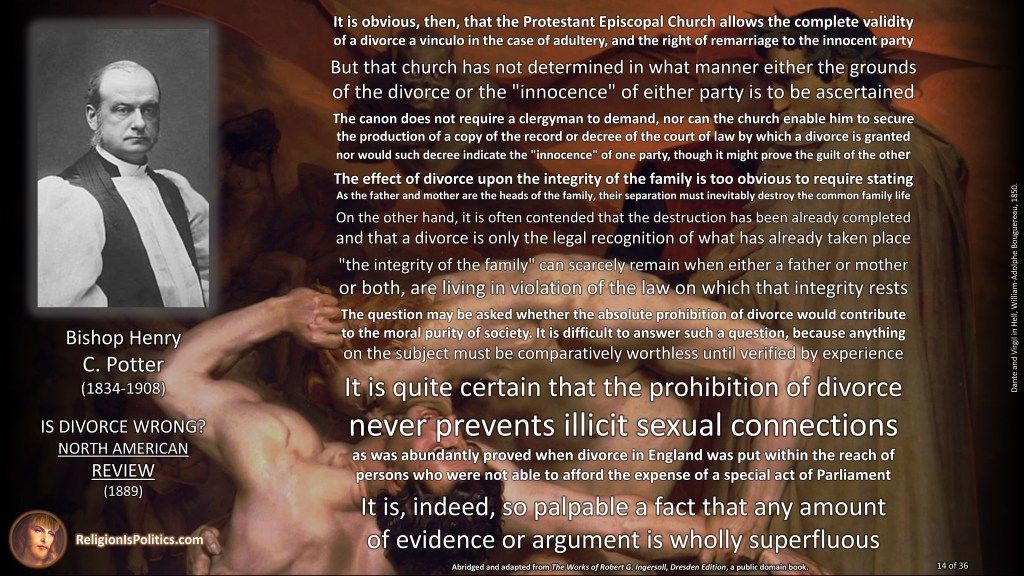
Unlike the Catholic Church, however, the Anglican Church is quite certain that rules never stopped an affair.
As long as you pay the pastor, the Anglican Church will be happy to suspend judgment and let God repay you. The Bishop is never going to tell us what he really thinks, all he’s going to tell us is that his church is made of irreconcilable differences and they hardly ever get divorced.
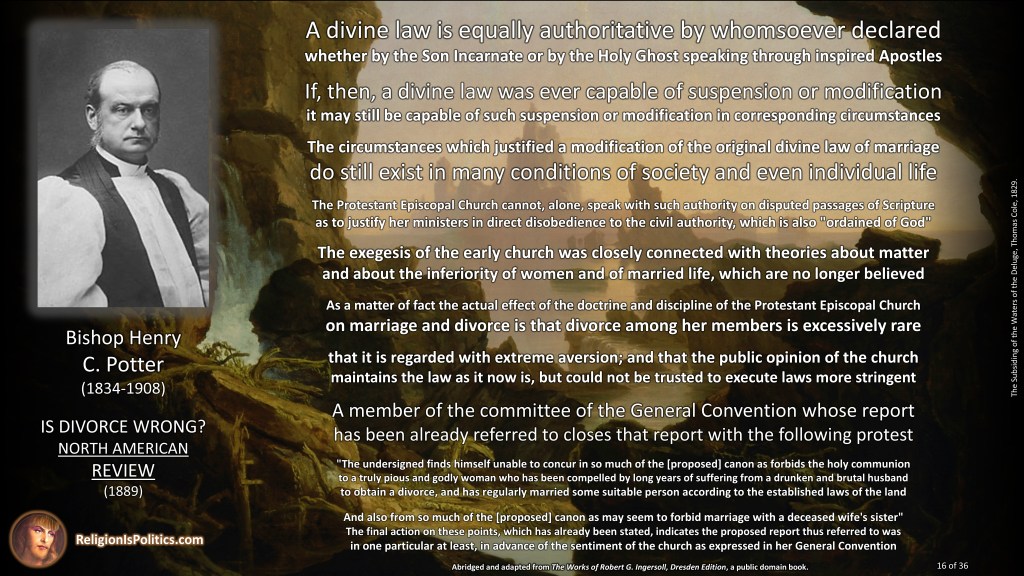
The Cardinal says the truth is always the same and that’s why it never changes. The Bishop says the truth is always the same and that’s why if it changed once it can change again. The gaslighting here is the point. Both churches are made up of irreconcilable differences that refuse to get divorced.
Ingersoll’s essay was less meal-mouthing and more mincemeat.
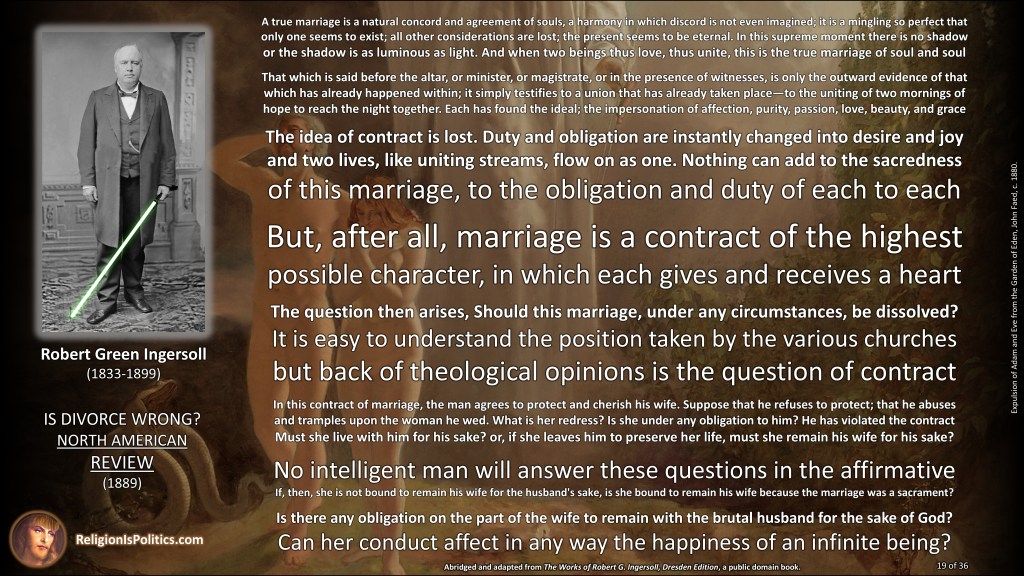

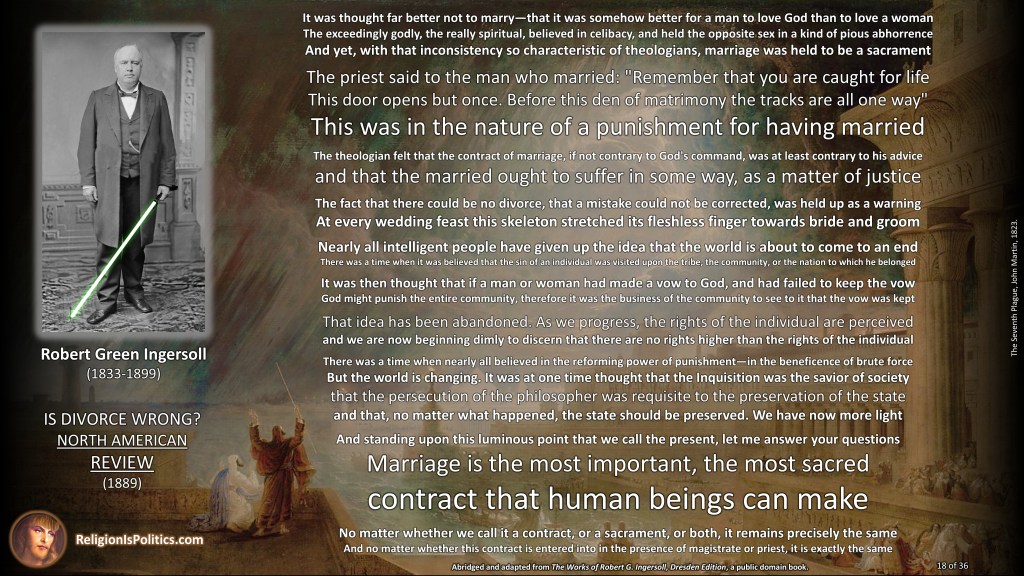
Like Ingersoll, I was raised to believe: not the truth, that all men were originally conceived female, but an ancient fiction, that a woman is a natural possession of a man, a piece of territory to be claimed as if reclaimed and taken for a piece of his own body, as it were.
As long as I held this perspective I was incapable of loving a woman as myself, or, for that matter, loving anyone else.
Maybe you can see the problem with these ideas. Maybe you can see the difference between your own body and someone else’s. Your own agency and someone else’s. But not if you believe someone else’s body is a part of yourself. Not if you were taught to think of a marriage as a kingdom.
What do you call a wolf in shepherd’s clothing? A shepherd, of course.
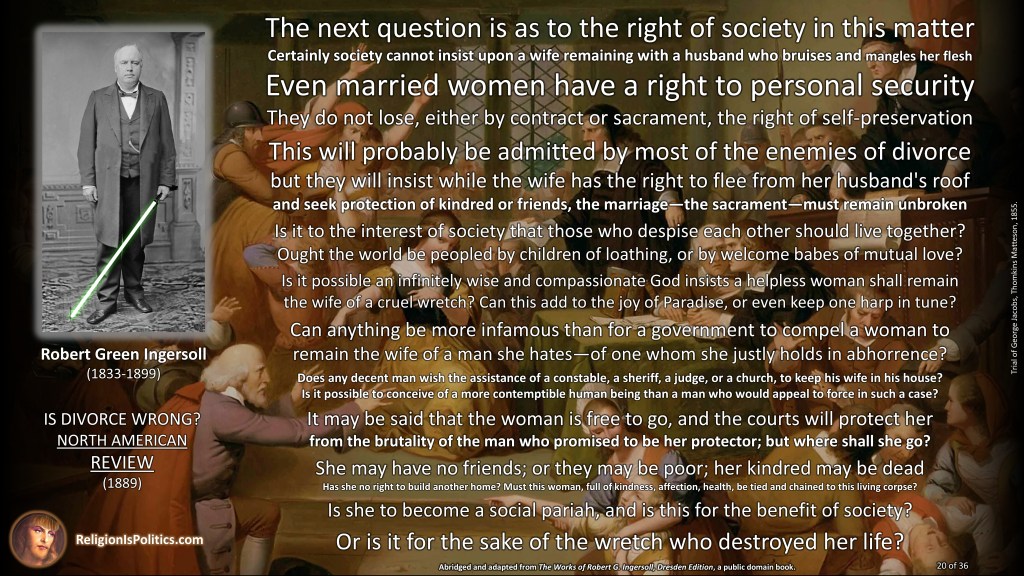
Who benefits when people are trapped in abusive relationships?
Does the abusive relationship benefit?
Does society?
Who benefits when wounded animals are cornered? Do the predators benefit, or does the prey?

Those who oppose the right to divorce say children need two parents. Do children need two parents who were only kept together by the absence of alternatives? Are such children ever capable of mutual love, freedom or respect? Are we in need of such children? Or are such children in need of therapy?

It is actually possible for two people who do not love each other to be married for their whole lives. Generally they have a favorite child into whom they project the worst parts of themself and a disfavorite child onto whom they project the bulk of their abuse.
When they remain married for their whole lives their church’s expectations are satisfied. If they were more honest they would be accused of living in sin.

As long as we believe our relationships have a mediating third party who is all-powerful, the more powerful person in our relationships will believe God is on their side and the less powerful person will blame themself for everything.
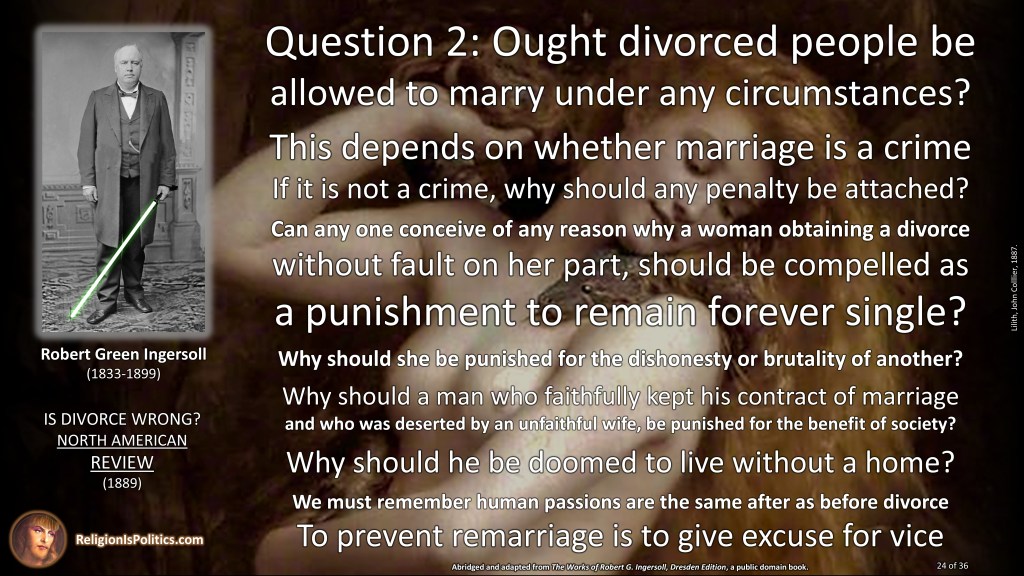

It should be about as easy to get out of bad relationships as it is to get into them, that way bad relationships will not be self perpetuating.


There is actually no human benefit to holding a stigma against divorce, only human cost. The idea that civilization is advanced or upheld by divorce being costly is absurd, and all it amounts to is gaslighting by people who should not be married.
At this point a number of other voices wrote to the Review. I regret that their comments are not included.
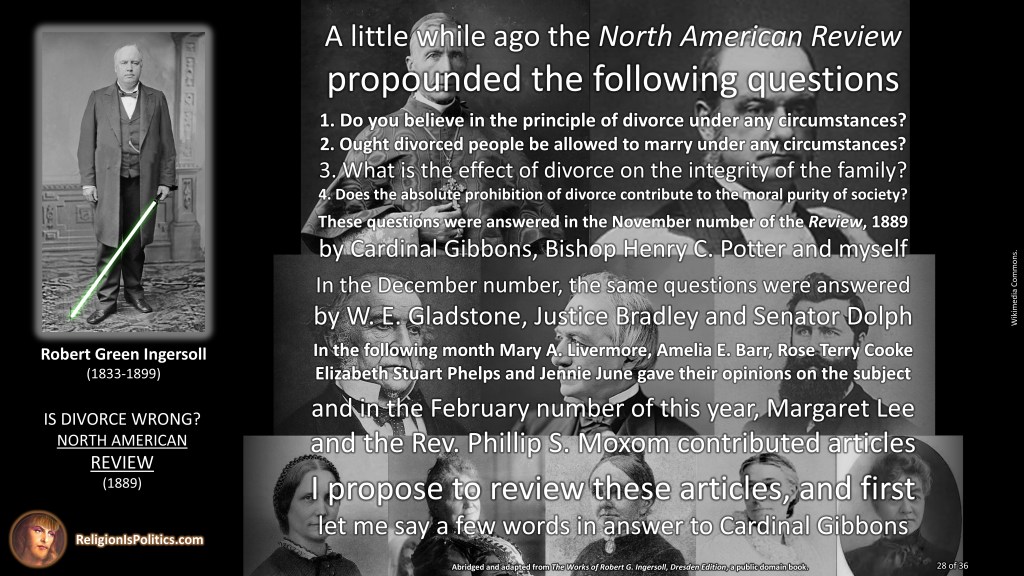
As a matter of fact, the quality of a marriage is in the relationship itself.
What determines the quality of a relationship is not what sexual activity goes on before or after a wedding, but whether both individuals have the same information and consent.
And what defiles the institution of marriage is, precisely, the difficulty of getting divorced.
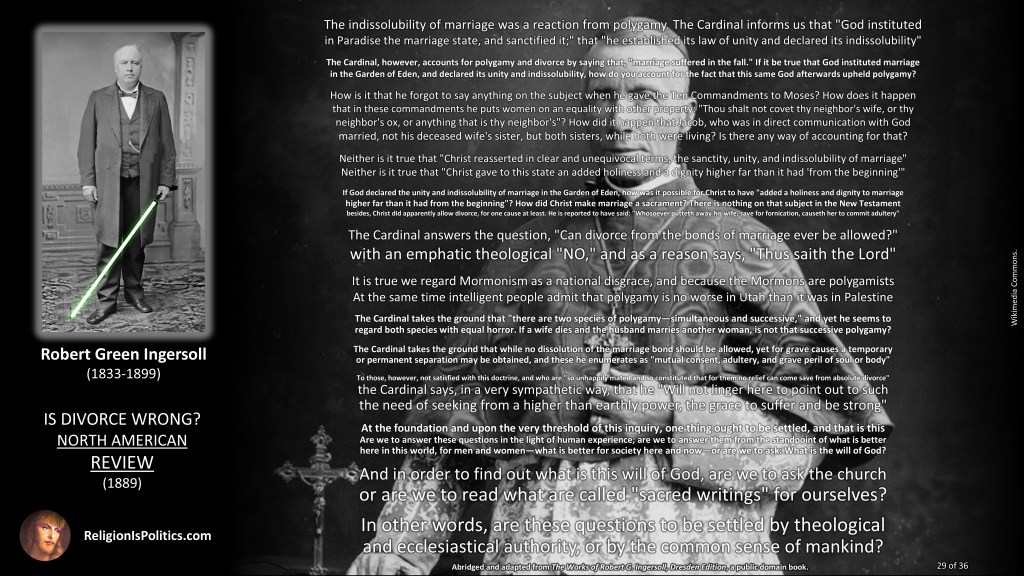
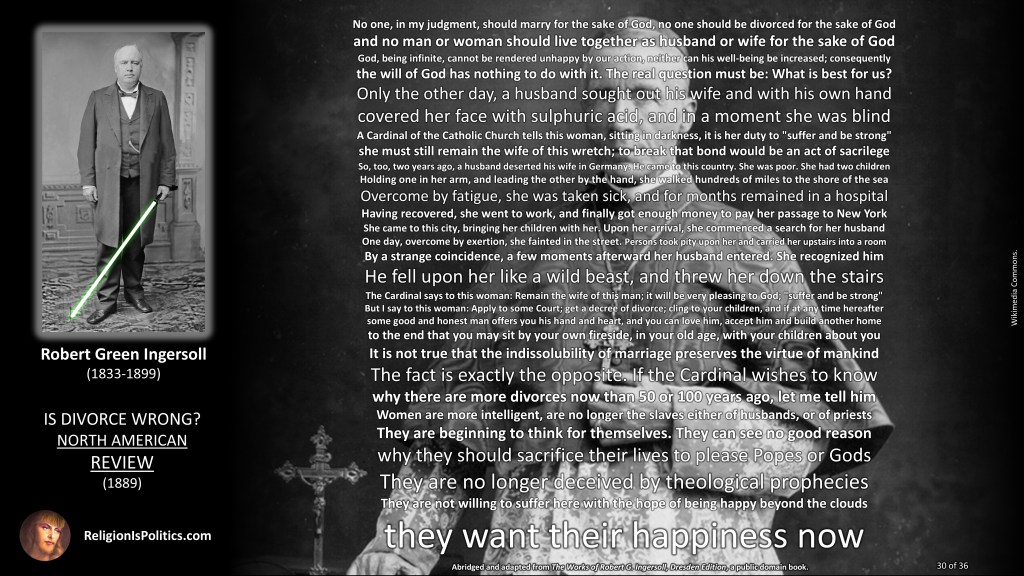
If a cardinal wishes to know why there are more divorces today than there might have been in the past, let him understand it is simply because women are his equals.


Recall: the whole reason for the Episcopal Church to exist was to be an alternative to the Roman church to increase the availability of divorce.
The Cardinal is absolutely sure that the only way to keep happy couples together is to take divorce away from couples who want it.
And the Bishop is equally certain laws never stopped anyone from cheating if they were so inclined.
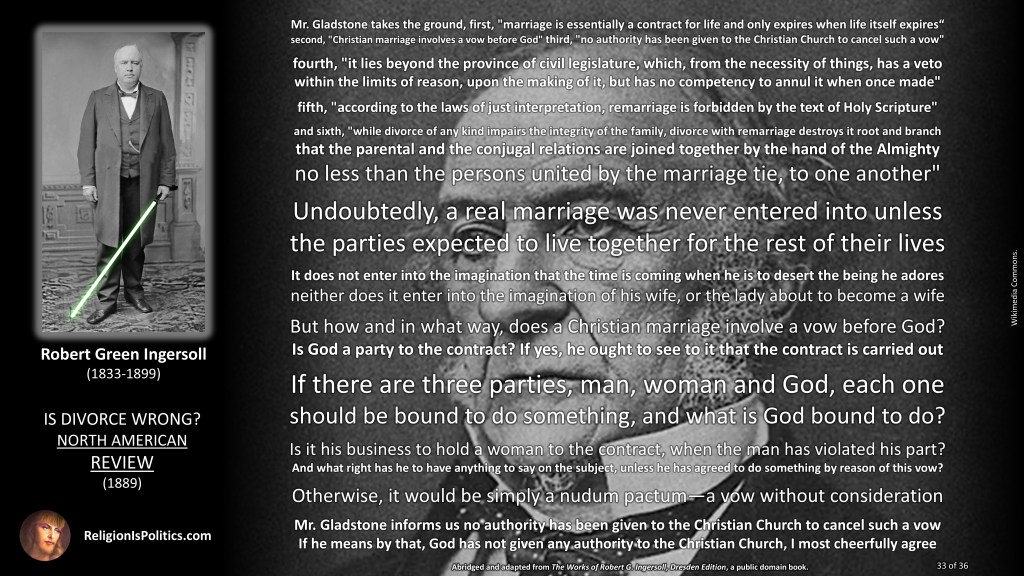
As a matter of fact, who cares what the Old Testament says? Are we to be forever enthralled by ancient barbarians?
If there is a God, there certainly have been marriages he did not approve. And certain it is that God can have no interest in holding together a marriage that should have never joined.

If there is no legal remedy for human suffering then the law itself will be set with defiance.
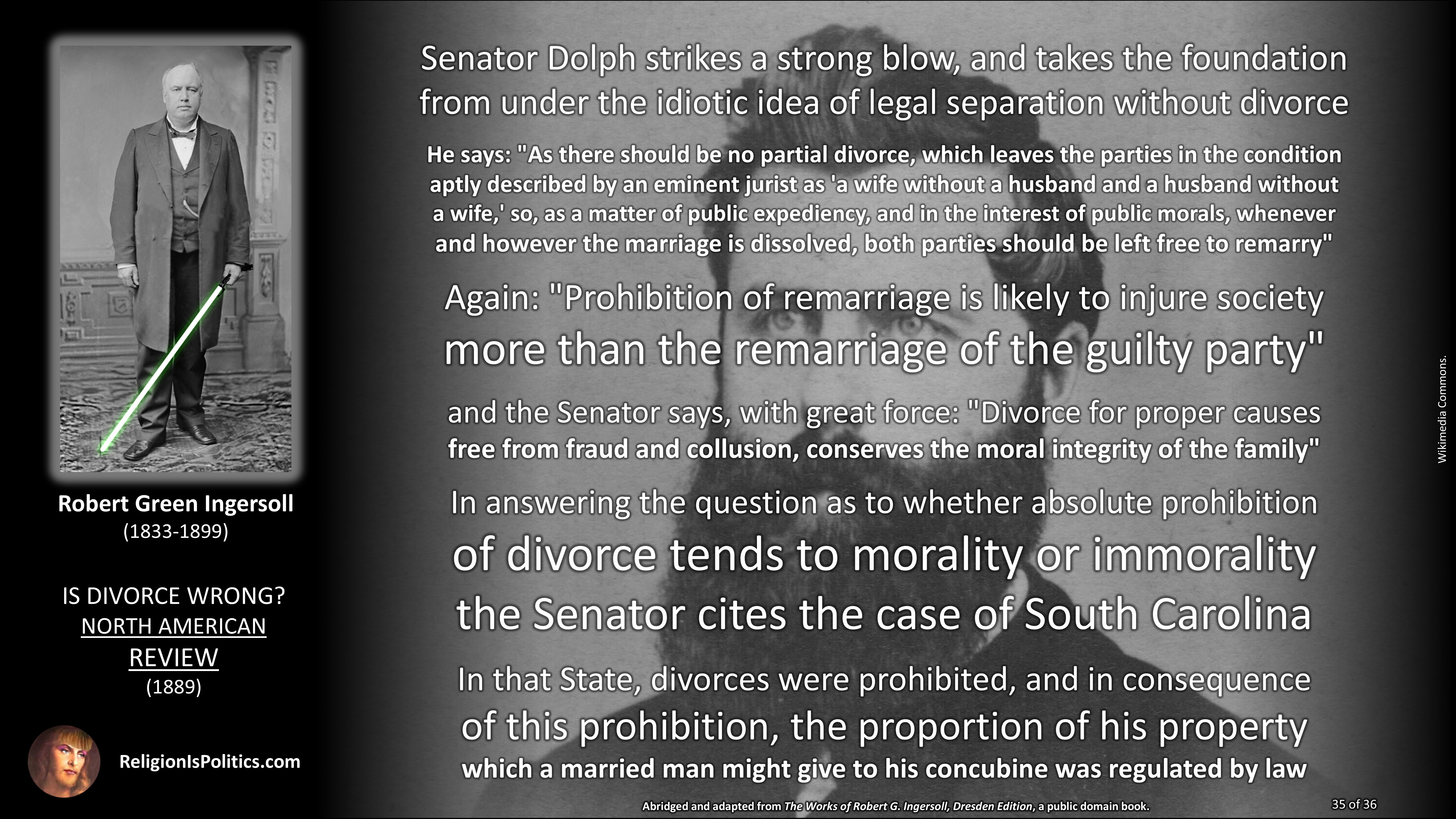
Senator Dolph from Oregon remarked that prohibiting remarriage was likely to injure society more than someone getting remarried.
He also noted that the same places prohibiting divorce were also apt to legalize adultery for purposes of financial regulation.
After summarizing these remarks, Ingersoll then felt that he had done all he could.
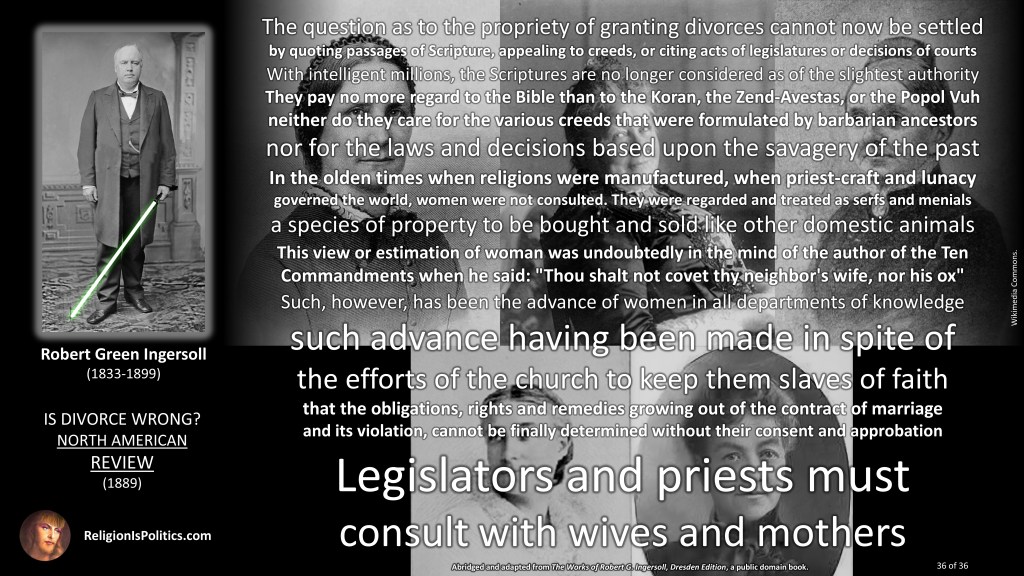
Do you think someone who’s shared their body with you owes you a physical relationship forever?
Do you think someone who’s shared their time with you owes you eternity?
If you do, that’s why your exes try to avoid you.
Background art
- Portraits of Cardinal Gibbons and Bishop Potter, Wikimedia Commons.
- Expulsion from the Garden of Eden, Thomas Cole, 1828.
- The Arcadian or Pastoral State, The Course of Empire, Thomas Cole, 1836.
- Destruction: The Course of Empire, Thomas Cole, 1836.
- Consummation: The Course of Empire, Thomas Cole, 1836.
- Desolation: The Course of Empire, Thomas Cole, 1836.
- The Savage State: The Course of Empire, Thomas Cole, 1836.
- The Garden of Eden, Thomas Cole, 1828.
- The Titan’s Goblet, Thomas Cole, 1833.
- The Good Shepherd, Thomas Cole, 1848.
- The Pilgrim and the Cross at the End of His Journey, Thomas Cole, 1836.
- Elijah in the Wilderness, Frederic Leighton, 1877-1878.
- Woman at the Well, Carl Heinrich Bloch, date unknown.
- Dante and Virgil in Hell, William-Adolphe Bouguereau, 1850.
- Appearance of Jesus Christ to Mary Magdalene, Alexander Andreyevich Ivanov, 1835.
- The Subsiding of the Waters of the Deluge, Thomas Cole, 1829.
- The Last Judgment, John Martin, 1853.
- The Seventh Plague, John Martin, 1823.
- Expulsion of Adam and Eve from the Garden of Eden, John Faed, c. 1880.
- Trial of George Jacobs, Thomkins Matteson, 1855.
- The Examination of a Witch, Thompkins Matteson, 1853.
- Queen Esther, Edwin Long, 1878.
- The Plains of Heaven, John Martin, c. 1851.
- Lilith, John Colllier, 1887.
- Lady Lilith, Dante Gabriel Rossetti, 1866.
- The Scarlet Letter, Hughes Merle, 1861.
- The Eve of the Deluge, John Martin, 1840.
28-36. Portraits from Wikimedia Commons.
 Religion is politics about the unknown