A Thanksgiving Sermon
In his 1897 ‘Thanksgiving Sermon,’ Ingersoll encourages us to be thankful, not for divine intervention, but for the best in ourselves and each other.
To be thankful for, or to be thankful to, one another is all we really have. Being thankful to a lord on high, instead of to those we depend on, is a misplacement both of gratitude for humanity below us and of accountability for humanity above us.
When we thank the infinite for our benefits, we take them for granted as blessings, and our wealth inequality evolves toward infinity. We say blessed are the poor, because we believe Jesus’ self-fulfilling prophecy that poverty will always exist until he returns.
In these beliefs we are conditioned to go the extra mile rendering unto Caesar and to God. We are trained to submit to abuses of power and to turn the other cheek to ongoing abuse.
We are taught to forgive abusers as soon as they confess, because, we are taught, we are just as depraved as they are. And we are primed to remind victims they are just as depraved as any of us as soon as they don’t forgive. We are groomed by predators to blame the prey for predation.
We are even told by Galatians, Colossians and 2 Peter that slaves must obey their masters as if obeying the LORD Jesus Christ himself.
Unbelievers may dismiss those verses as crimes against humanity. Believers must find some way of being thankful for them.


Is it true we can escape our problems by circumcising our extremities? Or must our hearts be circumcised instead?
Is physical abuse good for us? Or is emotional abuse good enough instead?
These are the questions the Bible was written, edited and published to answer.
And believers say it has the answer to every question.


Who do we have to thank for medicine? Who do we have to thank for plants? Who do we have to thank for biodiversity? Who do we have to thank for the fruit of the tree of knowledge?
Who do we have to thank for the Bible? For the books that were included, excluded, lost, burned? Did the editors of the Bible send us their best?
Should we be grateful that we have books by Saul of Tarsus but not Hypatia of Alexandria?
What do we gain by worshipping almighty power? What do we get when we think we are the center of a cosmic master plan?
We get atomized.
We believe political power is ordained from on high, rather than from the ground up. We believe our comforts and other people’s miseries are always for the greater good. We sit in our armchairs contemplating wars in which our government supports a tyrant and in the next thought we go back to thinking this is the best of all possible worlds.
We become willfully ignorant, irresponsible, paranoid, delusional and, ultimately, insecure.


A vaccine, by definition, is better than a prayer. If it isn’t, it won’t pass clinical trials. It won’t be called a vaccine and it won’t be brought to market. Except, perhaps, in a church.
We all know corporations are evil, but the evil of corporations is not infinite. It’s not even constant. It’s proportional to the wealth inequality of the total economy. When the inequality is infinite, so is the evil.
Most of the “fathers” of the corporation that became Christianity looked forward to infinite inequality. A few did not, and their reputations have suffered ever since.
These childless fathers also called themselves doctors, and these make-believe doctors sold faith remedies to contagious masses who had no other forms of health care. They denigrated the expertise of real physicians and told their suffering flocks that God knows every pain they endure, and their diseases were sent by him personally either to prove their faith or to punish their lack thereof.
What happens when we think health is a blessing from the infinite? We take it for granted, and we blame the less fortunate for their lack of faith.
What do we get when we think neurodivergence constitutes a vast cosmic conspiracy? We get witch trials. We get human sacrifice. We stain the earth with brave, honest blood.
Are diseases sent to punish prodigals and drive them back to church? Does it help during a respiratory pandemic to gather large groups of people indoors and pray? Did that help during the Middle Ages?


Should we be thankful for a great American novel? Should we be thankful for The Scarlet Letter? Should we be thankful to Nathaniel Hawthorne or to the God of the Puritans?
Are we not forced to admit that The Scarlet Letter is better than the Bible?
Are the Chronicles of Narnia as good as the Bible? Is The Lord of the Rings even better?
I think you know the answer in your heart.
Catholics and Protestants both believe the Bible is the best book there ever could have been. But Catholics write better books without even meaning to. And Protestants generally don’t dare.
Should we be thankful for private Christian schools? Should we be thankful for professors who swear to believe what they know ain’t so?
Should we be thankful for purity culture?
What do we get from purity culture?
We get unrealistic expectations, we get irrational phobias, and our country gets cursed with a spiritual despotism as infamous as it is absurd.


Even at a Bible college, the truth was undeniable.
Even there, I learned that the true shape and size of the earth had already been known for hundreds of years before Jesus marketed a cure for death. And his disciples, who still marketed his cure even after his demise, confirmed popular prejudices rather than confront them. They were not educators. They were salesmen. Their legacy was to evolve ignorance in place of knowledge, and we all knew it, we just pretended it wasn’t true.
How did we get our divine stories of chosen people, promised land, milk and honey, blood and soil, salvation by faith, manifest destiny and happily ever after?
Should we be thankful for these stories? Should we be thankful to their authors? To their editors? Should we be thankful for believers or for skeptics?
Will believing Jesus rose from the dead tell us the shape of the earth? Will it tell us how to save a life? Will it tell us any other truth about the world?
Who saved the lives of those Puritans in Massachusetts? The God they were praying to help them, or the indigenous people who actually did? Those people have regretted their generosity ever since. If the Puritans’ God existed, he meant for evil what the Wampanoag only meant for good. He could just as easily have filled the earth with Wampanoag as with Puritans, and he chose Puritans (or at least, their descendants tend to think so). If this God exists then he made the Wampanoag themselves, the very goodness of their hearts, be the instruments of his choice, and he made the Puritans, justified by the redeeming blood of Jesus, be his instruments of destruction.
Should we worship the author of these events?
Should we be thankful Jerusalem was destroyed almost 2,000 years ago? Should we be glad that established Judaism was discredited, the temple destroyed, the facts around Jesus’ life cleared away and the way prepared for Christianity to be appealing instead?
Were the crusades part of an almighty plan or were they the plans of foolish mortals? Does violence fulfill prophecy, or are violent prophecies predictably self-fulfilling?
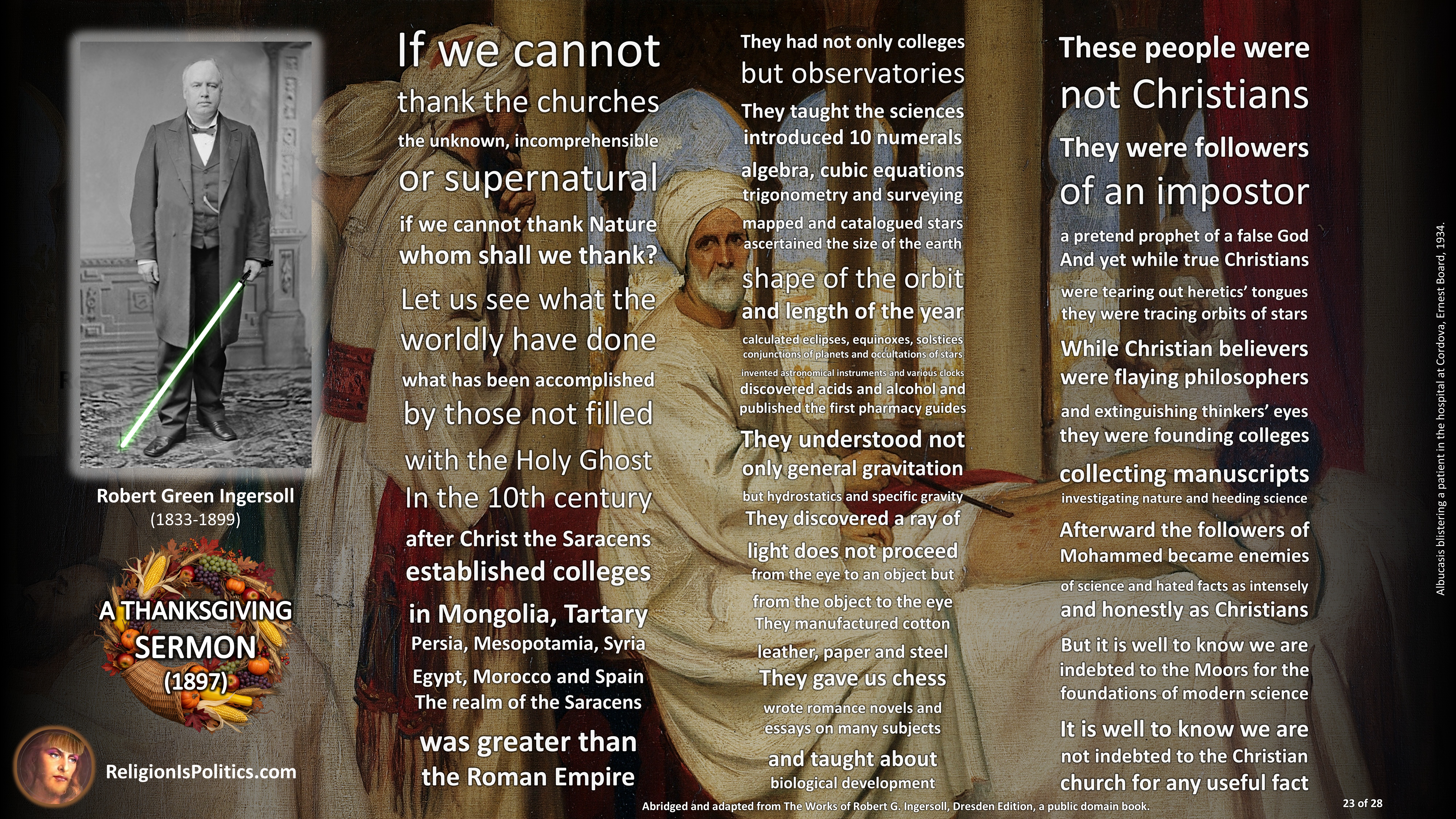
Were the heathen scientific writings in ancient libraries filthy rags? Should we be thankful for their loss? Are we better off with Psalms and Proverbs? Certainly they are the best the Old Testament has to offer. In the editions of the Bible for widest distribution they are the only Old Testament books included.
Which is better? To understand the truth, or to believe without understanding?
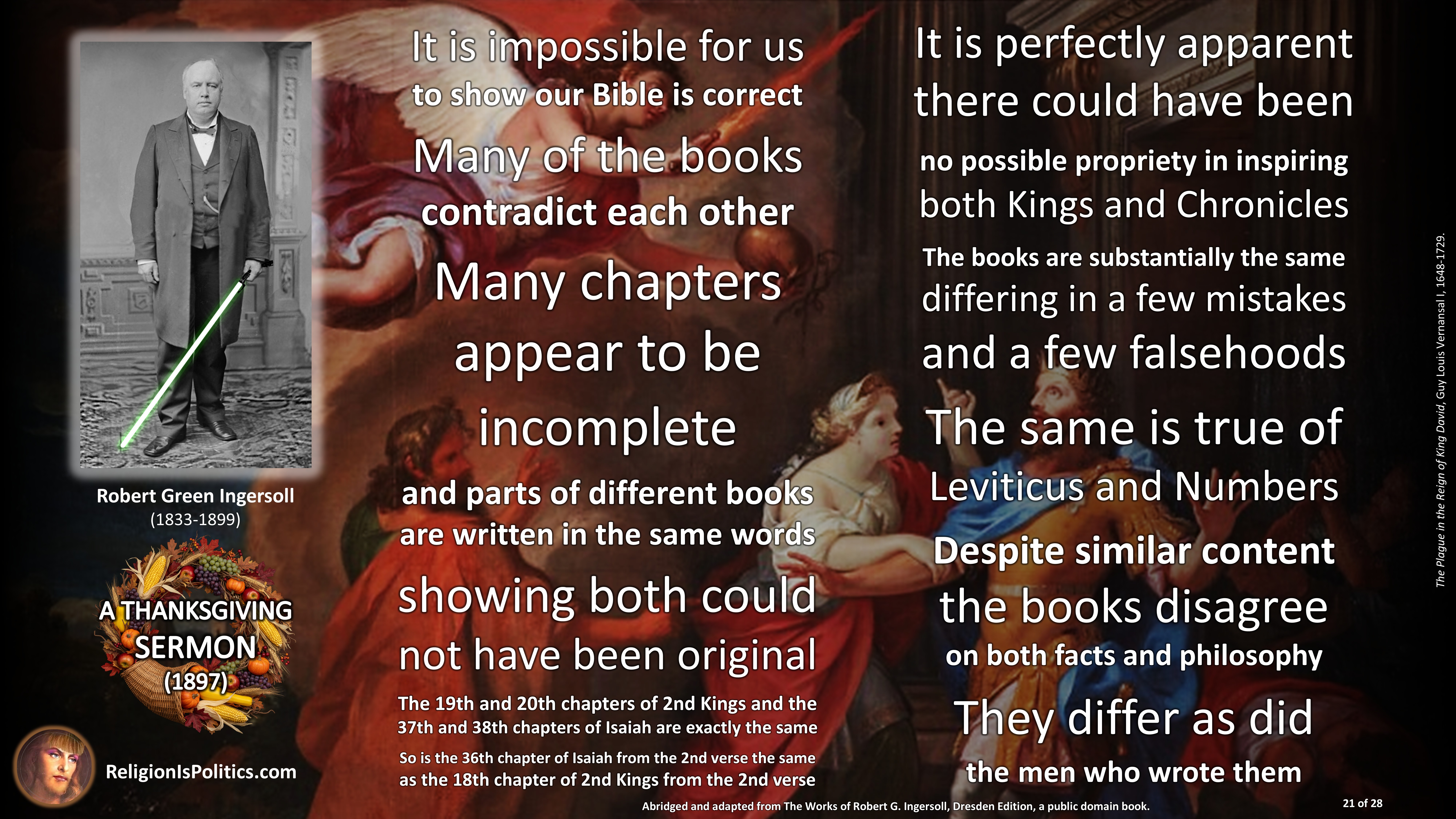

Should we be thankful for eye correction? Should we use it to search the scriptures? Should we be thankful they’ve misled us for so long?
Should we be thankful for four gospels and three editions of the Ten Commandments? Are we thankful for all the genealogies? Are we thankful that they disagree? Are the apparent contradictions between them a blessing or a curse?
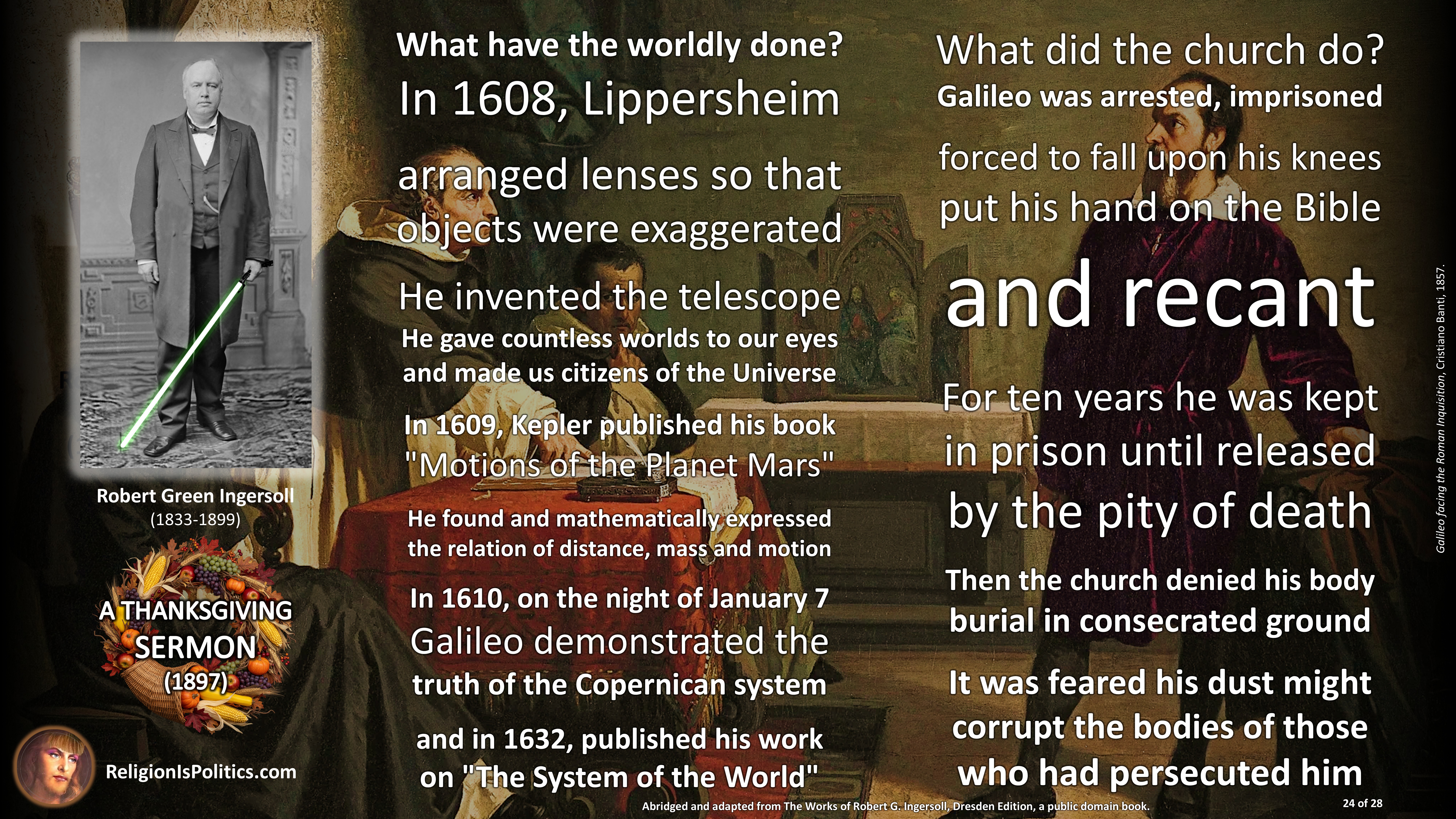
Should we be thankful for the freedom to doubt? Should we be thankful for the scientific method? Did we get it from the scriptures or did we get it from doubting them?
Are we thankful for mortality? Are we thankful for health care? Are we blessed by the expectation of living happily ever after? Are we cursed by phobias of fates worse than death?
I’ve heard that the Koran says the whole universe has no corners at all. Certainly that is better than anything in the Old or New Testament or the Book of Mormon.
I’ve heard that Hinduism predicted the age of the earth as 4.32 billion years, which happens to be about 95% right and probably has been for more than six thousand.
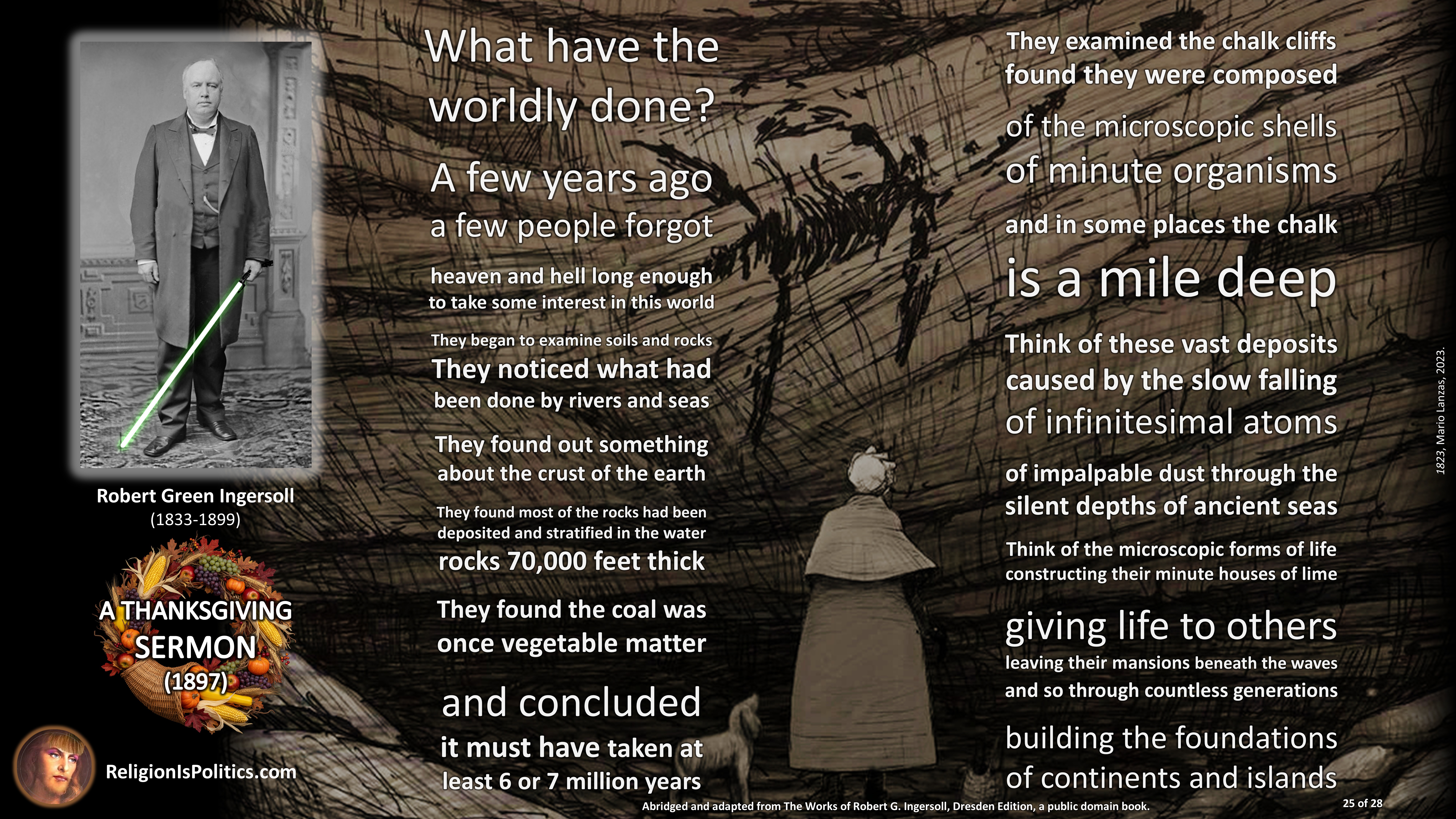

Should we be thankful for fossils? Should we be thankful for paleontology? Should we be thankful for extinction? Should we give students aid to become scientists?
Should we be thankful for comparative religion? Should we be thankful for critical scholarship? Should we invest in the humanities?
Should we be thankful for science fiction? Should we be thankful for Jurassic Park? Should we be thankful the author denied the scientific consensus on climate change?
Should we be thankful for risk-taking CEOs who cut corners and gamble with people’s lives while saying they spared no expense?
Should we give them tax breaks? Should we sing praises to a CEO in the sky?
Or should we believe the 97% of relevant experts who say climate change is real and it’s our responsibility?
All these questions the Bible was not written to answer, except to supply wrong answers. Whose fault was that? Was there anyone around at the time of writing who knew better?
It seems there always were people around who knew somewhat better. Just not the authors, the editors or the publishers of the Bible. And for their declining influence today, we know all too well enough to be thankful.
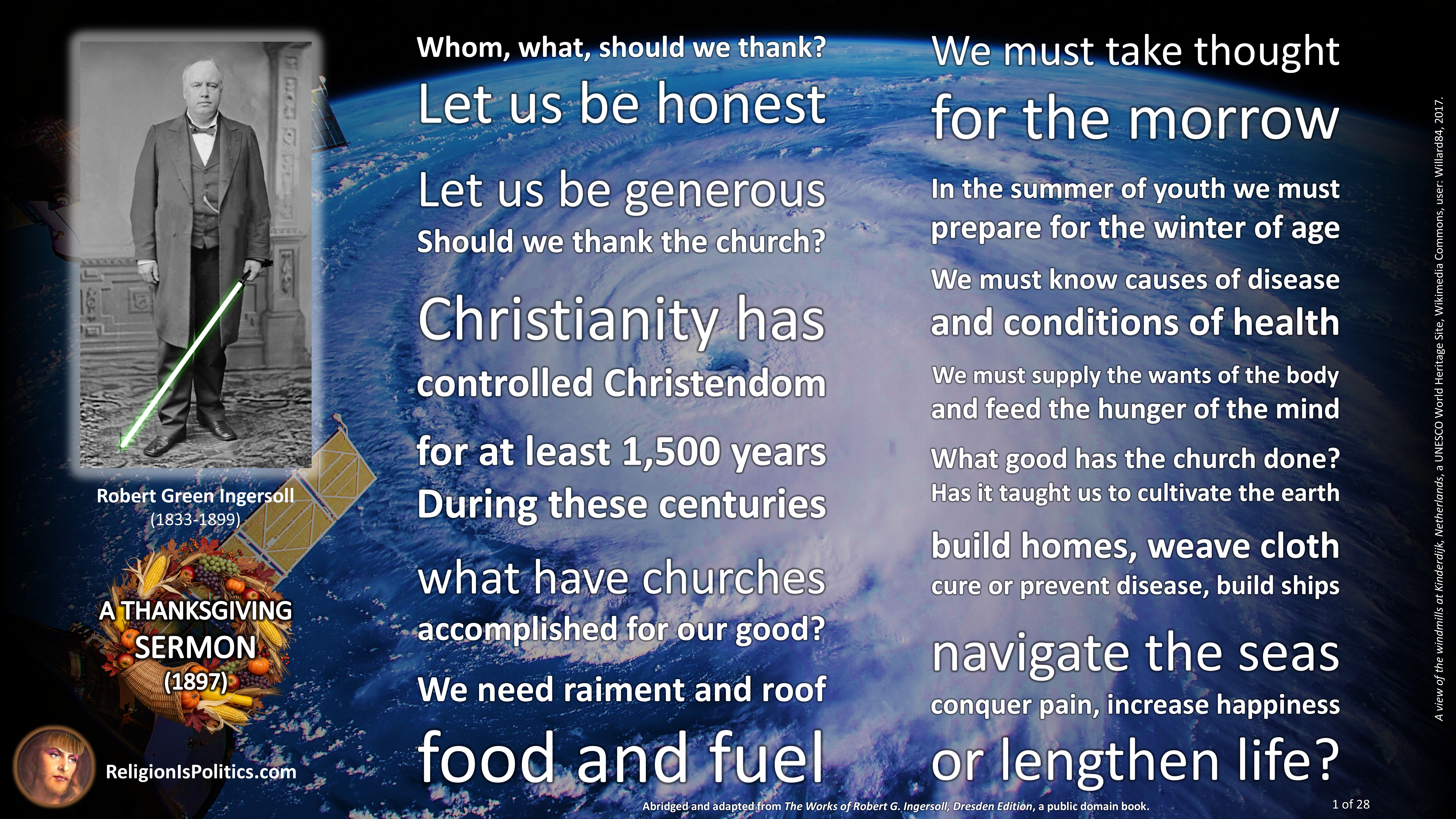
Background art:
- Hurricane Florence in 2018 as viewed from International Space Station, NASA Goddard Space Flight Center.
- The Passion of the Christ, 2004.
- The circumcision of Abraham, Jean de Sy, c. 1355
- The Passion of the Christ, 2004.
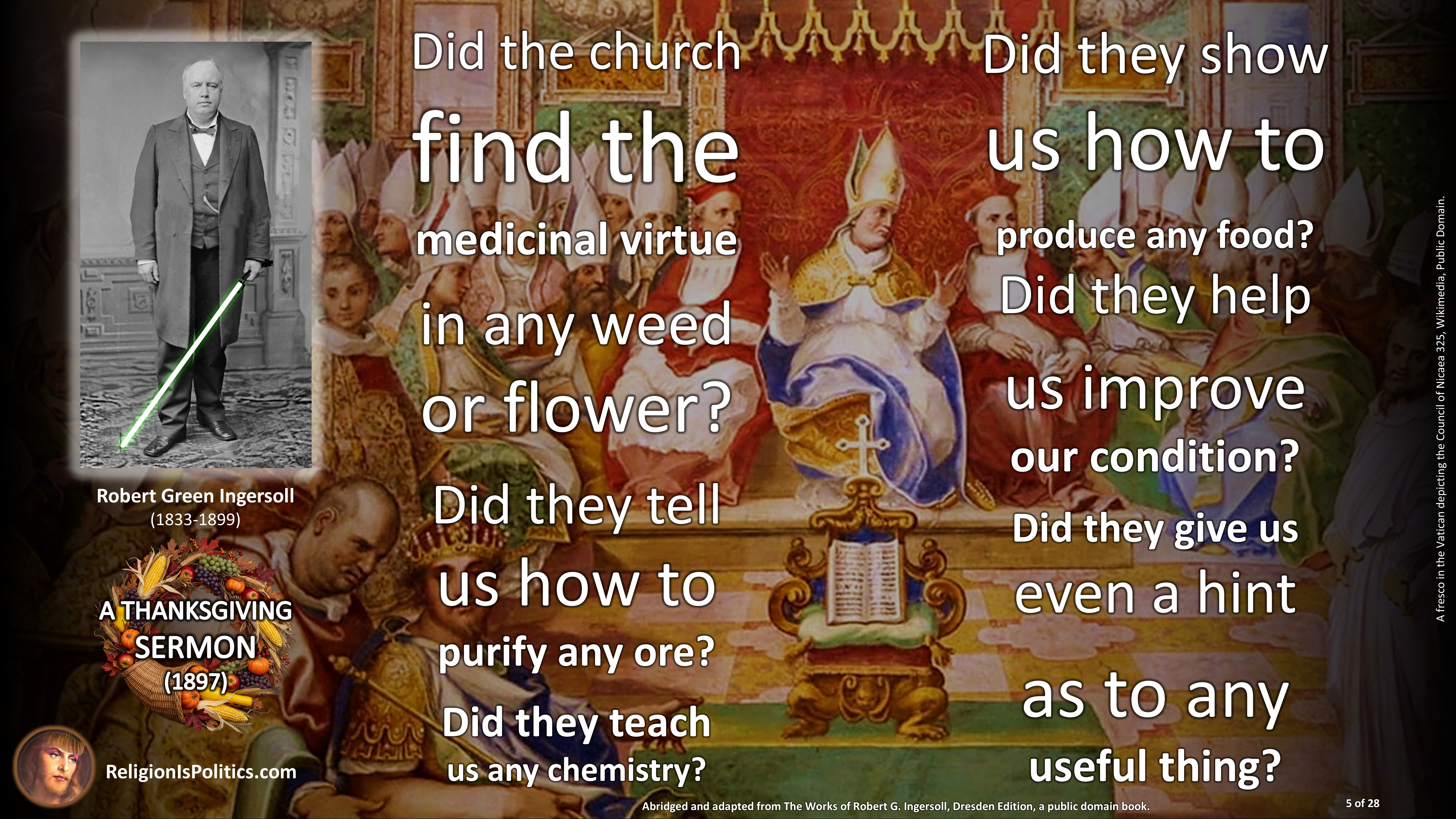
- A fresco in the Vatican depicting the Council of Nicaea 325, Wikimedia Commons.
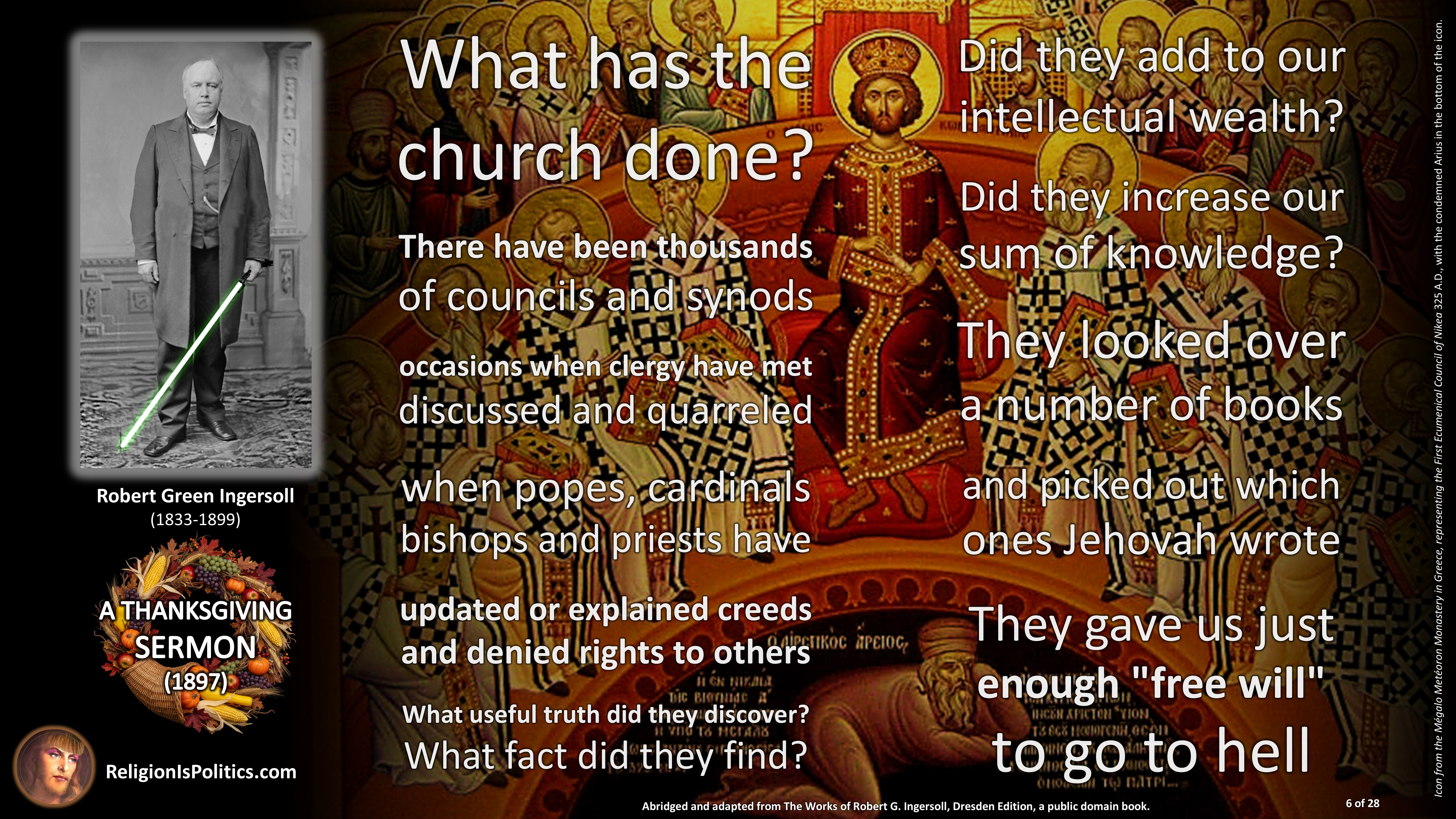
- Icon from the Mégalo Metéoron Monastery in Greece, representing the First Ecumenical Council of Nikea 325 A.D., with the condemned Arius in the bottom of the icon.
- Moses and Joshua in the Tabernacle, James Tissot, c. 1896-1902.
- Hypatia, Julius Kronberg, 1889.
- St. Guy Heals a Possessed Man, Gabriel Mälesskircher, 1474.
- Trial of George Jacobs, Sr. for Witchcraft, Tompkins Matteson, 1859.
- Christ Driving the Money Changers from the Temple, El Greco, 1568.
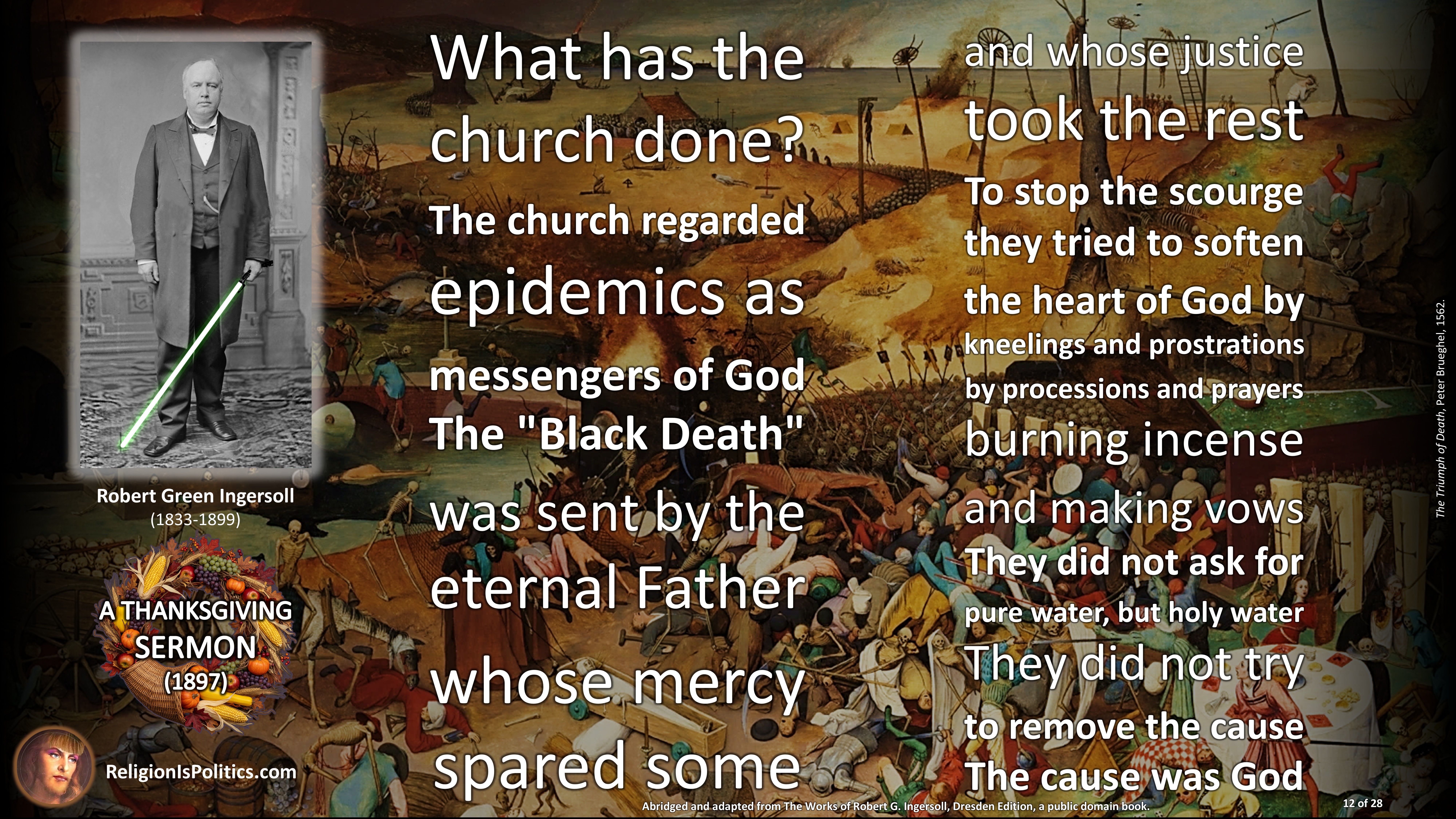
- The Triumph of Death, Peter Brueghel, 1562.
- Saint Jerome Visited By Angels, Bartolomeo Cavarozzi, early 17th century.
- Jesus Among the Doctors, Circle of Jusepe de Ribera
- The Handmaid’s Tale, 2017.
- The Triumph of Christianity over Paganism, Gustave Doré , 1866.
- What Our Lord Saw from the Cross, James Tissot, c. 1894-1896.
- Ezra Praying, Gustave Doré , 1866.
- The Siege and Destruction of Jerusalem by the Romans Under the Command of Titus, A.D. 70. Lithograph by Louis Haghe, after a painting by David Roberts, 1850.
- Destruction, Thomas Cole, 1836.
- The Plague in the Reign of King David, Guy Louis Vernansal I, 1648-1729.
- T. rex, Edmontosaurus, K-T Impact; Raul Martin, 2021.
- Albucasis blistering a patient in the hospital at Cordova, Ernest Board, 1934.
- Galileo facing the Roman Inquisition, Cristiano Banti, 1857.
- 1823, Mario Lanzas, 2023.
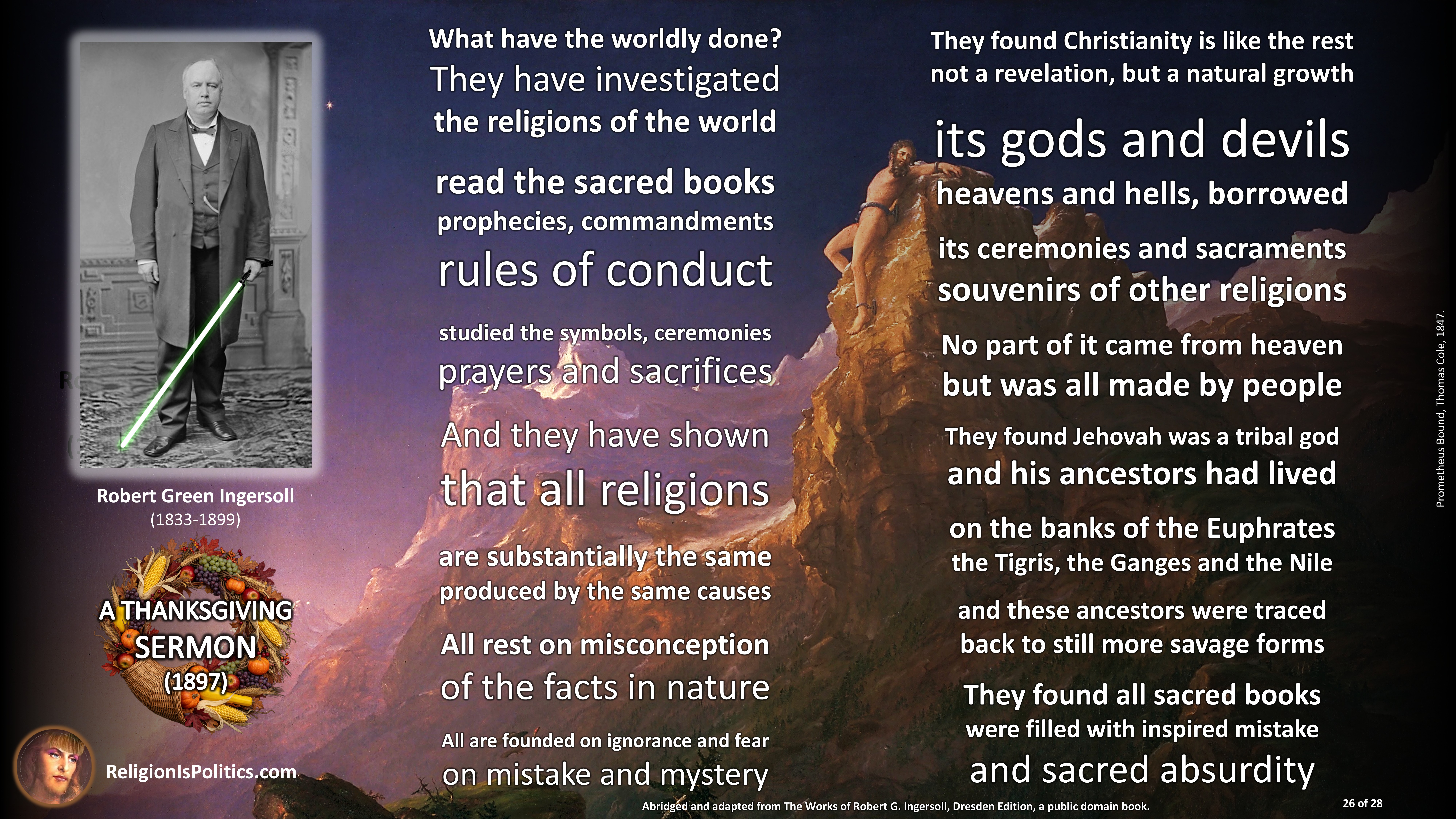
- Prometheus Bound, Thomas Cole, 1847.
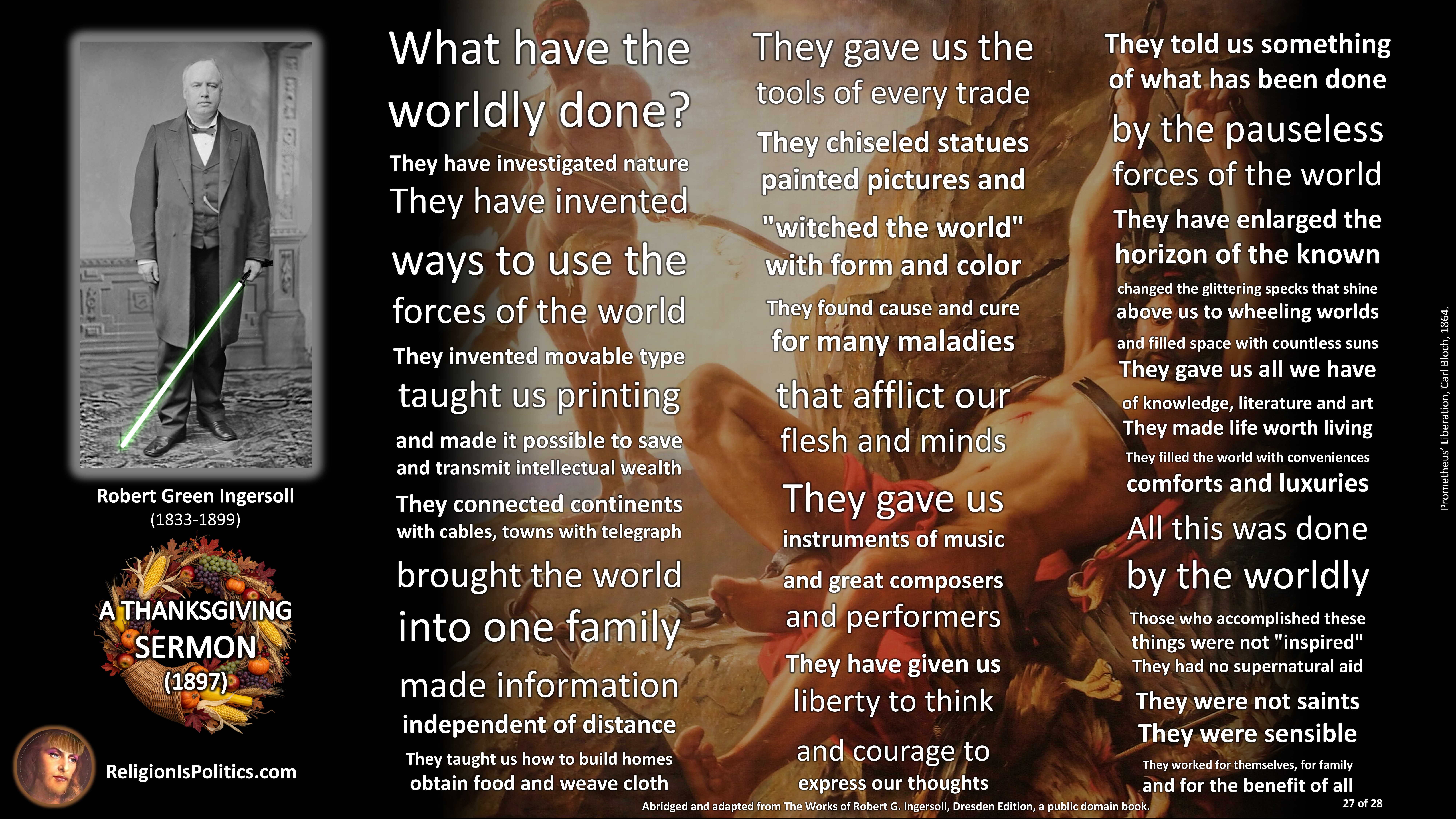
- Prometheus’ Liberation, Carl Bloch, 1864.
- Illustration from Camille Flammerion’s 1888 book, The Atmosphere: Popular Meteorology.

