What is Christ doing in Christmas?
It’s a serious rhetorical question even if it sounds silly.
Jesus is an historical figure, while Christ is a theological figure.
Both are popularly believed to have been born in December or January, but everyone who knows Jesus’ historical background knows that isn’t true.
According to accounts, Jesus was born at a time of year when shepherds and flocks sleep out of doors. If those accounts were factual, then we know he was born in summer or spring (maybe autumn), but not winter. From these accounts, we know he was not associated with those months until he needed to be for messaging purposes. In other words, until the previous version of his message was running out of appeal.
As for Christ, the theological figure, he was not born until after Jesus had died. He was not well defined, either, for another three centuries after that, and then, only by state authority, after the First Council of Nicea, which concluded in the month of July.
As a matter of fact, the closer we look to the time of Jesus’ life, the more diverse were people’s beliefs about him. This is typical of confidence men, and that was the reason for the First Nicene Council.
Christ was born gradually from the consolidation of various conflicting beliefs about Jesus. And unlike Jesus, Christ was born with the help of the Apostle Paul.
Paul was never part of Jesus’ inner circle, but he had the marketing skills and citizenship status both to steal their intellectual property and to do more with it than they ever could. Their living was based on miracles, which were always disputed and controversial, and so when Paul claimed based on miracles that he had seen their risen Christ, it was his word against theirs. With Paul’s charisma, education and citizenship, it wasn’t long before his sales numbers spoke for themselves. The twelve disciples, without his advantages, could not beat him: they had to join him.
No wonder so little evidence of Jesus survives from that first century after his life besides letters rightly or wrongly attributed to Paul.
Now, if Jesus was a confidence man, and Christ was a myth perpetuated by his successors, why should we celebrate either of them?
I was often told in church growing up that Jesus had been born at the perfect historical time to intersect with the right cultural trends and media technology for his followers to take over, first the Roman Empire, and eventually the whole world.
People who believe this are deciding, in advance, by definition, which facts they will believe about the world, and which they will not. They believe Jesus *is* Christ. They believe he has risen from the dead and sits in power somewhere in another dimension. They believe he is returning someday to throw whoever doesn’t like him in a lake of fire. They believe this will be glorifying. They believe the smoke of the damned will rise forever, and they believe the gates of hell will be locked from the inside.
What does it say about a creator, if so many of his creatures would lock the gates of hell from the inside just to get away from him?
In believers’ minds, belief is the ultimate fact. It is more reliable than any science. A church congregation thinks its pastor is more reliable, on any subject he cares to address, than a college professor is in their area of expertise. As long as he can keep his balance on that pedestal in the view of his congregation, his job will be easy. However, if his beliefs start contradicting his congregation’s prejudices, his job will get harder, and if he represents himself authentically, he will inevitably fail. As he fails, his message will lose appeal, and he could lose his flock. Some other pastor can then liberate them from the discomforting facts, and he will become their pastor instead.
Pastors have been working for 2,000 years, with all their hearts, minds, thoughts and prayers, both to make their unchanging theological definitions consistent with real-world facts, and to change the factual record to fit their definitions. Commercially, and politically, their efforts have been successful, but scientifically, their success has been all marketing spin.
If flocks followed facts instead of buying the most appealing gospel they could find, from the most likeable shepherd, they wouldn’t be like sheep anymore. They would be like goats: each individual freely holding their own ideas about truth, about good, about evil, and having between them the ability to digest any contradiction.
If a pastor is a woman, her very existence is a fact conservative believers are loathe to accept. If any woman has a job outside her home, they think it is only because a culture of weak men allowed her. And they look forward to the day a strong man is able to put her back in her place.
Christian conservatives and liberals alike remember Deborah, Barack, Jael and Sisera from the book of Judges, and they can agree the story is a model of women knowing their place. A woman leader such as Deborah, or an assassin such as Jael, conservatives will accept, as long as she is their handmaid politically. They will use her for her labor, they will take her credit, and they will put her aside as soon as they know a man who wants her job.
Christian liberals will point to the same story and see the feminism in Deborah and Jael being able to accomplish the same things as men and outdo them. But when Deborah and Jael are almost the only two women in the entire Bible who are able to make their own decisions, I hope you can see my point. Exceptions like these prove not the contrary, but the rule.
I read books growing up, by conservative Christians, about what a tragedy it was for women to have rights, and how to blame weak men for allowing women’s rights to exist. Women were not to be blamed for exercising rights, as long as they had them, as long as their exercise served their rights’ eventual removal. And men were not to be blamed either for removing women’s rights when they wanted. Boys would be boys, and this could only be according to God’s will.
I wish I was exaggerating.
Does our sanity depend on everyone sharing the same greedy wish to live forever, the same cowardly fear of a fate worse than death, the same loyalty to a cosmic dictator and the same self-fulfilling prophecy of permanent separation? Would that be sanity or insanity?
Does the reason for the season come from on high? Can there only be one? Is it the name of Jesus? Does Jesus insist that every tongue confess and every knee bow before him? Does he call himself the prince of peace? Would he be pleased with a Peace Prize?
Or do our celebrations arise naturally from our communities, our bodies, and our harmonies: every rhythm and cycle between ourselves, our planet and our star?
Does sharing humanity mean embracing diversity and surrounding contradictions, or does it mean total conformity and total allegiance to total power?
Does sharing joy, itself, teach us better than that?
In what is allegedly the year of our lord 2025, I am sure the difference is clear to us all. And I give you these thoughts of Ingersoll’s from 134 years ago.
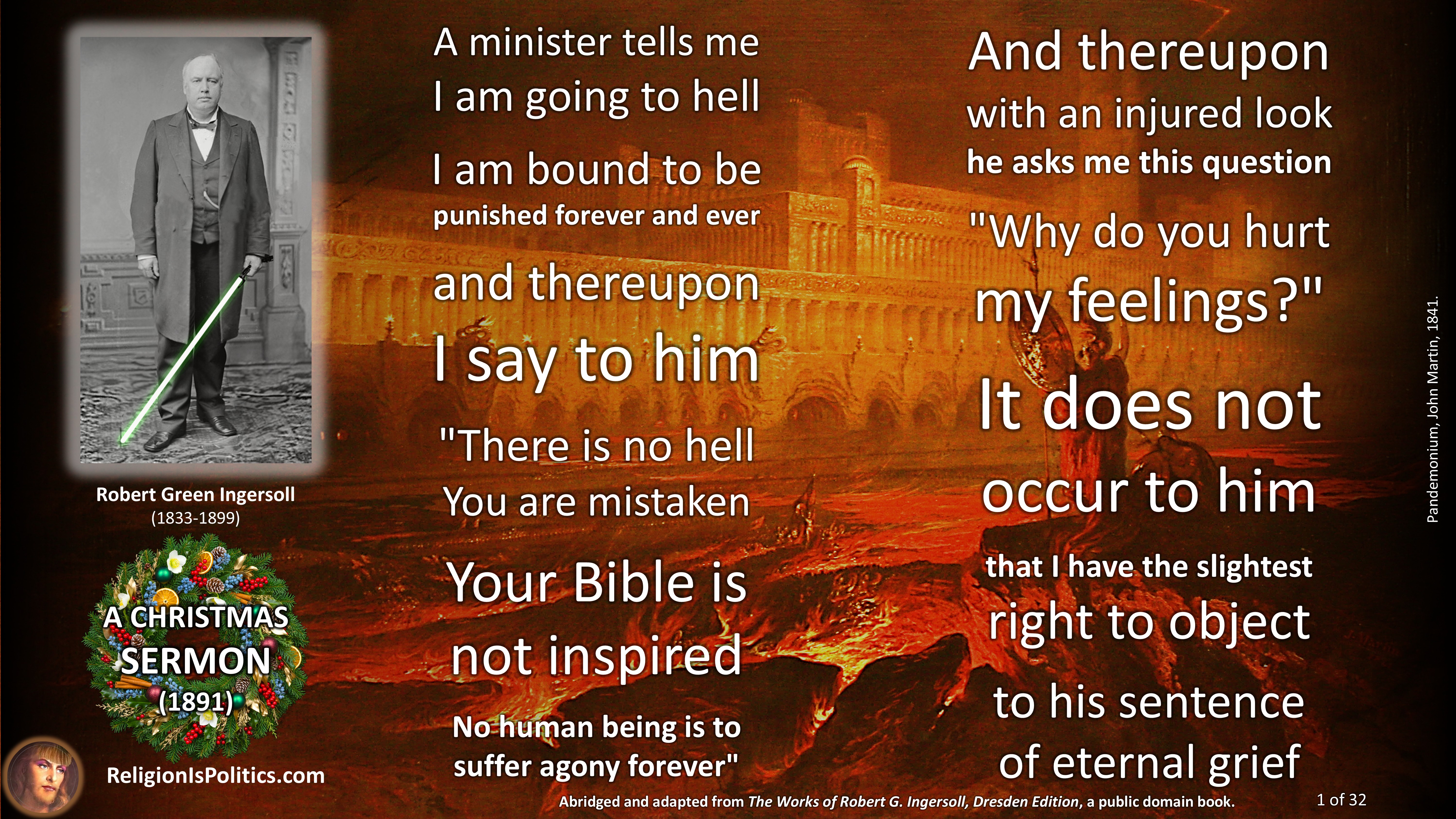
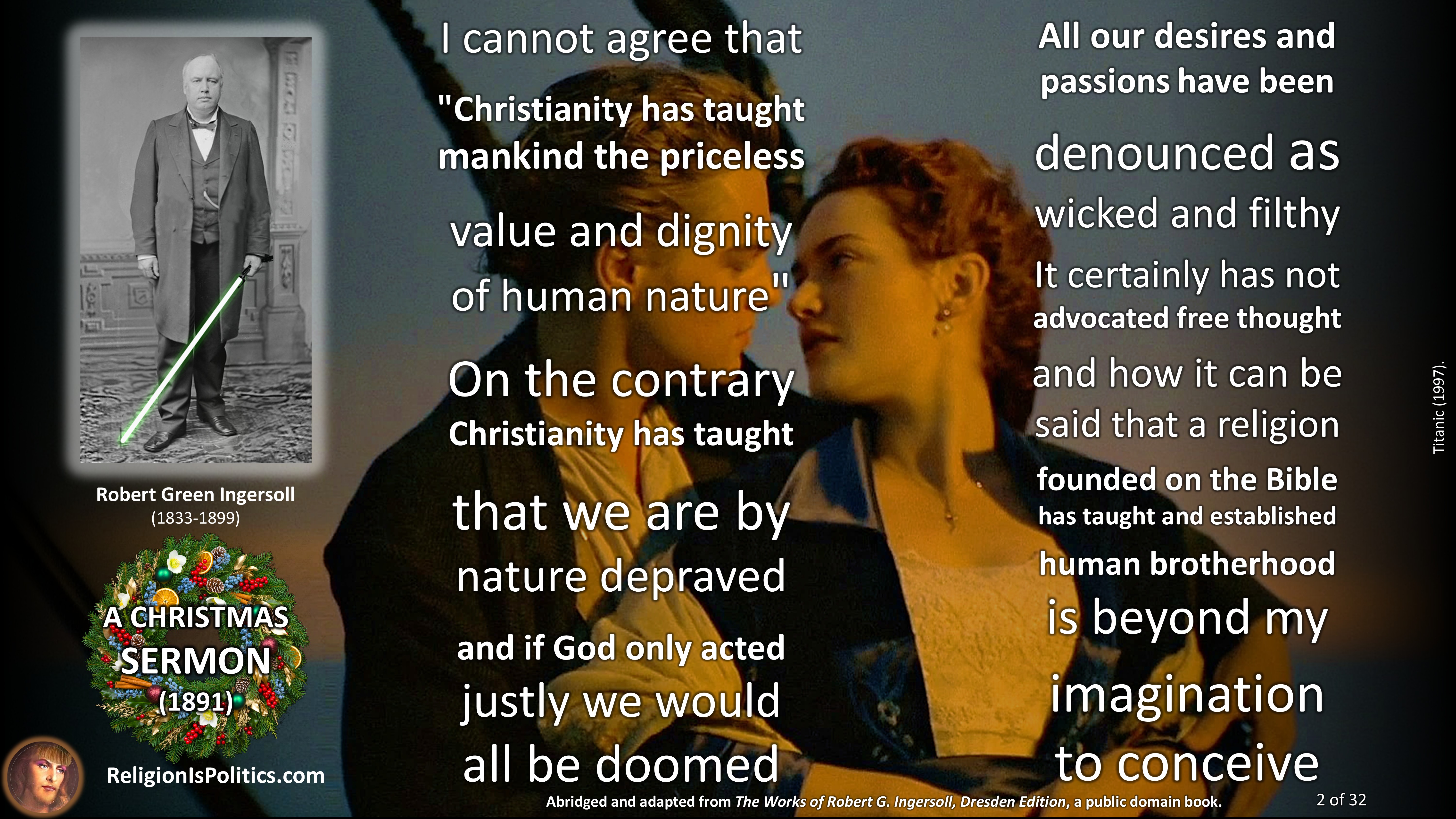

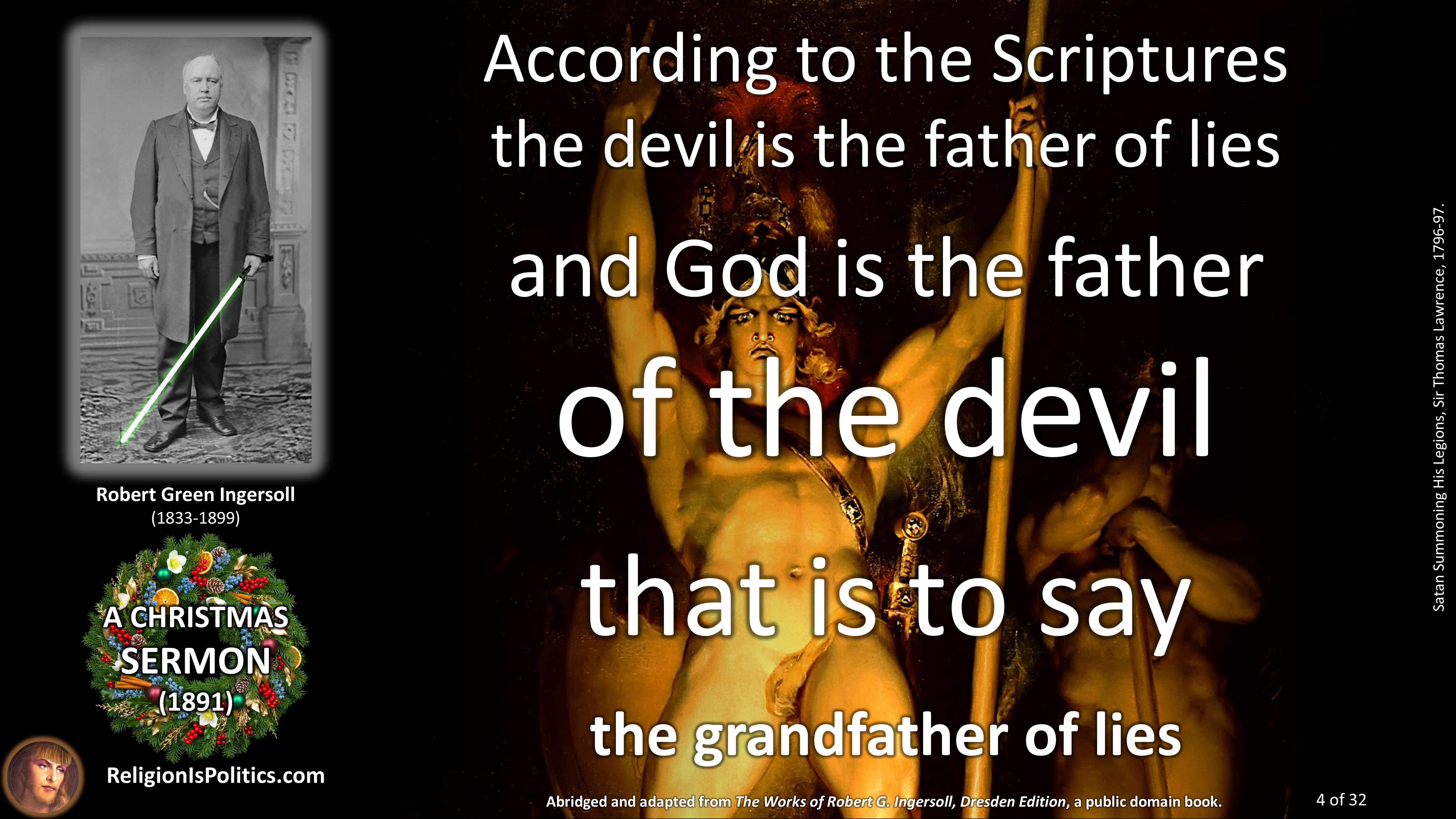
Preachers of Christianity claim credit for the idea that all lives matter, but this is doublespeak. Actually, their faith teaches that some lives matter more than others. It teaches that God is mysteriously sorting us out, selecting who to save and who to damn, based on whoever obeys him in advance, or whoever does not.
This mystery, for which competing evangelists advertise competing answers, they call good news. Either that, or the gospel they preach is even better.
What could be worse news than a fate worse than death? What could be more callous than to colonize someone’s last moments with anxiety?
Only the fate itself.
The God in Christianity is even crueler than his believers are. And however kind or cruel they may be, they are always trying to be more like him.
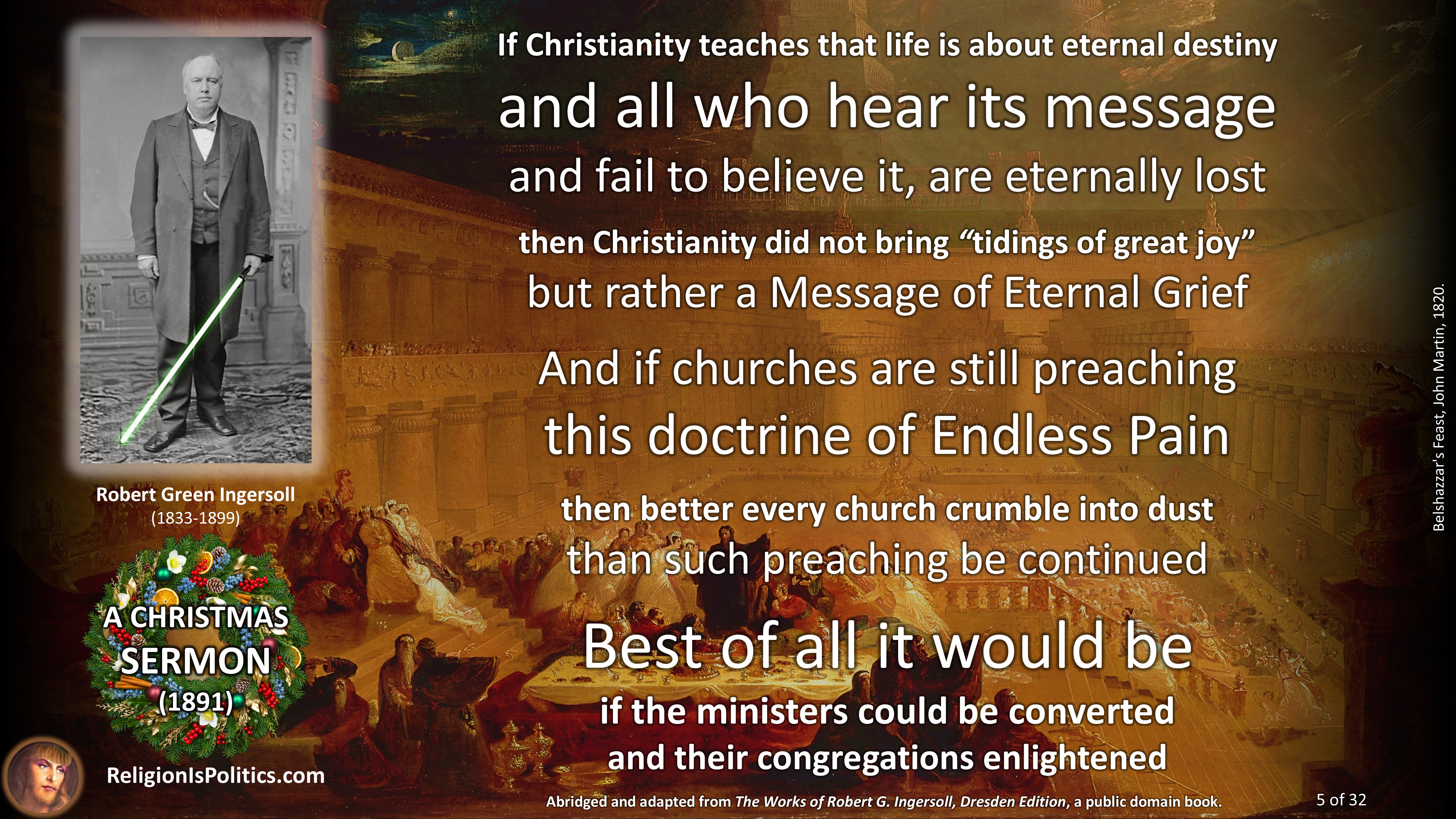
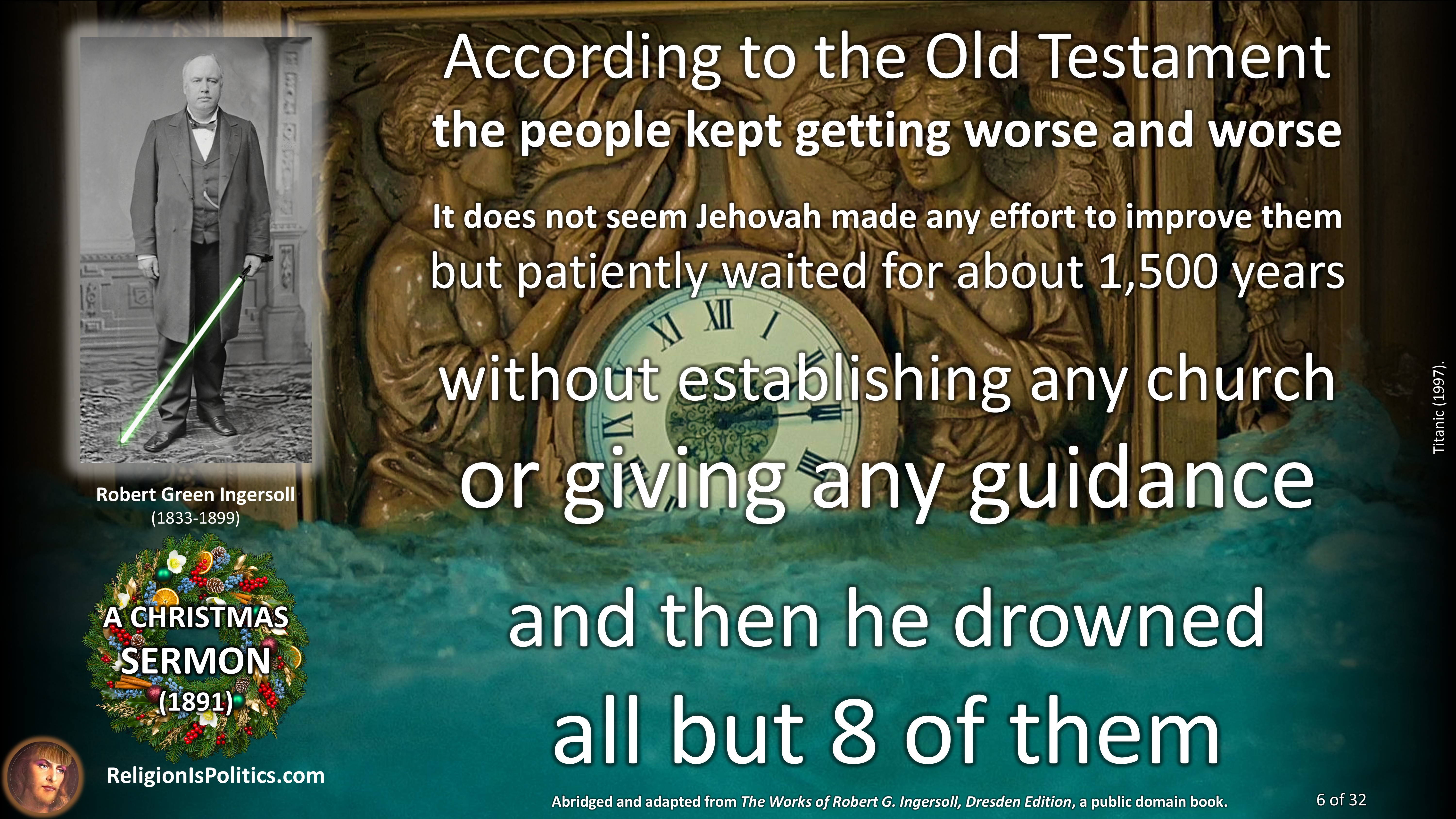
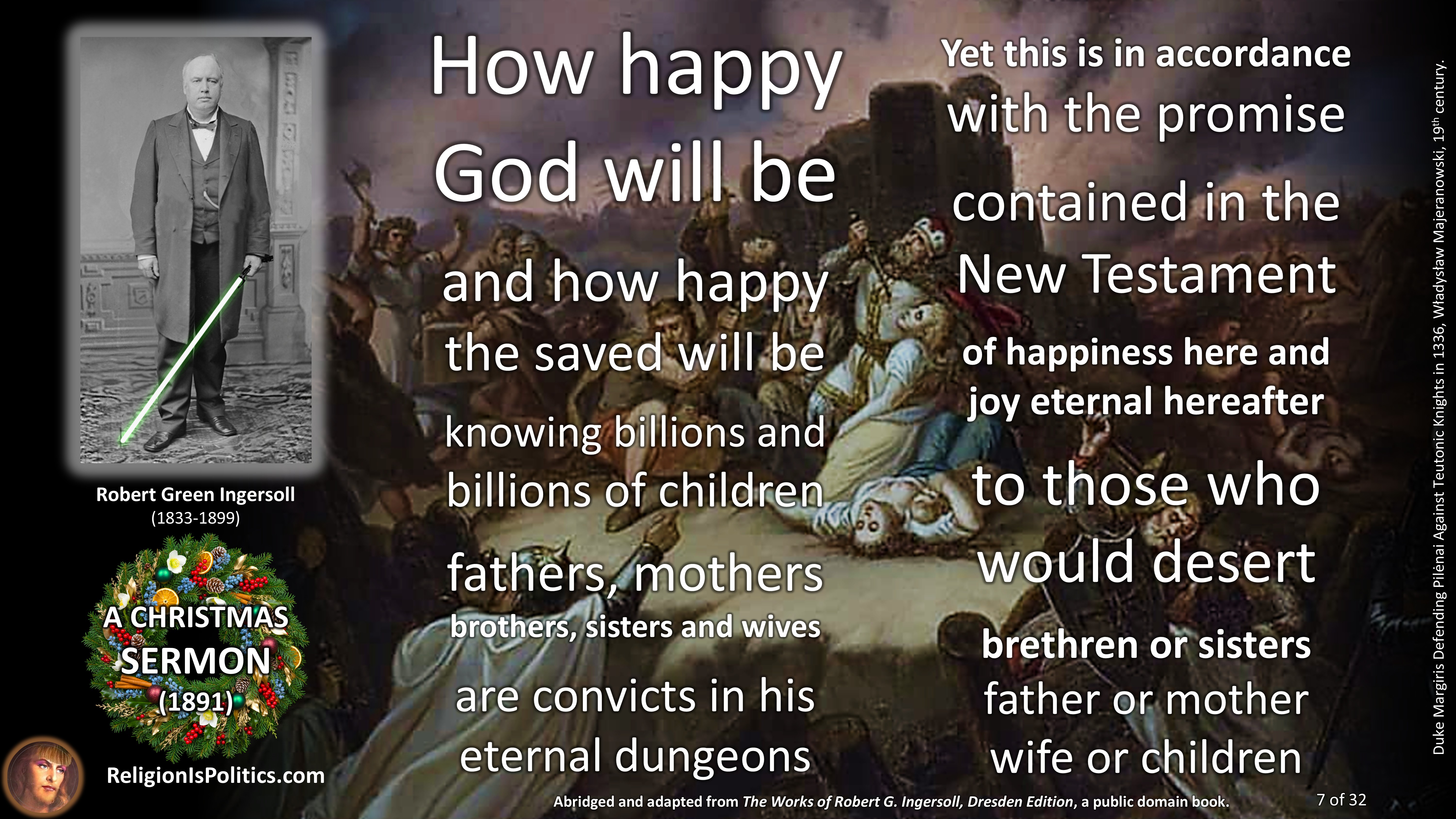
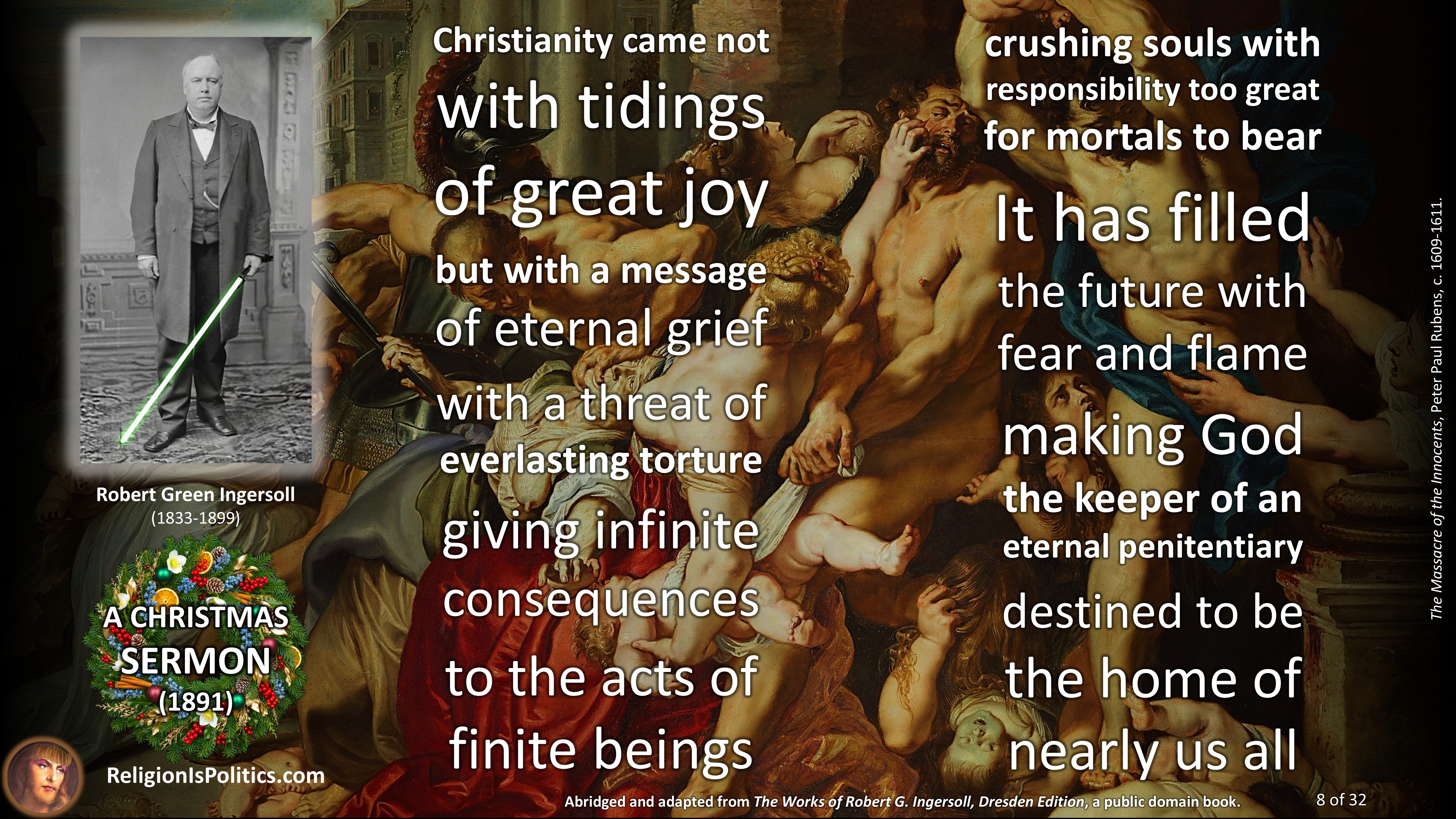
Certainly power wants to be worshipped.
When we are told that the universe is a clockwork of almighty wisdom and almighty power, and almighty power has established all lesser powers, and yet almighty power has an enemy, certainly power is gaslighting us to make us think it is infinite. But it is not.
What would you do if the universe turned out to be an eternal dictatorship and the dictator commenced an eternal holocaust before your very eyes?
Would you join the eternal resistance, or would you kiss the boot?
According to the Bible, this has happened before, and it will happen again and again, ultimately forever.
Not every believer signs up to kiss the boot eagerly. Some bargain with God for humanity’s sake like Abraham over Sodom. But most take Pascal’s wager to live happily ever after while others they knew (especially in the biblical sense) are miserable.


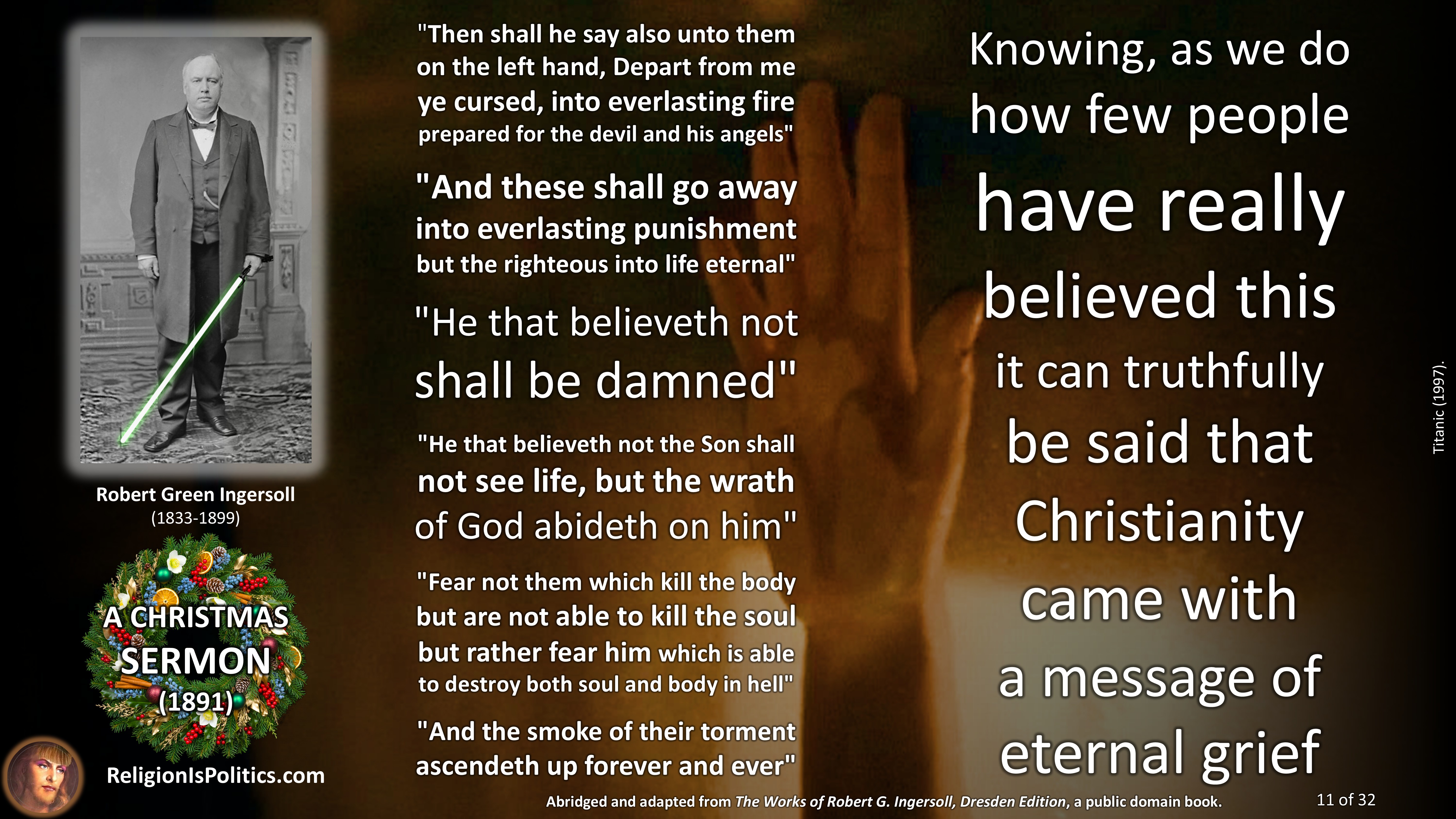
What kind of person wishes for personal salvation while others are lost? What kind of person believes bloodshed washes away guilt? What kind of person wants to live happily ever after while others are suffering?
Certainly we have words for these kinds of people.
Sociopaths. Saints. Billionaires.
Those who already are wealthy because of other people’s poverty, and those who’ve signed up to be after they die.
As long as this political coalition is winning, poverty will approach the infinite. The poor will not inherit the earth. Instead, the rich will inherit the poor, and both will call themselves meek in spirit.

To save everyone on the Titanic, more than just the wealthy and some crew, the crew needed not God’s grace, but his knowledge. What cost so many people their lives that night was not sexual depravity, but technical ignorance.
They needed either better optical technology to avoid the iceberg entirely, or they needed worse technology, to hit it head on.
The shuddering stop would have caused minor injuries among unprepared passengers and made everyone understandably angry. It would have cost the investors some money and ultimately some people their jobs, but barring any deadly falls or heart attacks, everyone would have arrived in port alive. The ship was pretty much unsinkable by that kind of collision.
The long, glancing blow the Titanic received was perfectly designed to deliver an unsurvivable injury to a mostly unsinkable ship.
And if the crew had distinguished the iceberg from the horizon’s optical illusions and responded any fractions of a second sooner, the damage would have been exponentially less. The vessel easily could have survived, and would at least have taken longer to sink.
What saved so few, was not generosity, but the opposite. The wealthy, in their underfilled lifeboats, could hear drowning people screaming and stayed far away, saying it was too dangerous to help until things calmed down.
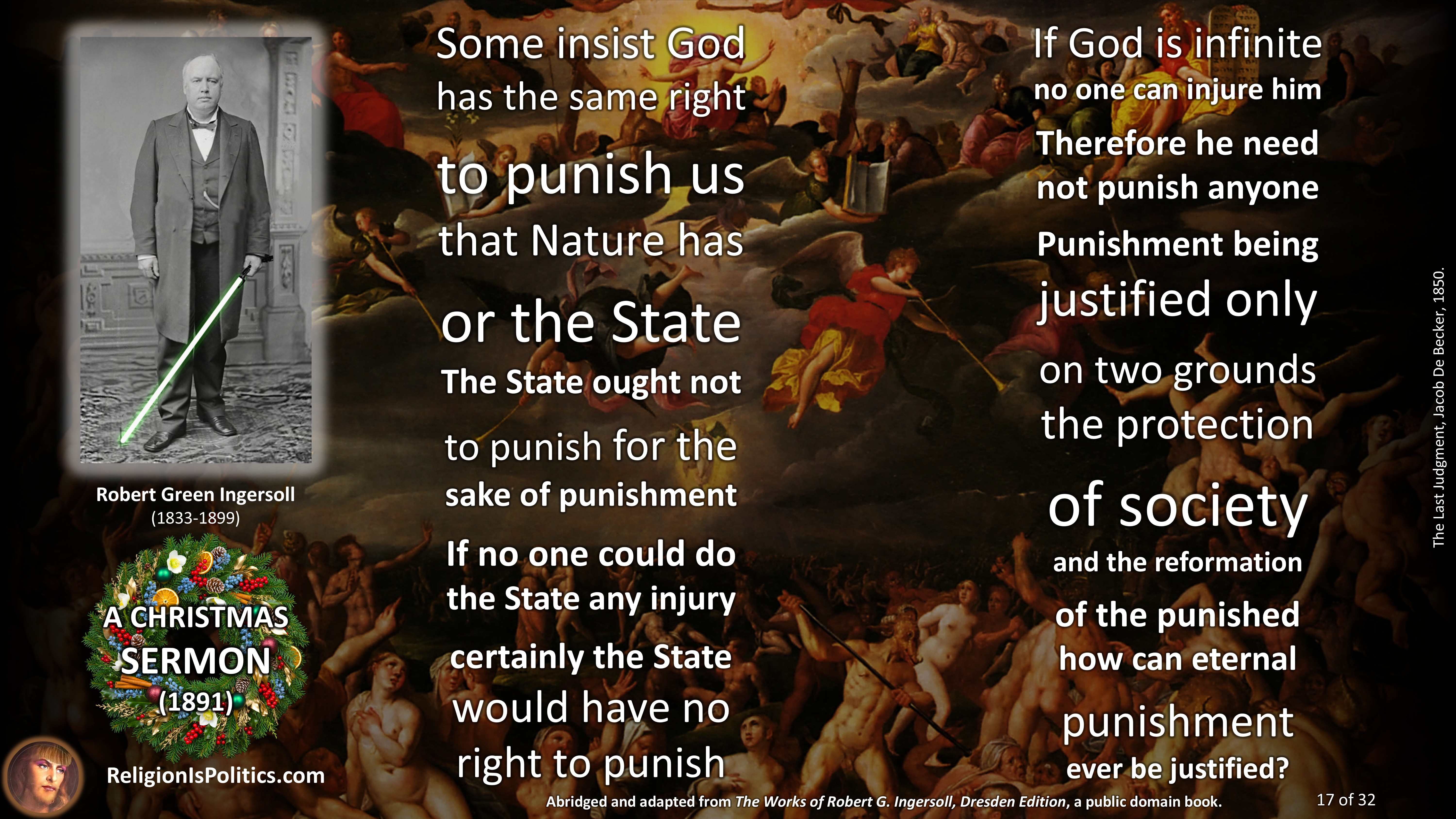

Universal salvation was the hope of Buddhism long before it was crucified with Jesus.
Long before Jesus ever said that the way to salvation was narrow, that those who found it would be few, Buddhist monks were saying all souls could and would eventually find their way to perfect peace.
When Christian soldiers, from the Netherlands, Portugal, France and the United States, abused Buddhist civilians in Southeast Asia, the Buddhists generally turned the other cheek.
They were already in a Christian hell. The soldiers who were occupying them deserved it more than they did. And yet, despite centuries of missionaries telling them to be afraid and soldiers giving them reasons, they still were not afraid of eternity.
I think if Jesus had been intentional about his legacy, he would not have said the things he said: he would have said different things and he would have kept his disciples’ stories straighter. At least, he would have, if he could.
I think, especially, if Jesus or his disciples (or the holy spirit for that matter) had anticipated the rise of Islam, then their canon would have more consistency.
If they’d wanted to keep Islam from rising, that’s the best thing they could’ve done. That, and make the Roman Empire better on human rights.
If Jesus had wanted the rich to give their wealth to the poor then he shouldn’t’ve said the poor would always be with us until he returns. And if he’d meant to take more than two thousand years then he shouldn’t’ve said he was coming quickly. That was a self-fulfilling prophecy of perpetual apocalypticism.
If he’d wanted his followers to turn the other cheek when abused and show forbearance and forgiveness in the exercise of power, then he shouldn’t’ve said when he returns they’re going to judge the world together and whatever they bind on earth will be bound in heaven.

If Jesus had known he was going to need Paul, he should have recruited him while he was alive, as one of the twelve. Otherwise, what did he need the twelve for? Numerological alignment with Abraham? Or with the zodiac?
Was Paul speaking for Jewish people? Or was he appropriating their culture and repackaging it to sell to a wider audience?
Jesus prayed that his disciples be united. At least, that’s how they remembered him. But if he didn’t want division, he shouldn’t’ve said he was coming back with a sword in his mouth to throw false prophets and whoever said he was one into a lake of fire.
If he’d wanted peace then he wouldn’t’ve said the smoke of his enemies would rise forever. A prince like this makes his own enemies. Certainly, once he starts burning them, he will not be able to stop, and that, an all-knowing being would know.
If a character in a story devises a fate worse than death, it can only be because he gets off on it. In other words, it makes him feel glorified. Is it possible that a being of almighty wisdom and power can’t get high without smoking some of his offspring?
What happens to our criminal justice system when we believe in heaven and hell? We reproduce them, not only in criminal justice but in all our other social systems as well: medical, educational and mental health.
This is what happens when everyone believes bloodshed atones for offenses.


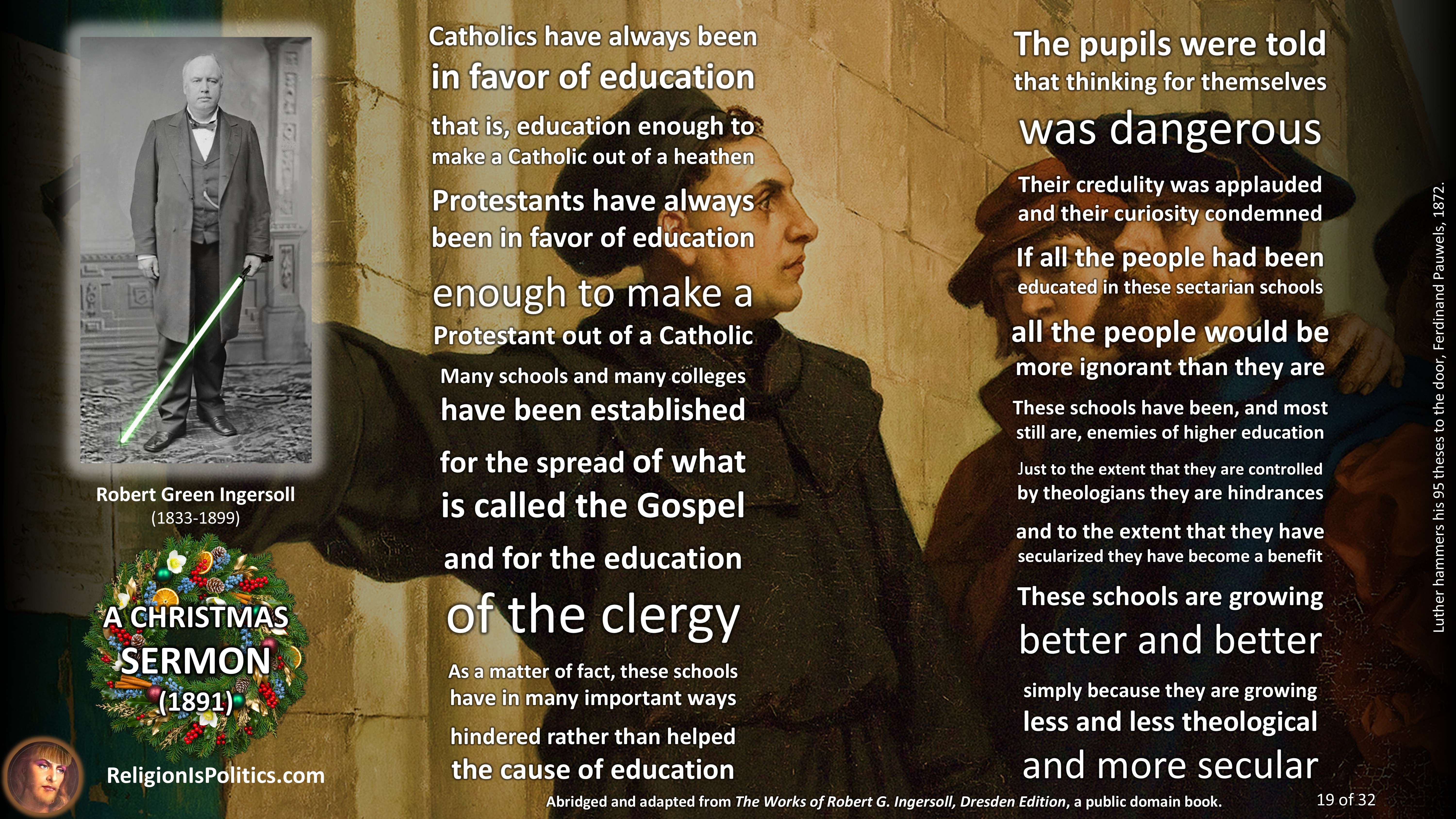
What can we say of a school where teachers swear on their intellectual integrity and their immortal soul to keep believing the same wrong things even if they find out they were wrong? That is the definition of a religious school. It functions according to design. At least, it functions to an extent.
I admit I got the better part of my education from such a school. Every year the professors signed a statement promising that they still believed in the historicity of Adam and Eve and the infallible truth of the Bible. Nevertheless, in every class, the Bible’s failures accumulated, until eventually Adam and Eve were nothing but dusty archetypes and metaphors.
When kids grow up Christian, they are told that Christianity gave rise to modern science, that it is a gift from God, and that, therefore, Christianity is the foundation of civilization. To “integrate faith and learning” is to preserve this narrative intact even while incorporating facts that contradict it.
I went to college believing Christianity was the foundation of modern science. Nevertheless, as a science major, I learned that the truth was closer to the opposite. In fact, every science was developed, not because of sincere belief in the Bible, but in spite of it. And the scientific facts are abundant, apparent, and unequivocal.
Historically, individual Christians have stretched forth their hands to take the fruit of the tree of knowledge and give to others, but faithful masses were generally against them unless they occupied a high enough seat of privilege. People who sacrificed themselves to bring knowledge to others were threats to the power structure. They were dehumanized as unbelievers, their property was redistributed, their accomplishments were forgotten or credit given to others, their legacies were erased and their bodies were sacrificed to an ignorant, bloodthirsty god.
Whenever I had professors outside the sciences, I could see it was their very faith in biblical preconceptions, which was a precondition of their employment, that made their ignorance palpable and made their misconceptions durable. Their faith was the reason they were wrong: it was the reason they had confidence in facts outside their area of expertise, and it was the reason they might stay wrong, even in their area of expertise, while working as educators teaching daily the evidence that they were wrong.
Certainly Paul would have been proud of my professors. They were all things to all people, swallowing any contradiction with the filmy doublethink he pioneered in his epistle to the Romans.
If we think one book is the best book that could have ever been written, what reason is there to read a better one? What reason to write it?
Are the Chronicles of Narnia not as good as the Bible? Is the Lord of the Rings not even better? Aren’t most books, actually? Is that why books get banned?
If we think one mythology is the absolute truth then how can we appreciate any others? If we believe we have the absolute truth then how can we ever admit we were wrong?
The movement of Christian colleges arose from the fact that universities founded Christian had become secular. After my experience at a Christian college I want to remind everyone of this fact.
What happens to our education system when criticism is judged by literature, rather than the other way around? What happens to our brains when we believe in advance that one book written long ago is the best book that ever could have been written?
Look as far as Afghanistan today. Look no farther than the Middle Ages.
Paul said science was filthy rags. That’s why science had to be imported to Christendom from outside cultures rather than cultivated from within. That’s why it had to be covered in the blood of Jesus, and that’s why it had to benefit power rather than the people. Because otherwise, sooner or later, the church would burn it with fire.
At a Christian college, they say “all truth is God’s truth.” That’s what they mean by “integration of faith and learning.” That’s how you spell “totalitarianism.”
I wonder why Christian universities became secular? I wonder why the alumni did not remain Christian?
From my experience, all I can say for certain is, progress happens in spite of prayers, not because of them.


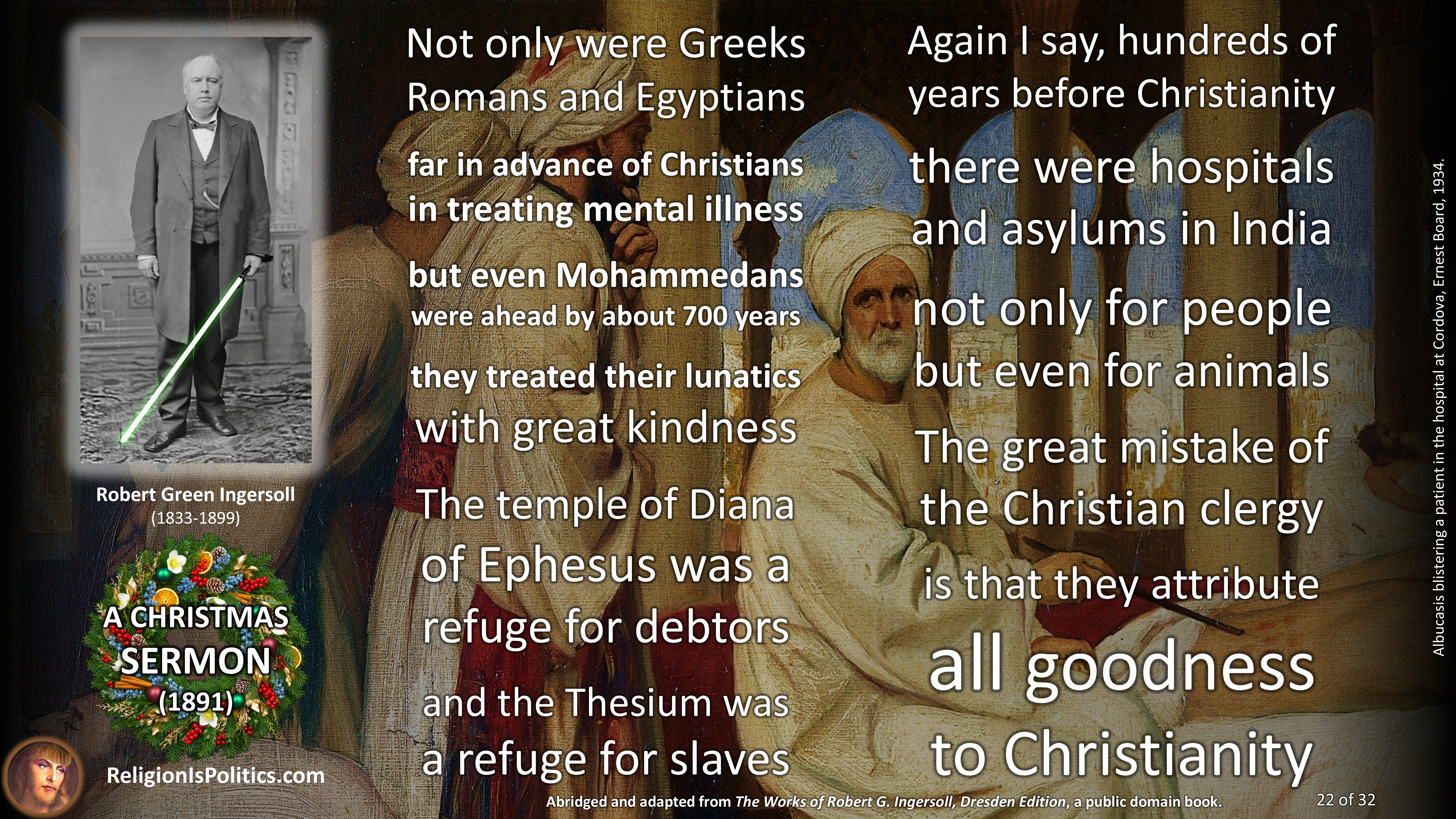
What happens to our medical system when it is run for private profit? In the United States, we all know. Elite health care gets better, while public health generally gets worse. Fake medicine becomes big business. Churches buy up hospitals and sell fake insurance plans based on prayers and religious discrimination.
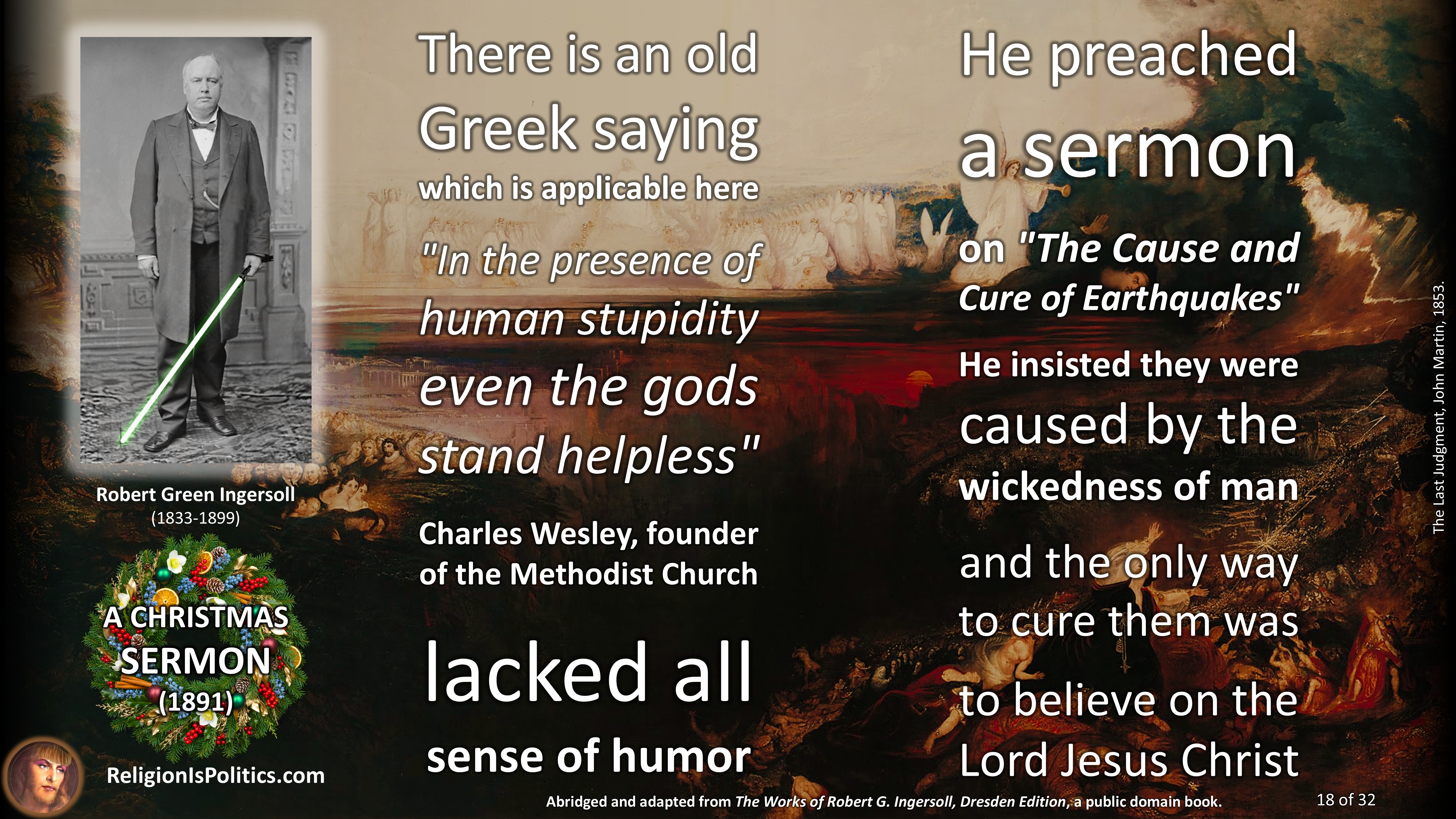
There is an old Greek saying which is applicable here. In the presence of human stupidity, even the gods stand helpless. And that’s because they are little more than that themselves.
The author of ‘Amazing Grace’ was a former human trafficker who came to understand that what he did for a living was wrong. But it seems he didn’t understand why it was wrong. He believed his crimes against humanity were between himself and God. And he believed reparations came from on high.
Did Jesus of Nazareth know what he was doing? Were his intentions in real life any better than yours or mine? We do not know.
But we do know Christ, who people believed in, said vengeance belonged to God, and by that he meant himself.
He said whoever was loyal to him would receive a blanket pardon for any and all offenses. He said they would be rewarded with life happily ever after and the only unforgivable offense was disloyalty, for which the punishment would be equally endless and horrendous.
An almighty being who could have anticipated videoconferencing technology, had a message every person around the world needed to hear, needed people to accept that message before they could live happily ever after, and let hundreds or thousands of generations go at a stretch before any new forms of media were invented.
Imagine an almighty being taking thousands of years to spread key communications using only a multilevel marketing campaign.
However generous Jesus may have been, his teachings were quickly corrupted into self-fulfilling prophecies of endless prosperity for the few and endless poverty for the many. And Christ was the one who corrupted him. Or, rather, Paul was, in Christ’s name, with the message he stole from Jesus’ disciples.
Knowing, as we do, that only a minority of human beings from all time have ever completely believed it, we can truly say it is a message of eternal grief.
Should we celebrate Christ at Christmas?
Or should we celebrate everything else instead?
There is good in the world, and it’s worth celebrating. And we’re here for it.
Background art:
- Pandemonium, John Martin, 1841.
- Titanic (1997).
- Return of the Jedi, 1983.
- Satan Summoning His Legions, Sir Thomas Lawrence, 1796-97.
- Belshazzar’s Feast, John Martin, 1820.
- Titanic (1997).
- Duke Margiris Defending Pilėnai Against Teutonic Knights in 1336, Władysław Majeranowski, 19th century.
- The Massacre of the Innocents, Peter Paul Rubens, c. 1609-1611.
- Titanic (1997).
- Sacrifice of Isaac, Caravaggio, 1603.
- The Last Judgment, Jacob De Becker, 1850.
- Titanic (1997).
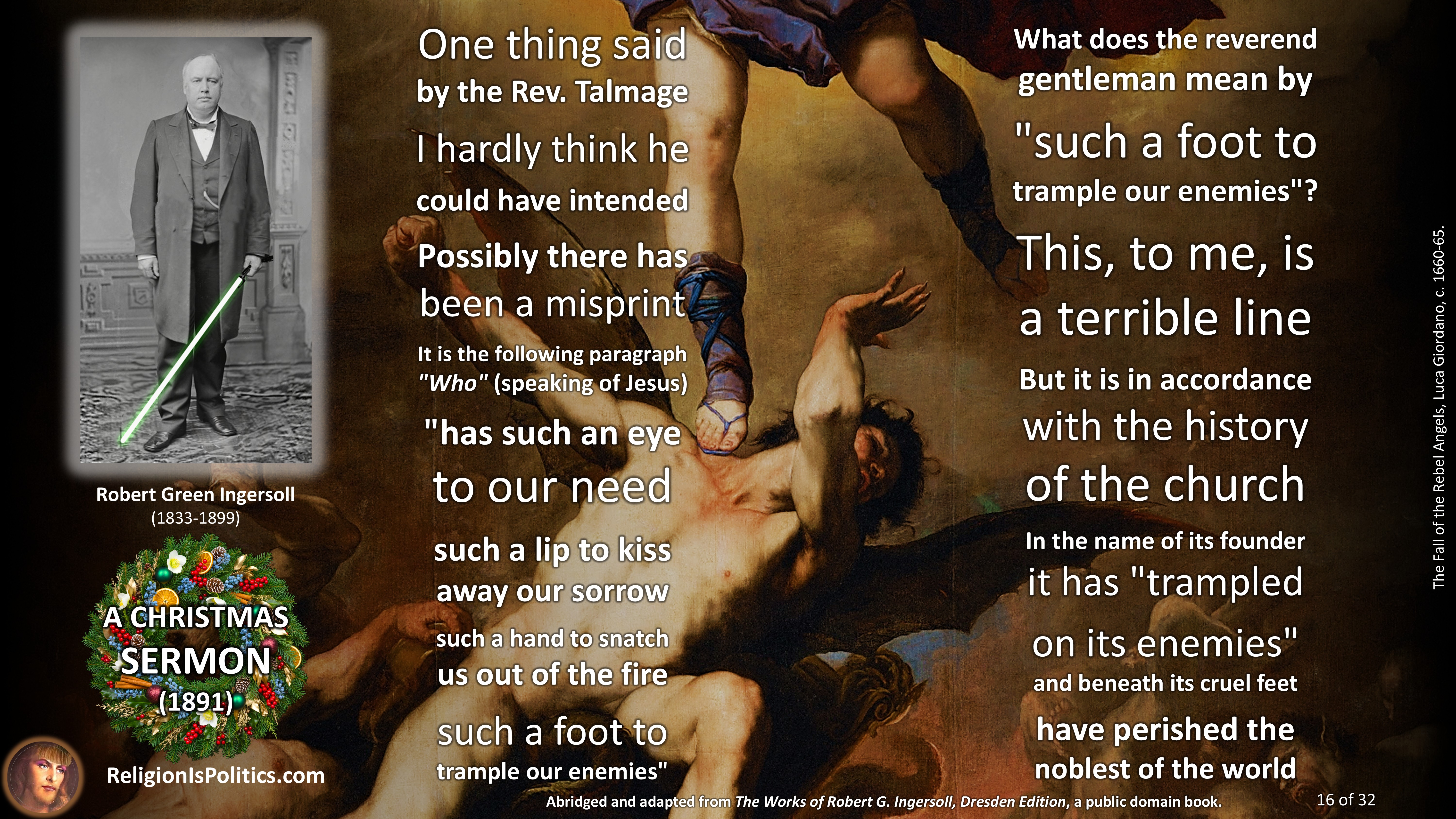
- The Fall of the Rebel Angels, Luca Giordano, c. 1660-65.
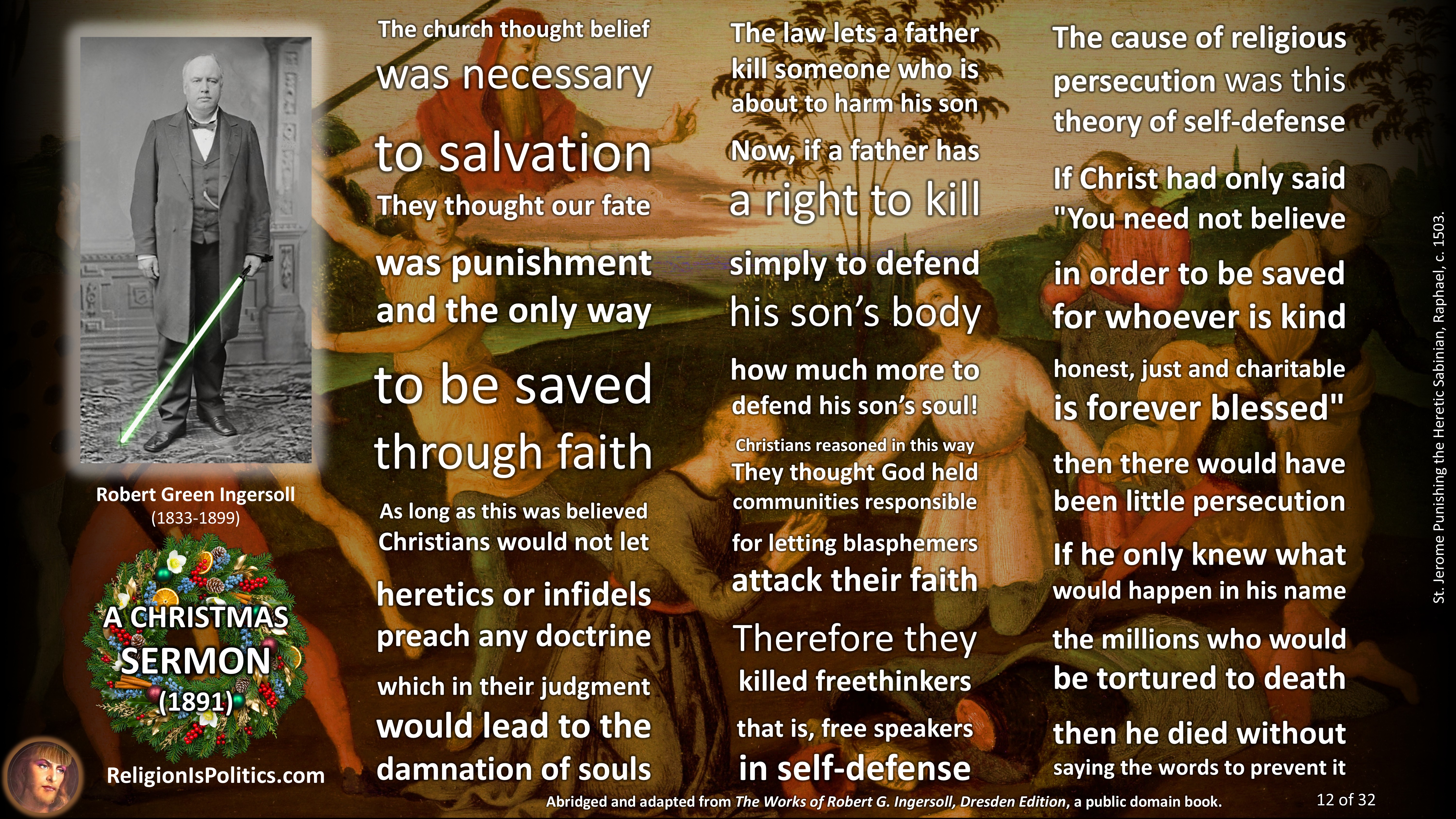
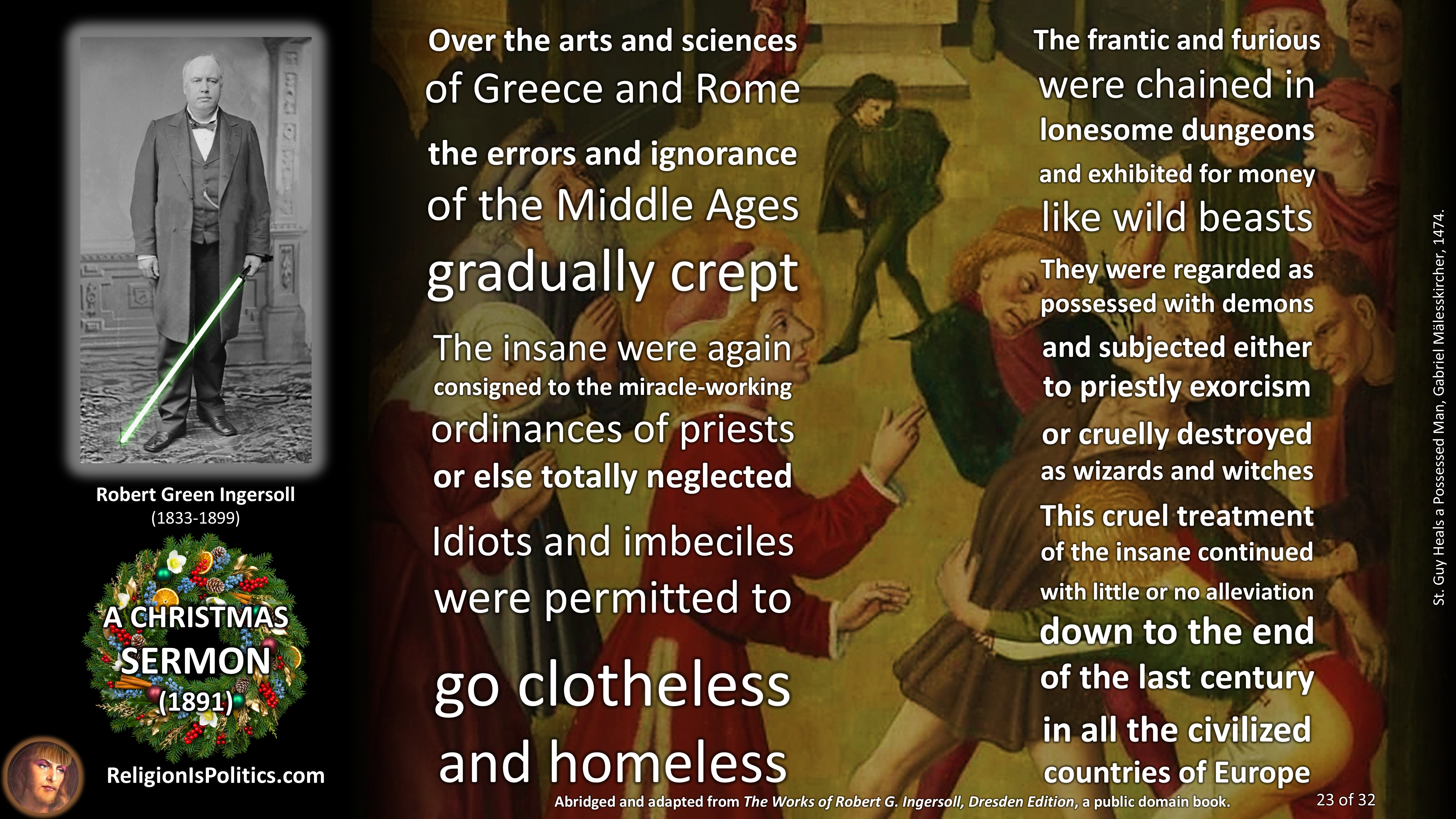
- St. Jerome Punishing the Heretic Sabinian, Raphael, c. 1503.
- Explosion following the plane impact into the South Tower, September 11, 2001, Wikimedia Commons.
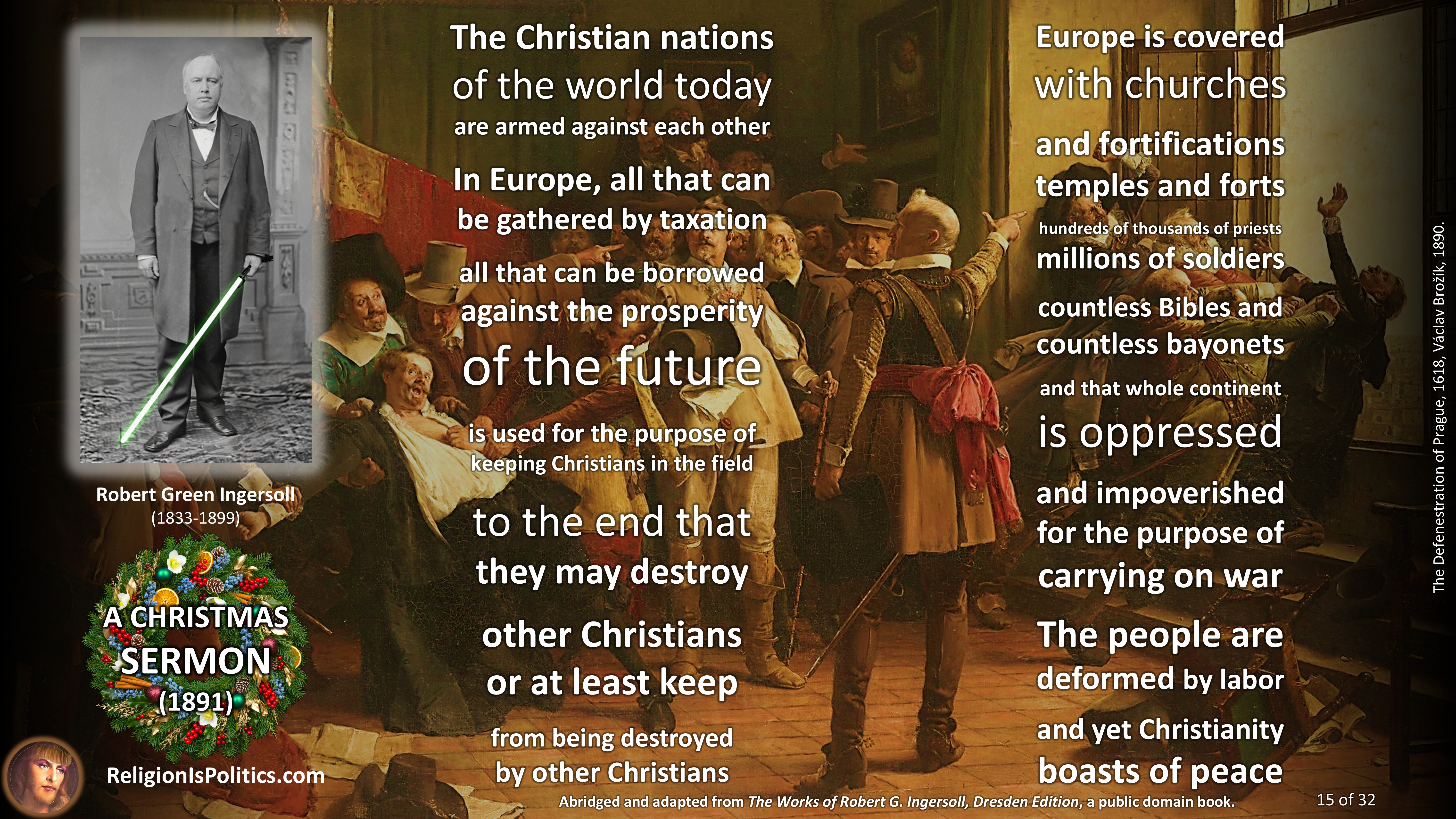
- The Defenestration of Prague, 1618, Václav Brožík, 1890.
- The Last Judgment, John Martin, 1853.
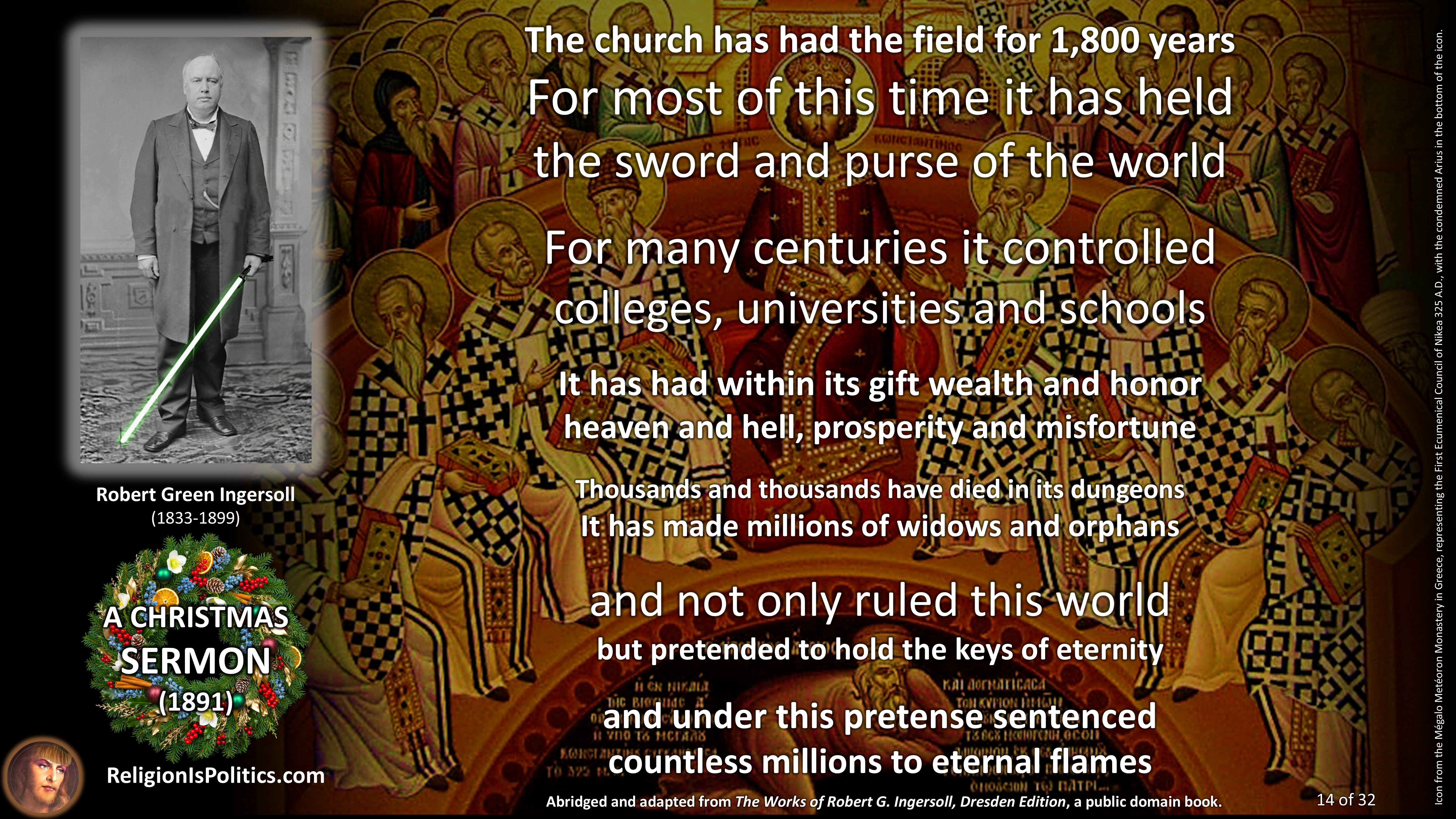
- Icon from the Mégalo Metéoron Monastery in Greece, representing the First Ecumenical Council of Nikea 325 A.D., with the condemned Arius in the bottom of the icon.
- Luther hammers his 95 theses to the door, Ferdinand Pauwels, 1872.
- Saint Dominic Presiding over an Auto da Fe, Pedro Berruguete, 1495.
- Interrogations in Jail, Alessandro Magnasco 1667-1749.
- Albucasis blistering a patient in the hospital at Cordova, Ernest Board, 1934.
- St. Guy Heals a Possessed Man, Gabriel Mälesskircher, 1474.
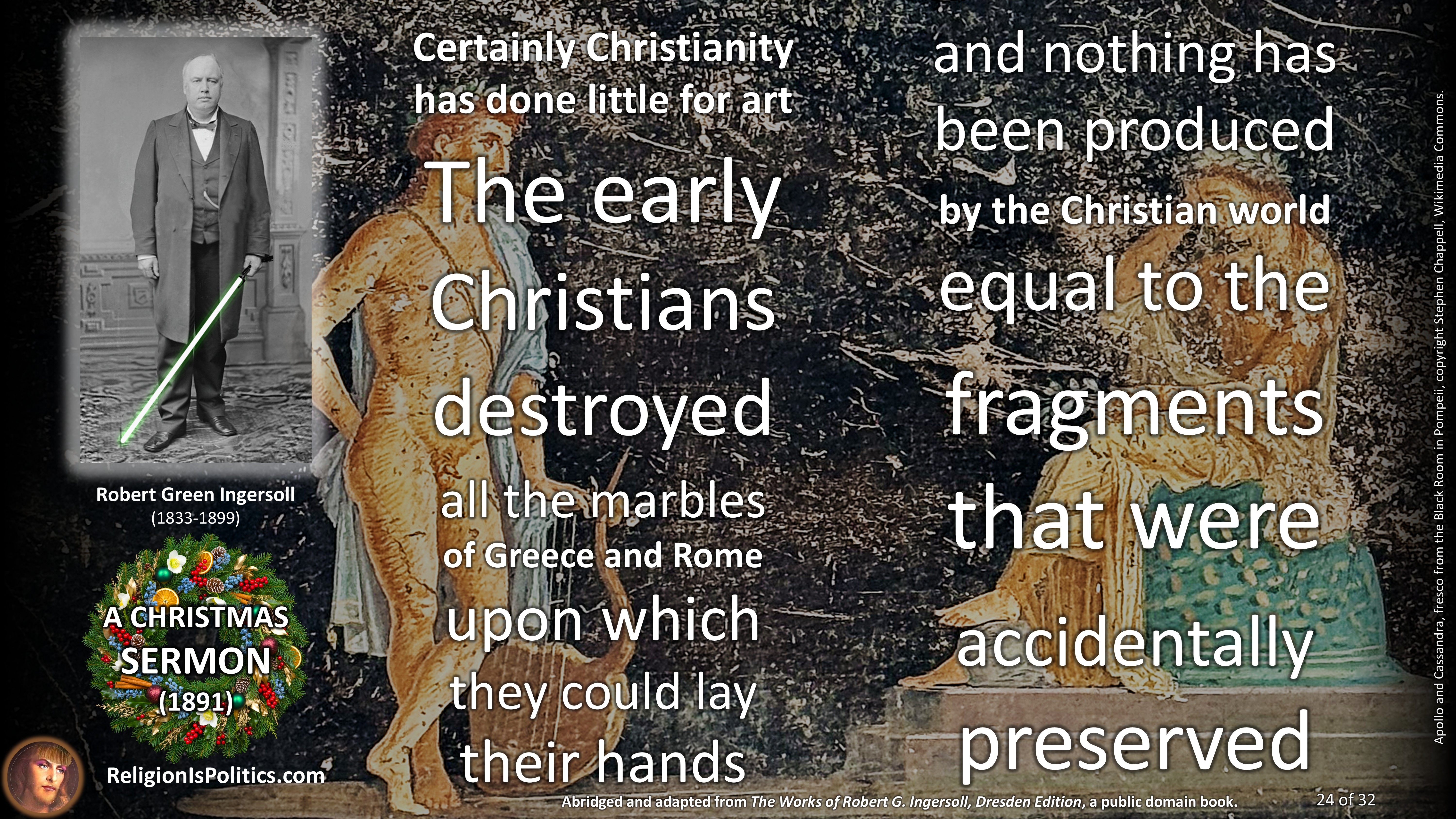
- Apollo and Cassandra, fresco from the Black Room in Pompeii, copyright Stephen Chappel.
- Macbeth and Banquo encounter the witches for the first time, Théodore Chassériau, 1855.
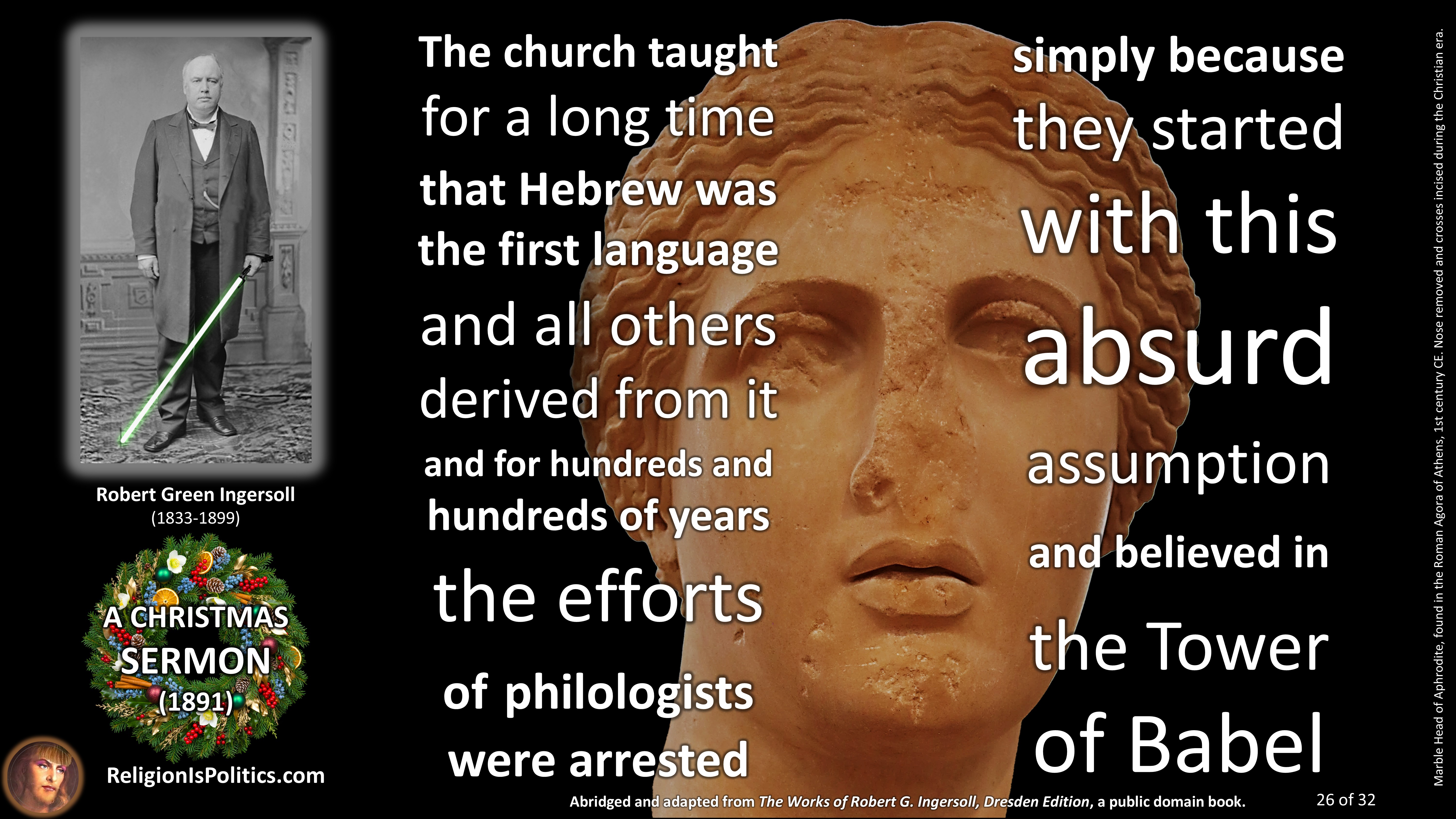
- Marble Head of Aphrodite, found in the Roman Agora of Athens, 1st century CE. Nose removed and crosses incised during the Christian era.
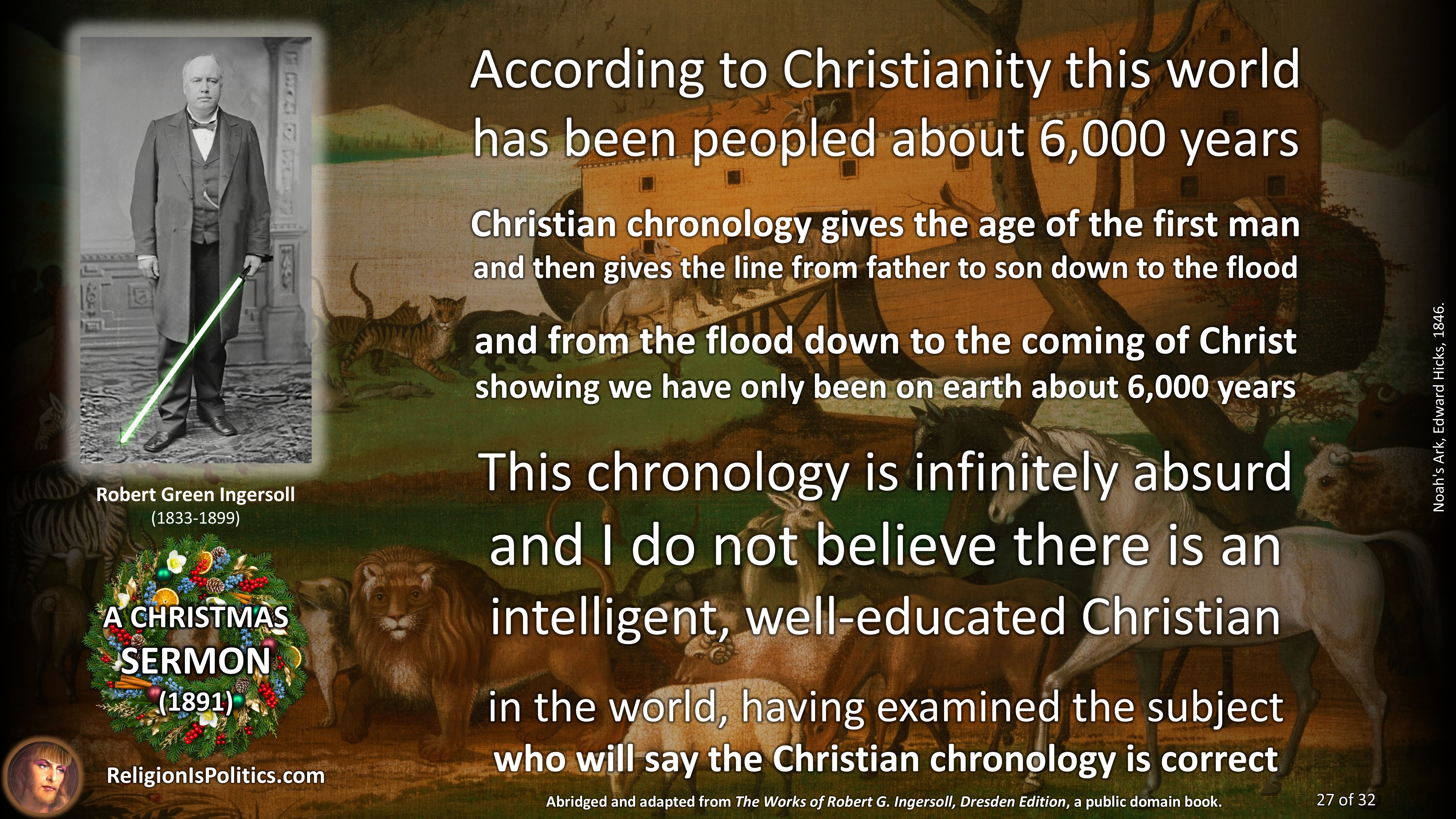
- Noah’s Ark, Edward Hicks, 1846.
- The Subsiding of the Waters of the Deluge, Thomas Cole, 1829.
- Titanic (1997).
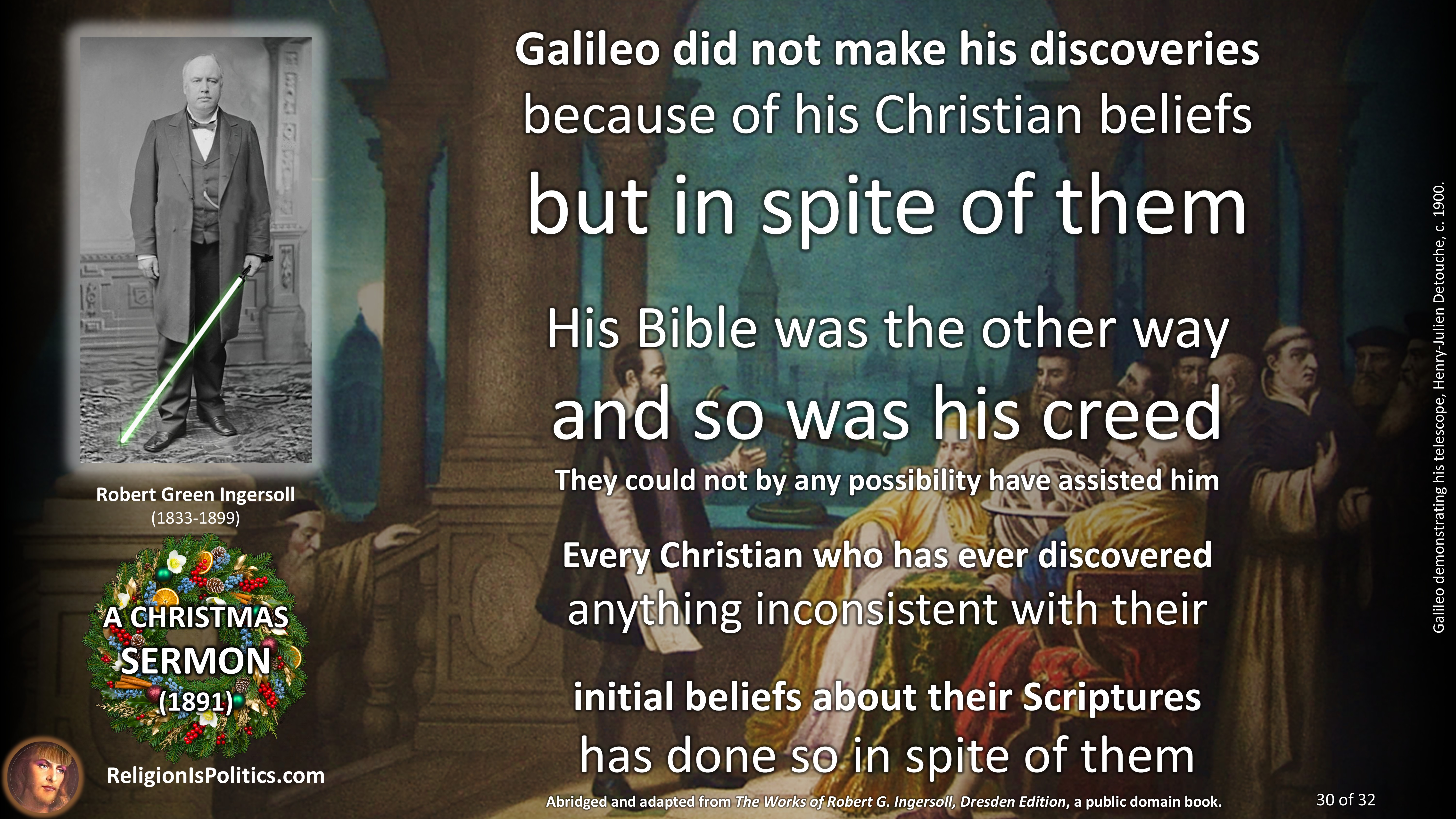
- Galileo demonstrating his telescope, Henry-Julien Detouche, c. 1900.
- Titanic (1997).
- The Wizard of Oz (1936).
 Religion is politics about the unknown